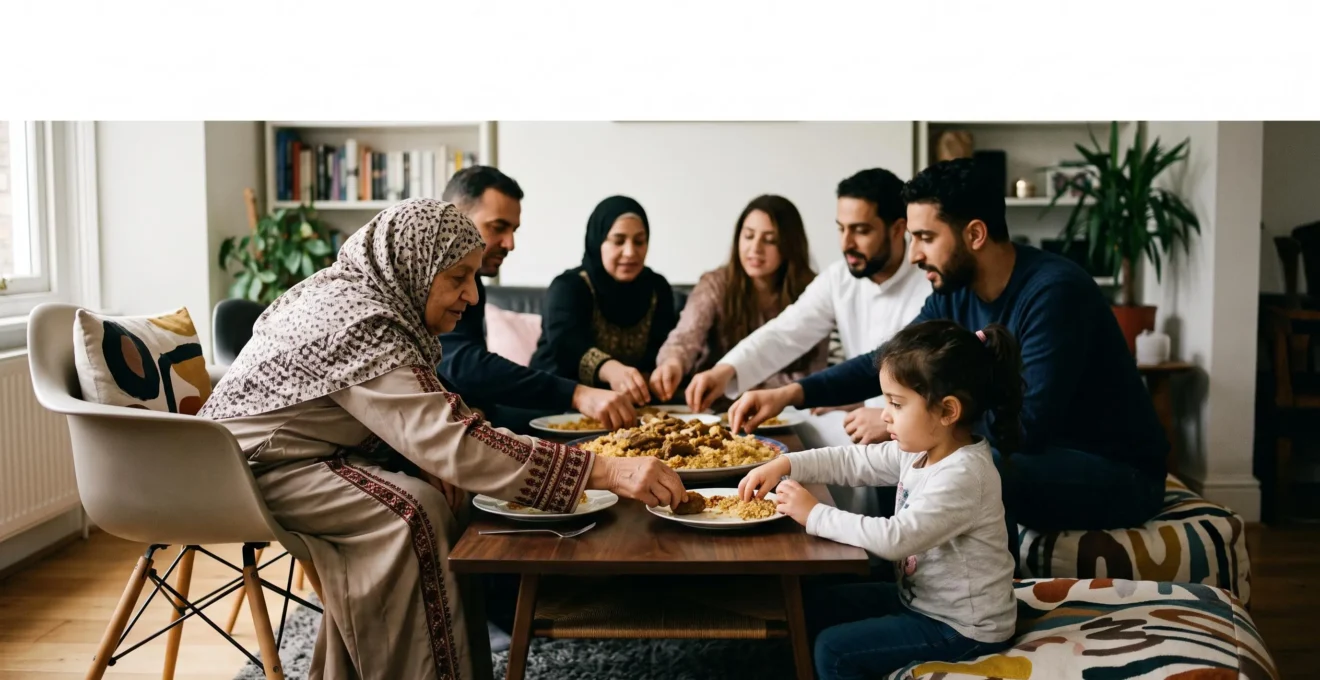
Contrary to the popular view of Arab dining as simply an expression of hospitality, it functions as a highly structured social theatre for cultural transmission.
- The shared platter is not just for sharing; it is a tool that forces psychological synchrony and reinforces the collective over the individual.
- Seating arrangements and the distribution of specific foods are active pedagogical tools used by elders to teach hierarchy and respect to younger generations.
Recommendation: Sociological analysis must look beyond the surface-level generosity of these meals to decode the complex system of socialisation and structural reinforcement enacted at the dinner table.
For observers unfamiliar with the nuances of Middle Eastern culture, the communal meal is often distilled into a single, overarching concept: hospitality. The image of a table laden with food, extended to family and strangers alike, is a powerful symbol of generosity. While this perception is not incorrect, it remains critically incomplete. It overlooks the intricate social mechanisms at play, where the act of eating together is less a casual gathering and more a meticulously choreographed performance. This performance is a form of social theatre, a living classroom where social structure is not just displayed, but actively constructed and passed down.
Standard analyses focus on what is served, but the deeper sociological insights lie in how it is served and consumed. The choice between individual plates and a single large platter is not a matter of convenience; it is a fundamental structural decision that shapes interaction. Likewise, the physical placement of individuals around the food and the deliberate act of an elder offering a choice morsel are not merely quaint customs. They are powerful, non-verbal lessons in status, respect, and relational dynamics. This framework transforms the dining space from a place of simple nourishment into a primary vehicle for reinforcing social hierarchy and forging the deep, resilient bonds that characterise the extended family unit.
This analysis moves beyond the platitude of “generosity” to deconstruct the meal as a pedagogical tool. We will examine how shared platters build psychological cohesion, how elders use food to impart lessons in social order, and why this communal model persists as a cornerstone of social structure despite the pressures of modernisation. The goal is to understand the Arab meal not just as an event, but as a core process of cultural continuity.
To fully explore this dynamic, this article breaks down the specific components of the communal meal, from the psychological impact of a shared platter to the symbolic meaning encoded in seating arrangements. The following sections will provide a structured analysis of how these elements work in concert to build and maintain the social fabric.
Contents: The Social Architecture of the Arab Meal
- Why Does Eating From Shared Platters Create Stronger Bonds Than Individual Plates?
- How Do Elders Use Meal Placement to Teach Hierarchy to Youth?
- Communal Meals or Family Dinners: Which Builds Stronger Intergenerational Trust?
- The Seating Mistake That Accidentally Insults a Guest
- When Should Hosts Invite Guests Rather Than Eating Alone First?
- Why Does Multigenerational Living Improve Financial Resilience?
- Why Does Serving Spiced Lamb Signal Greater Generosity Than Other Dishes?
- Why Has The Extended Family Remained The Cornerstone Of Social Structure Despite Modernisation?
Why Does Eating From Shared Platters Create Stronger Bonds Than Individual Plates?
The distinction between eating from individual plates and a communal platter is the foundational difference between a Western-style meal and a traditional Arab one. While the former facilitates individual autonomy, the latter enforces a state of interdependence. The simple act of multiple hands reaching into the same space for sustenance requires constant, subconscious negotiation, coordination, and mutual awareness. This creates a powerful, non-verbal synchrony among diners, a mechanism that goes far beyond simple conversation in fostering social connection. This is not merely a cultural belief; it is a phenomenon with a scientific basis.
As a key prophetic tradition in Islam states:
Eat together and do not eat separately, for the blessing is in being together.
– Prophetic tradition (Hadith), cited in ‘The Concept of Barakah (Blessing) in Everyday Life’
This concept of “barakah” (blessing) in togetherness finds a modern parallel in sociological and psychological research. A Dartmouth study confirmed that shared experiences—measured through emotional, motoric, physiological, and cognitive alignment—promote social bonding. Eating from a single platter is the epitome of such an experience. The coordinated physical actions, the shared focus on a central object, and the implicit trust required all contribute to a heightened sense of rapport and belonging. The platter itself dissolves personal space, forcing individuals to operate as a cohesive unit and physically embodying the principle that the group’s well-being is intertwined.
Therefore, the shared platter is not simply a traditional serving method. It is a sophisticated social technology designed to generate affective synchrony. It physically and psychologically primes participants for pro-social behaviour, transforming a meal into a powerful ritual of group cohesion that individual plates, by their very nature, cannot replicate.
How Do Elders Use Meal Placement to Teach Hierarchy to Youth?
In the social theatre of the communal meal, elders are not just participants; they are the directors. They use the distribution of food as a primary pedagogical tool to impart the culture’s most important values: respect for age, honour for guests, and affection for the young. This is most vividly expressed through the act of placing the best portions of food—the choicest morsels of meat, for instance—directly into another person’s eating space on the shared platter. This gesture is a powerful and unambiguous piece of non-verbal communication, a lesson in social hierarchy made tangible.
This practice is a lived experience for anyone who has been a guest at a traditional Arab table. As one travel account notes, the host will often physically move pieces of meat or other prized items into the guest’s section of the dish. This is not a suggestion but a gentle command to accept the honour. When an elder performs this act for a younger family member, the message is layered. It is simultaneously an expression of love and a reinforcement of the elder’s status as the provider and arbiter of resources within the family unit. The child learns to receive gracefully, understanding their position within the familial power structure.
As the image above illustrates, this gesture is one of intimate connection. The physical act of the elder’s hand entering the child’s space is a breach of personal boundary that, in this context, signifies care, not intrusion. It is through these repeated, embodied rituals that the abstract concept of “respect for elders” is learned. The youth internalises that status and affection are demonstrated through the giving and receiving of food, a lesson far more profound than any verbal instruction could ever be. The meal becomes a practical demonstration of the social order, with the elder’s hand guiding both the food and the lesson.
Communal Meals or Family Dinners: Which Builds Stronger Intergenerational Trust?
While any shared meal can foster connection, the structure of the Arab communal meal is uniquely designed to build a specific kind of robust, intergenerational trust. The Western-style family dinner, centered on individual plates, allows for passive coexistence. Family members can eat in relative autonomy, each managing their own portion and physical space. The Arab communal meal, by contrast, enforces active negotiation and dismantles personal boundaries, creating a fundamentally different social dynamic.
This structural difference is key to understanding its impact on trust. When generations must coordinate their actions to share from a single source, it requires a higher degree of mutual awareness and consideration. A younger person learns to moderate their pace and choices out of respect for their elders, while elders, in turn, demonstrate care by ensuring the younger members receive enough. This constant, subtle dance of reciprocity builds a powerful, unspoken trust. The table below, based on observations of dining practices, breaks down these key structural distinctions.
The comparative analysis presented in this table, drawn from established cultural practices documented by resources like Arabic Online’s guide to regional eating habits, clarifies the mechanisms at play.
| Aspect | Arab Communal Meal | Western-Style Individual-Plate Dinner |
|---|---|---|
| Pace & ceremony | Unhurried, ceremonial gathering around a shared dish | Often eaten in a hurry and without ceremony |
| Interaction mechanism | Forced negotiation: coordinating who takes what from the same platter | Passive coexistence permitted by separate, individual portions |
| Physical space | Shared dish breaks down personal space between diners | Individual plates preserve personal space and boundaries |
Ultimately, the communal meal builds stronger intergenerational trust because it leaves no room for social isolation. The shared physical space and the required interaction make it impossible for a family member to be present yet emotionally distant. The structure itself compels engagement, ensuring that the meal is a true “communal experience” where bonds are not just celebrated but actively forged through enforced cooperation.
The Seating Mistake That Accidentally Insults a Guest
In the social theatre of Arab hospitality, the script begins long before the food is served. The arrangement of seating is the first and one of the most critical acts, encoding a complex map of status, respect, and relationship dynamics. For an uninformed guest, a simple misinterpretation of this spatial language can lead to an unintentional insult to the host or a misjudgment of one’s own standing. This is because, as an editorial in Mojeh Magazine puts it, “How a person treats a guest has long been read as a measure of their character.” The seating is the first test of that character.
The most formal and traditional setting is the majlis, a reception room typically arranged with seating along the walls in a U-shape, creating a clear focal point. The head of the room, farthest from the door, is the seat of the highest honour, reserved for the host or the most senior family member. The guest of honour is invariably seated to the host’s right. Proximity to the host directly correlates with status. To be seated far from the host, near the entrance, signifies a lower rank in the social hierarchy. A guest who, out of ignorance, presumes to take a seat of honour is committing a significant social faux pas, effectively claiming a status they have not been granted. Conversely, a host who fails to guide a respected guest to an appropriate seat is seen as negligent or even insulting.
This arrangement, visible in the empty majlis above, is a physical manifestation of the social order. The space itself dictates the flow of interaction and visually reinforces the hierarchy. Understanding this spatial negotiation is crucial. The mistake is not simply sitting in the wrong chair; it is a failure to read the social text of the room, thereby demonstrating a lack of cultural fluency and respect.
Action Plan: Decoding Seating Etiquette as a Guest
- Identify the host & head of the table: Observe who directs conversation and where the guest of honour is placed (usually to the host’s right).
- Assess your placement: Note your proximity to the host. Closer proximity signifies higher status or a warmer welcome.
- Scan the room’s layout: Differentiate between a formal ‘majlis’ U-shape and an informal family circle. The former has stricter rules.
- Observe non-verbal cues: Watch how others sit (cross-legged, feet hidden) and interact based on their position. Mimic the general decorum.
- Formulate a response plan: If seated in a place of honour, prepare to engage more with the host. If in a junior position, adopt a more observant role.
When Should Hosts Invite Guests Rather Than Eating Alone First?
The concept of “karam,” or profound generosity, dictates a simple answer to this question: always. In many Middle Eastern cultures, the act of extending an invitation to share a meal is not a calculated decision but a deeply ingrained, almost reflexive social obligation. To be found eating by another person—be they a friend, neighbour, or even a passerby—and not immediately inviting them to join is considered a serious breach of etiquette and a mark of poor character. The presence of food automatically triggers the duty to share.
This principle is so fundamental that refusing an invitation can be nearly impossible, as the host’s honour is tied to the guest’s acceptance. A first-hand account in Arab America highlights this dynamic perfectly, explaining that “A host will do everything in his power to make guests feel at home, which effectively means that refusing an invitation is not really an option.” The invitation is not a casual offer but a social imperative. This transforms the meal from a private act into a public or semi-public event, reinforcing the idea that one’s resources are not solely one’s own but are available to the community.
The language itself reflects this automaticity. A common, enthusiastic invitation is “Itfadal, kol ma’ana”—an expression that translates to “Do us the honour, eat with us.” It is a phrase offered without hesitation, a testament to a culture where sharing is the default and eating alone is the exception. This constant reinforcement of hospitality serves a crucial social function: it weaves a tight web of reciprocity and mutual obligation that strengthens community ties. Every accepted invitation creates a social debt, a bond that will be repaid in the future, ensuring a continuous cycle of interdependence and social cohesion.
Therefore, the question is not “when to invite,” but rather understanding that the invitation is an unconditional social duty. Eating alone first is rarely a culturally sanctioned option if there is even a remote possibility of being joined. The honour of the host and the fabric of the community depend on the open-ended, reflexive nature of sharing a meal.
Why Does Multigenerational Living Improve Financial Resilience?
The social structures reinforced at the dinner table—interdependence, respect for elders, and collective identity—extend far beyond the meal itself. They are the micro-level expressions of a macro-level social organisation: the multigenerational, extended family. This model, where several generations often live together or in close proximity, functions as a powerful engine of economic stability and financial resilience for its members, a stark contrast to the nuclear family model prevalent in many Western societies.
The primary mechanism for this resilience is the pooling of resources and the diversification of risk. In a multigenerational household, financial shocks are absorbed by the collective. The unemployment of one member can be offset by the income of others. The cost of childcare is dramatically reduced or eliminated as grandparents and other relatives take on caregiving roles, enabling parents to work. Large capital expenditures, such as purchasing a home or funding an education, become more attainable when multiple incomes and savings can be combined. This family unit operates as a form of private social security and economic cooperation.
As Professor Yahya El-Haddad noted in a report for the United Nations, this role is fundamental. He states:
The Arab Gulf family as a basic unit… performs a number of economic roles to the benefit of its own members and of society.
– Prof. Yahya El-Haddad, Major Trends Affecting Families in the Gulf Countries, United Nations Department of Economic and Social Affairs
This economic function is not a byproduct of the family structure but one of its core purposes. The intergenerational trust and a strong sense of collective responsibility, cultivated through daily rituals like communal meals, create the social foundation necessary for this economic model to thrive. It fosters an environment where the individual’s financial well-being is intrinsically linked to the group’s, promoting a long-term perspective over short-term individual gain and creating a robust safety net against economic volatility.
Why Does Serving Spiced Lamb Signal Greater Generosity Than Other Dishes?
Within the grammar of Arab cuisine, not all foods are created equal. While any meal offered is an act of hospitality, the specific dishes served function as a form of symbolic currency, communicating the level of esteem for a guest and the significance of an occasion. At the apex of this culinary hierarchy stands lamb. Serving a whole, slow-cooked, and generously spiced lamb is the ultimate expression of generosity and honour, a signal that no expense has been spared for the guest.
The reasons for this are rooted in both economic and cultural history. Lamb has traditionally been more expensive and resource-intensive to raise than chicken or to procure than fish. Its preparation is often a laborious, time-consuming affair, requiring skill and care. Therefore, presenting a lamb dish is a conspicuous display of the host’s resources and effort. It is a symbolic investment in the guest and the relationship. Serving chicken is hospitable; serving lamb is an honour.
Furthermore, the spices used, such as a rich *baharat* blend, add another layer of symbolic value. Historically, spices were precious commodities, and a heavily spiced dish signaled wealth and access to trade routes. Today, even with global access, a complex and fragrant spice blend signifies culinary expertise and a dedication to providing a rich, sensory experience. It elevates the dish from mere sustenance to a celebratory feast. This is why a simple grilled chicken might be served for a casual family meal, but for a wedding, a religious festival, or to welcome a highly respected guest, a magnificent spiced lamb dish is often the centerpiece. It non-verbally communicates: “You are important, and this occasion is important.”
The serving of lamb, therefore, is not just a choice of menu but a strategic social act. It is the deployment of a powerful symbol of status and affection, a clear and unambiguous message in the sophisticated language of food that is understood across the region.
Key Takeaways
- The Arab communal meal is a structured social institution that actively teaches and reinforces hierarchy, not just an expression of hospitality.
- Physical elements like a shared platter and seating arrangements are non-verbal tools for building psychological synchrony and communicating social status.
- The extended, multigenerational family model, cemented by these dining rituals, functions as a resilient economic unit that persists despite modernisation.
Why Has The Extended Family Remained The Cornerstone Of Social Structure Despite Modernisation?
As societies modernise, a common trajectory observed globally is the shift from the extended family to the nuclear family. Yet, in many parts of the Middle East, the extended family has demonstrated remarkable resilience, remaining the central pillar of the social structure. This persistence is not a failure to modernise, but a testament to the enduring functional advantages of this model, which are constantly reinforced through cultural rituals like the communal meal.
The extended family provides an unparalleled support system—economically, emotionally, and logistically. As discussed, it acts as a private safety net in the face of financial instability. Emotionally, it offers a dense network of relationships and a strong sense of belonging that can mitigate the alienation often associated with modern urban life. The daily and weekly rituals of communal dining are the engine of this cohesion. They are the regular, scheduled moments where the family reconnects, intergenerational bonds are renewed, hierarchies are respectfully performed, and the collective identity is affirmed over individualistic pursuits. This constant reinforcement makes the family unit indispensable to its members.
Case Study: The Resilience of the Family in Saudi Arabia
A study published in the SAGE Open journal on family demographic transition in Saudi Arabia provides a clear example of this phenomenon. By analysing national census and survey data, researchers examined how family structures were changing amidst rapid economic and social development. The findings, detailed in the study on Saudi Arabia’s family demographic transition, showed that while trends like lower fertility rates were emerging, the fundamental role of the extended family as a cohesive and functional unit persists. This demonstrates that modernisation does not automatically equate to the dissolution of traditional family structures; instead, these structures adapt and continue to perform essential social and economic roles.
The communal meal, in this context, is the primary mechanism for the socialisation that makes this resilience possible. It is where children learn the grammar of respect, where adults practice the language of reciprocity, and where elders perform their role as keepers of tradition. The structure is not just a relic of the past; it is a highly effective, living system for ensuring social solidarity and continuity. It has remained the cornerstone because it continues to deliver immense value that more modern, individualistic structures struggle to replace.
Ultimately, a deep sociological reading of these practices reveals that the communal meal is the engine of cultural reproduction. To fully understand the stability and dynamics of these societies, one must begin by analysing the intricate, powerful social theatre that unfolds at the dinner table.