Arts and cultural expressions
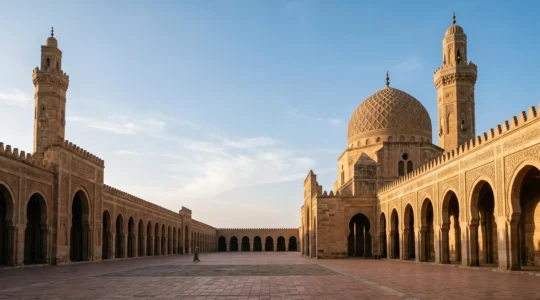
How Did Architectural Engineering Solve The Challenge Of Building Tall Structures Without Steel?
Pre-industrial engineers mastered height not with brute force, but by designing structures that worked exclusively in compression, turning structural necessities into profound aesthetic statements. Double-shell designs and vaulted ceilings created stable, large-span structures by efficiently channelling loads through pure compressive…
Read more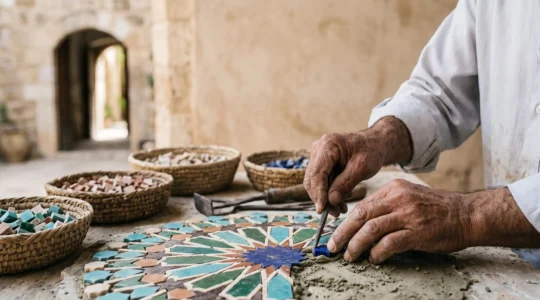
Why Did an Ancient Mosaic Cost Thousands of Hours Per Square Metre?
The immense time investment in mosaics stems not from simple manual labour, but from a constant battle against material fallibility and systemic constraints. The process was governed by the physics of stone, the chemistry of pigments, and the optics of…
Read more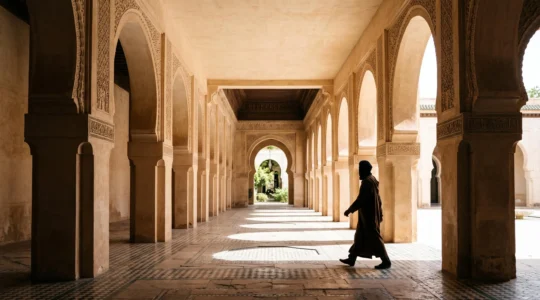
How Did Horseshoe Arches Transform Load Distribution Into Aesthetic Poetry?
The horseshoe arch’s structural brilliance lies not in its efficiency, but in its intentional inefficiency. Its extended curve lowers the springline, creating a visually grounded and human-scale rhythm impossible with semi-circular arches. It functions as a ‘force diffuser’ for wide…
Read more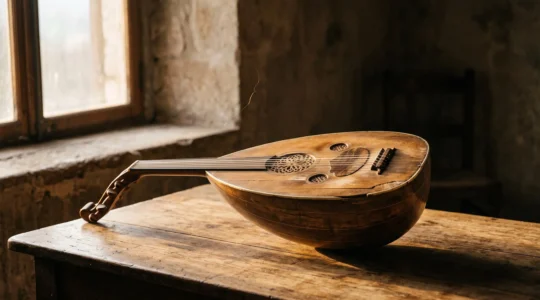
Why Has the Oud Remained the Soul of Arab Music for Over a Thousand Years?
The oud’s enduring dominance in Arab music is not simply a matter of tradition. It stems from a unique convergence of factors: the fretless neck’s capacity to produce neurologically resonant quarter-tone overtones, a vibro-acoustic design optimized for projecting these nuances,…
Read more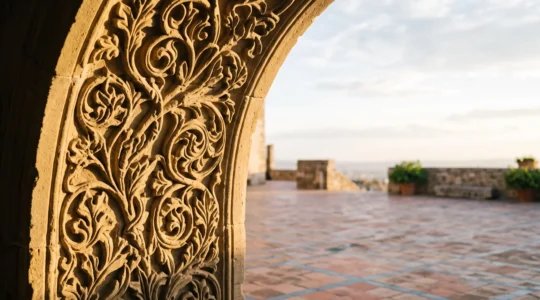
How Did Arabesques Transform Plants Into Infinite Mathematical Poetry?
The Islamic arabesque is not a simple decoration of plant life but a sophisticated philosophical engine. It employs a precise mathematical grammar to deconstruct the finite, organic forms of nature, transforming them into a visual theorem that expresses the abstract…
Read more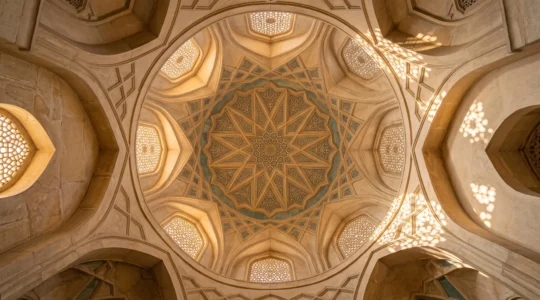
Why Do 32-Point Star Patterns Express Infinite Divine Unity Better Than Human Figures?
Islamic geometric patterns are not just decoration; they are a visual technology for mapping the infinite, using a mathematical grammar that pre-dates Western discovery by 500 years. They bypass the theological prohibition on figuration by using universal, abstract principles to…
Read more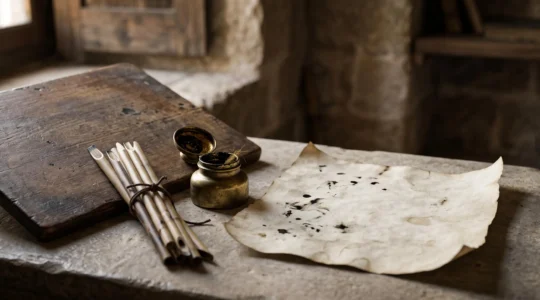
Who Were the Master Calligraphers Whose Styles Defined Islamic Art for Centuries?
The enduring genius of Islamic master calligraphers lies not just in their beautiful writing, but in their creation of replicable systems that allowed their art to be transmitted for centuries. Pioneers like Ibn Muqla didn’t just invent scripts; they codified…
Read more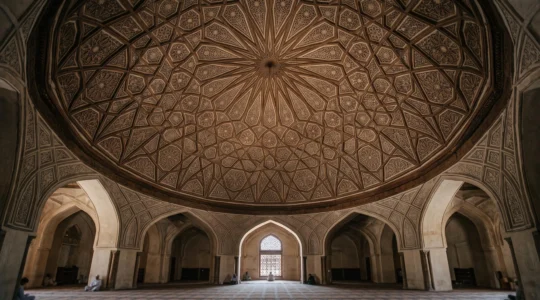
How Do Geometric Patterns Express Infinite Divine Unity Through Finite Mathematics?
While many assume Islamic geometric art arose simply to avoid depicting living figures, its true purpose is far more profound. This artistic tradition is a sophisticated spiritual technology. It uses the finite, rational tools of mathematics—a compass and a straightedge—not…
Read more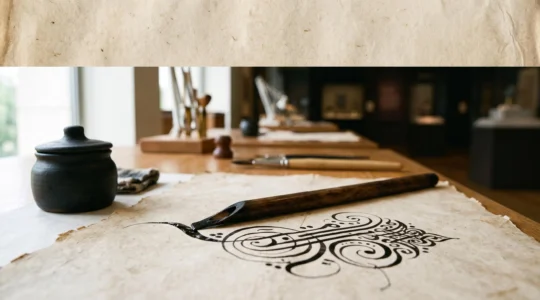
How Did Calligraphic Scripts Transform Writing Into the Supreme Visual Art?
Arabic calligraphy’s status as a supreme art stems not from mere beauty, but from a systematic fusion of spiritual purpose, geometric precision, and institutionalized training. The sanctity of the Qur’an provided the initial impetus, turning the act of writing into…
Read more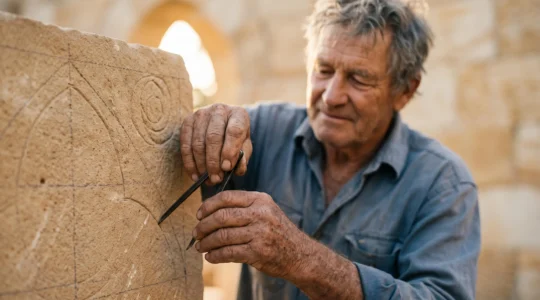
How Did Medieval Engineers Build Structures That Modern Architects Struggle to Replicate?
Medieval Arab and Islamic monuments were not built on mystical knowledge, but on a rigorous, repeatable system of geometric problem-solving that served as a powerful alternative to modern calculus. Architectural forms like the pointed arch and horseshoe arch were primarily…
Read more