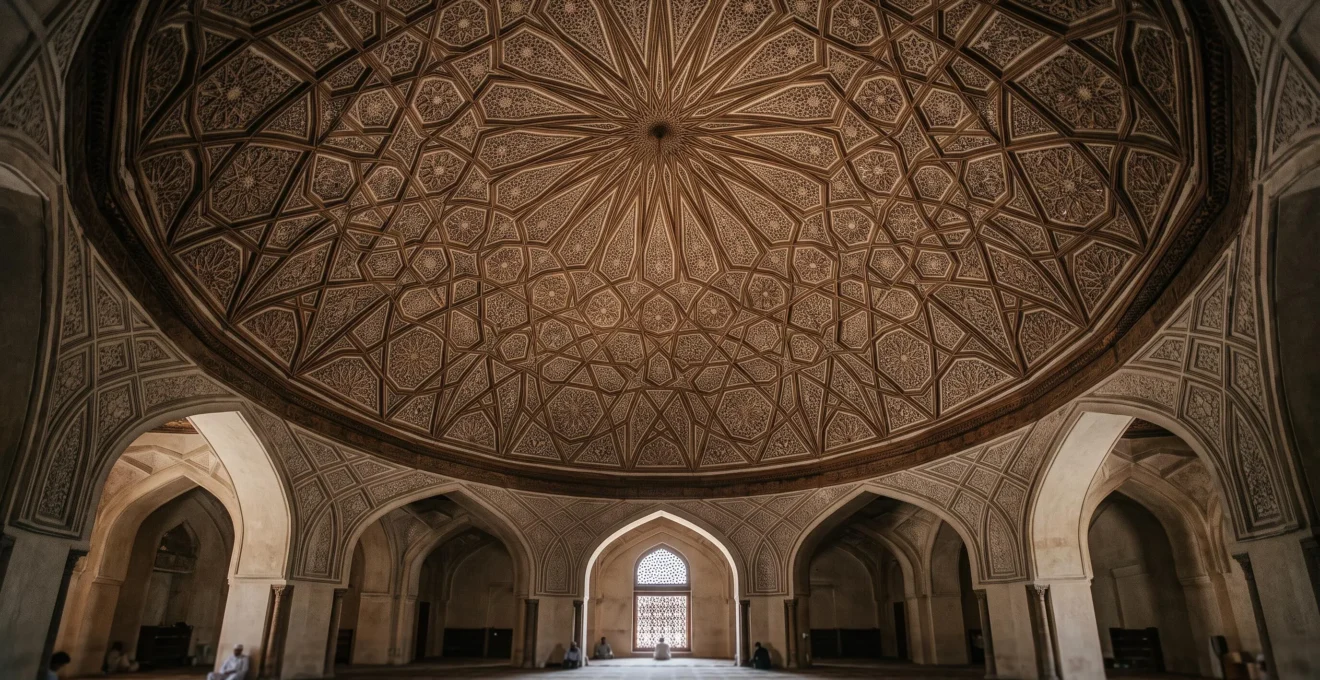
While many assume Islamic geometric art arose simply to avoid depicting living figures, its true purpose is far more profound. This artistic tradition is a sophisticated spiritual technology. It uses the finite, rational tools of mathematics—a compass and a straightedge—not merely to represent, but to actively contemplate the infinite, unseen, and unified nature of the Divine. The patterns are a tangible bridge between the human mind and metaphysical principles, transforming geometry into a form of intellectual worship.
In the vast tradition of Islamic art, three pillars stand preeminent: the fluid grace of calligraphy, the swirling, organic forms of the arabesque, and the rigorous order of geometric patterns. While all three seek to beautify surfaces, geometry holds a unique and profound intellectual status. The common understanding posits that this focus on abstraction, known as aniconism, emerged primarily as a prohibition against idolatry and the depiction of living beings. While this is a foundational element, it is an incomplete explanation. It frames the choice as a restriction, a turning away from something, rather than what it truly is: a proactive turning *toward* something far more ambitious.
The masters of this art were not simply avoiding a subject; they were pursuing a different one entirely. Their goal was to find a visual language capable of expressing the inexpressible: the core Islamic principle of Tawhid, the absolute, indivisible oneness of God. How could the finite human hand create a window into the infinite? The answer they discovered was not in depiction, but in construction. The patterns are more than just symbols of infinity; they are a method for its contemplation. They are a form of tangible metaphysics, where the act of creating and observing the intricate, endlessly repeating yet unified designs becomes a spiritual and intellectual exercise.
This exploration will move beyond the surface-level explanation of aniconism to reveal the deeper mechanisms at play. We will investigate how simple tools could give rise to staggering complexity, how this mathematical sophistication surpassed other traditions, and why these abstract forms are considered a more potent expression of divine unity than any finite figure. This is the story of how a compass and a ruler became instruments of profound spiritual insight.
Contents: The Mathematical Path to the Metaphysical
- Why Did Islamic Artists Choose Mathematical Patterns Over Human and Animal Forms?
- How Did Artisans Design 32-Point Star Patterns With Only Compass and Straightedge?
- Islamic Geometry or Gothic Tracery: Which Tradition Achieved Greater Mathematical Sophistication?
- The Geometric Mistake That Required Demolishing and Rebuilding an Entire Mosque Panel
- When Did Architects Employ 16-Point Stars Over 16-Point: The 4 Spiritual Determinants?
- Why Do 32-Point Star Patterns Symbolise Infinite Unity More Than Human Figures?
- Why Did Mosaicists Arrange Stones by Colour Rather Than By Figure?
- Why Do 32-Point Star Patterns Express Infinite Divine Unity Better Than Human Figures?
Why Did Islamic Artists Choose Mathematical Patterns Over Human and Animal Forms?
The pivot toward geometric abstraction in Islamic art was not a sudden event but a deliberate philosophical evolution. While early Islamic art did incorporate figurative elements inherited from Byzantine and Sasanian traditions, a profound shift occurred over time. Historical analysis shows that from the 9th century onward, a range of sophisticated geometric patterns based on polygonal tessellation began to proliferate, eventually becoming a dominant visual language across the Islamic world. This was not merely a decorative choice but a theological one, deeply rooted in the concept of Tawhid, or divine oneness.
Representing God, who is considered transcendent and beyond any form, was impossible. Furthermore, depicting living beings was seen by many theologians as an attempt to imitate God’s act of creation, a form of hubris. Geometry offered a perfect alternative. It was an art of pure intellect, of principles and order, that did not seek to replicate the created world but to reflect the universal laws that underpin it. The patterns became a visual metaphor for the divine order itself. As noted in analyses of the tradition, the arabesque and its geometric counterparts are often used to symbolize the transcendent, indivisible, and infinite nature of God.
Therefore, the choice was not a limitation but a liberation. By abandoning the finite and changeable forms of the living world, artists were freed to explore an abstract language capable of gesturing toward the eternal and the infinite. The pattern, with its ability to repeat endlessly beyond the confines of its frame, became a more fitting tribute to an infinite creator than any single, static image could ever be. It shifted the focus from the created to the principles of creation itself.
How Did Artisans Design 32-Point Star Patterns With Only Compass and Straightedge?
The staggering complexity of a 16- or 32-point star pattern might suggest the use of advanced computational tools, yet these masterpieces were constructed using the simplest instruments available: a compass and a straightedge. This minimalist toolkit was not a constraint but the very key to the tradition’s philosophical depth. The process was a form of mathematical contemplation, where universal, perfect forms were coaxed into existence from a few fundamental axioms: the circle (drawn by the compass) and the line (drawn by the straightedge).
The construction began with a single circle, representing unity and the heavens. By dividing this circle into equal segments—four, six, eight, and so on—and connecting points and intersections with straight lines, a foundational grid would emerge. This grid contained all the necessary information to generate the final pattern. The artisan was not inventing so much as discovering the forms latent within the geometry of the circle. Complex star polygons and interlocking tessellations were not drawn arbitrarily but were revealed through a logical, repeatable process. It is a method that, as artist Sharmeen Sidiki describes her own work, creates a system where complex patterns “resemble fractals” and seem to bring order out of chaos.
This ancient technique remains profoundly relevant. As demonstrated in a workshop at MIT, participants could faithfully reproduce intricate historical designs, such as those from the Al-Aqsa Mosque, using only these basic tools. The process transforms the artist from a mere decorator into a geometer, one who engages in a dialogue with the fundamental principles of cosmic order. The final pattern is not just a beautiful design; it is the physical evidence of a rigorous intellectual and spiritual journey.
Action Plan: Deconstructing a Geometric Pattern
- Identify the Unit: Look for the primary repeating shape or module. Is it a square, a hexagon, or a star? This is your starting point.
- Find the Grid: Trace the underlying lines of construction. Can you see the initial circle and its primary divisions that form the grid?
- Trace the Weave: Follow a single line or ribbon as it weaves over and under others. Observe the rules of its path and how it interacts with the grid.
- Analyse Symmetry: Identify the types of symmetry present. Is it rotational (spinning around a point) or reflective (a mirror image)? How many axes of symmetry are there?
- Scale and Extension: Imagine the pattern continuing beyond its frame. How does the unit cell tessellate to cover an infinite plane?
Islamic Geometry or Gothic Tracery: Which Tradition Achieved Greater Mathematical Sophistication?
When comparing the great architectural traditions of the medieval world, both Islamic geometry and European Gothic tracery stand out for their mathematical ingenuity. Gothic architecture, with its soaring pointed arches, ribbed vaults, and intricate rose windows, certainly relied on sophisticated geometry. However, a closer look at the mathematical principles involved reveals that Islamic artisans were exploring concepts that Europe would not understand for another five centuries.
While Gothic tracery was primarily based on Euclidean geometry of circles and straight lines to create its forms, Islamic artists made a groundbreaking leap into aperiodic tiling. This is most evident in the use of “girih” tiles, a set of five specific tile shapes that could be used to create patterns that never repeated, yet were not random. In a landmark 2007 discovery, physicists Peter J. Lu and Paul J. Steinhardt analyzed medieval Islamic patterns and found that by the 15th century, artisans were constructing nearly perfect quasi-crystalline Penrose patterns. These complex, non-repeating tilings were thought to have been first described in the West by Roger Penrose in the 1970s.
This discovery proves that Islamic designers had an intuitive—if not formal—understanding of extremely advanced mathematical concepts. Their work was not just about creating repeating tessellations but about exploring a higher form of order: one that could generate infinite variety from a finite set of rules. As scholar R. Tennant noted, these findings suggest that the mathematical understanding of these artisans was much deeper than was previously imagined. While Gothic art achieved breathtaking aesthetic heights, the underlying mathematical framework of Islamic geometry was, arguably, exploring a more complex and forward-thinking universe of form.
The Geometric Mistake That Required Demolishing and Rebuilding an Entire Mosque Panel
In a system dedicated to divine perfection and mathematical precision, a mistake can seem like a catastrophic failure. Stories persist in the craft world of entire panels of tile or stone being dismantled because of a single miscalculation that disrupted the harmony of the whole. The demand for precision was absolute, as the pattern was not merely decoration but a reflection of cosmic order. An error in the geometry was an error in theology, a jarring note in a hymn to the Creator. The human hand, in its fallibility, was always at risk of failing to live up to the perfect, abstract ideal it sought to manifest.
However, Islamic philosophy offers a profound and paradoxical perspective on imperfection. While perfection is the goal, only God is perfect. For a human to achieve absolute perfection in their work could be seen as an act of arrogance. Out of this humility, a fascinating tradition emerged: the deliberate mistake. In some instances, it is believed that mistakes in repetitions may be intentionally introduced as a show of humility by artists who believe only God can produce perfection. This single, slightly “off” tile in a vast mosaic or a subtle break in a repeating pattern serves as a signature of human fallibility and a nod to divine supremacy.
This concept is visible in the architecture itself. The stunningly decorated vaulted ceilings of many historic mosques often appear perfectly symmetrical at first glance. Yet, upon close inspection, they frequently contain minor irregularities imperceptible to most visitors. Whether a genuine error that was too costly to fix or a deliberate act of piety, the “mistake” becomes part of the art’s deeper narrative. It embodies the tension between the human aspiration for perfection and the humble acknowledgment of divine transcendence, making the finished work both a mathematical and a spiritual statement.
When Did Architects Employ 16-Point Stars Over 8-Point: The 4 Spiritual Determinants?
The choice between an 8-point star (khatim) and a more complex 16-point or 32-point star was not arbitrary or purely aesthetic. It was a decision guided by a confluence of spiritual, symbolic, economic, and hierarchical determinants. At its core, the increasing complexity of a pattern reflected a deeper dive into the contemplation of divine unity, but practical factors were also at play.
First, the symbolic intent was paramount. Simpler patterns like the 8-pointed star, formed from two overlapping squares, were widely understood. As one source on Moroccan tile explains, eight-pointed stars symbolize harmony and cosmic order, making them suitable for a wide range of applications. A 16-point star, requiring more complex divisions of the circle, represented a more intricate and profound meditation on the infinite, often reserved for spaces of greater spiritual significance like a mihrab (prayer niche) or a mausoleum.
Second, the patron’s status and wealth were a major factor. Creating complex geometric patterns, especially in the form of zellige tilework, was an incredibly laborious and expensive process. As the official Moroccan tourism guide notes, the training to become a master craftsman (maâlem) took many years. Consequently, highly intricate zellige was a powerful status symbol, used to “express the wealth and the sophistication of the owner.” A patron commissioning a 16- or 32-point star pattern was making a public statement about both their piety and their resources.
Third, the skill of the artisans available determined what was possible. A workshop of master maâlems could execute a complex design that lesser-skilled artisans could not. Finally, the architectural hierarchy of the space itself dictated the level of ornamentation. A main prayer hall would command greater complexity than a simple ablution courtyard, creating a grammar of geometry that guided visitors through the space, from the simple to the sublime.
Why Do 32-Point Star Patterns Symbolise Infinite Unity More Than Human Figures?
The symbolic power of the star pattern in Islamic art is immense, serving as a primary vehicle for expressing divine concepts. While a human figure is, by its nature, finite, singular, and bounded, a star pattern is inherently expandable and abstract. A 32-point star is not simply a shape; it is a nexus of lines radiating from a central, unseen point, a perfect visual metaphor for the One from which all of creation emanates. The central point remains unified and whole, while its manifestations radiate outwards into multiplicity, reflecting the core theological concept of unity in diversity (al-wahda fil-kathra).
Stars, across many cultures, are celestial symbols. Within an Islamic context, they often represent the heavens and, by extension, the divine itself. As one analysis of Moroccan tile symbolism states, “Stars often represent the heavens and divine light.” A pattern of interlocking stars creates a sense of infinite expanse, a celestial map on a terrestrial surface. It invites the viewer’s mind to travel beyond the physical wall or floor and into a metaphysical realm of perfect, unending order.
Furthermore, the flexibility of the star system allowed for incredible artistic and symbolic richness. Artisans were not limited to a single type of star. For example, the minaret socle of the Bibi Khanum Mosque in Samarkand masterfully combines different geometric patterns, featuring 10-, 8-, and 5-pointed stars within the same overall composition. This ability to layer and combine different orders of symmetry within a unified design demonstrates a profound understanding of harmony. A human figure cannot be so easily combined or tessellated without losing its integrity. The star, however, thrives in combination, its power amplified as it connects with others to form a seamless, infinite web, perfectly symbolizing a unified but infinitely complex creation.
Why Did Mosaicists Arrange Stones by Colour Rather Than By Figure?
In the intricate art of zellige, the vibrant mosaic tilework of Morocco, the process of creation is as meaningful as the final product. The small, hand-chiseled tiles (known as furmah) are not arranged to form a picture of a person, animal, or object. Instead, they are sorted and laid out by color to create abstract geometric patterns. This method is central to the art’s purpose: to build a vision of harmony and divine order through the interplay of geometry and color, rather than through figurative representation.
The process itself is a testament to this philosophy. Master craftsmen, or maâlems, oversee a team that begins by chiseling out thousands of small tile pieces from larger glazed blanks. These pieces are then arranged face-down in a frame, following a memorized geometric pattern. This “negative” assembly means the artisans cannot see the final result until the very end, when a layer of mortar is applied to the back and the entire panel is lifted. This requires immense skill and trust in the underlying geometric logic. The primary organizing principle during assembly is the flow of color through the pre-determined pattern.
This focus on color is deeply symbolic. The palette of traditional zellige is not random; as the Serenity Morocco Tours guide explains, “Each color carries symbolic meaning rooted in Islamic tradition.” White represents purity, blue represents the sky and water (wisdom), green symbolizes Islam, yellow signifies wealth, and red stands for strength. By arranging these symbolic colors into a perfect geometric matrix, the mosaicist creates a work that is not a picture *of* something, but an embodiment *of* spiritual principles. The color provides the emotional and symbolic content, while the geometry provides the intellectual and structural framework, together forming a complete metaphysical statement.
Key Takeaways
- Beyond Aniconism: The use of geometry is not just a prohibition against figures, but a proactive choice to create a more profound language for the divine.
- Mathematical Contemplation: The process of creating patterns with a compass and straightedge is a spiritual and intellectual discipline, a way of engaging with cosmic order.
- Advanced Mathematics: Islamic artisans discovered and used principles of quasi-crystalline geometry (aperiodic tiling) five centuries before their formal description in the West.
- Unity in Multiplicity: Star patterns, with their ability to tessellate infinitely from a central point, are a more effective symbol of God’s infinite and unified nature (Tawhid) than any finite figure.
Why Do 32-Point Star Patterns Express Infinite Divine Unity Better Than Human Figures?
The ultimate purpose of Islamic geometric art is to create a tangible point of access to metaphysical truths. As a comprehensive body of research affirms, these patterns reflect an intricate “balance between the material and the metaphysical.” When measured against this goal, a 32-point star pattern, or any complex geometric tessellation, proves to be a vastly superior vehicle for expressing divine unity than a human figure. A human figure is, by definition, an image of a created being—finite, temporal, and individual. It represents a single part of creation. A geometric pattern, in contrast, represents the universal laws that govern all of creation.
The genius of the pattern lies in its self-similarity and scalability. As demonstrated by the sophisticated girih tilings, these patterns possess properties consistent with fractal and quasi-crystalline structures. This means a small section of the pattern contains the blueprint for the whole, and the pattern can be expanded infinitely without losing its coherence. This is a powerful visual analogy for Tawhid: the idea that the entire, infinitely complex universe operates on a set of unified, underlying principles emanating from a single source. A human figure cannot do this. It is a closed system; a geometric pattern is an open one.
Thus, the pattern functions as a form of proof, not just a picture. It doesn’t just tell you God is infinite; it demonstrates what infinity looks like within a structured, comprehensible system. It allows the human intellect to grasp a concept—the seamless transition from the one to the many, the generation of infinite complexity from simple rules—that is otherwise purely abstract. The pattern is a map of the divine order, and by tracing its lines, the viewer is invited into a state of contemplation, a spiritual journey from the material surface to the metaphysical reality it signifies. In this context, a human figure is a beautiful but finite statement, while the geometric pattern is an unending, intellectual prayer.
Ultimately, these patterns are not silent decorations. They are a dynamic and rigorous form of philosophy made visible, offering a window into the unity of the cosmos for all who take the time to look.