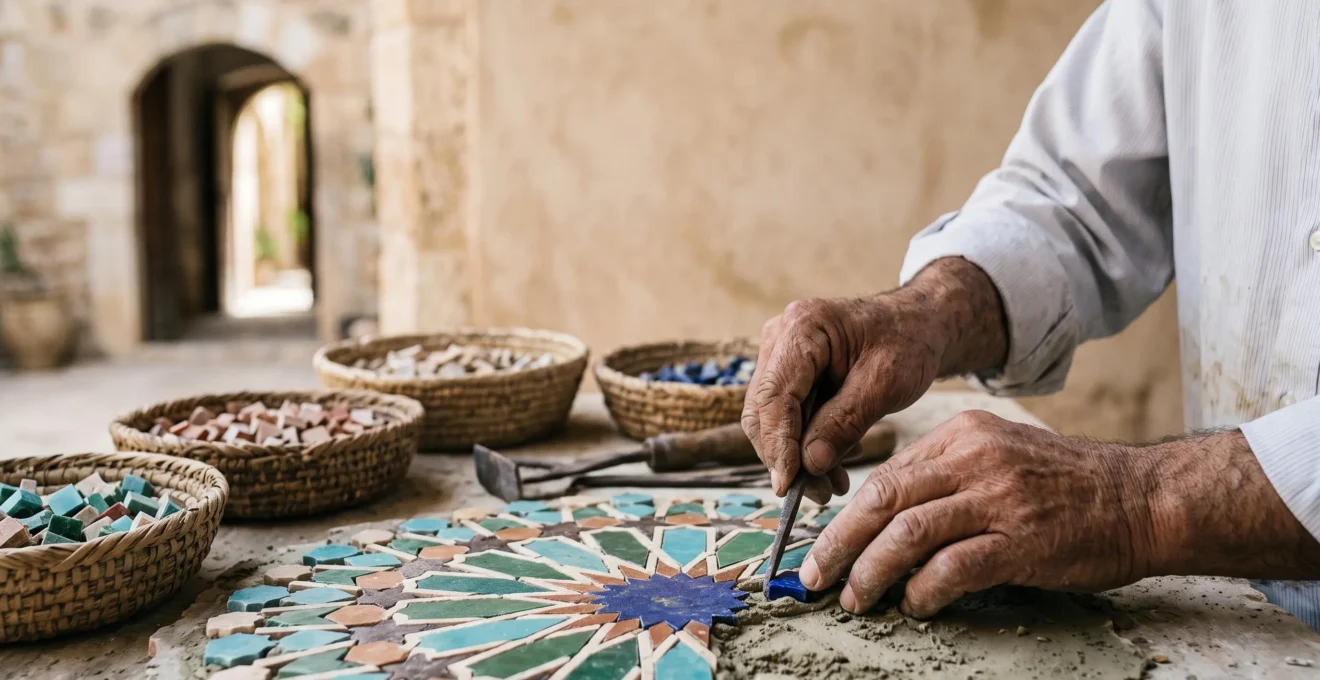
The immense time investment in mosaics stems not from simple manual labour, but from a constant battle against material fallibility and systemic constraints.
- The process was governed by the physics of stone, the chemistry of pigments, and the optics of natural light, requiring meticulous, multi-stage problem-solving.
- Failures were cumulative; a microscopic error in the foundation or grout could lead to catastrophic failure decades later, demanding extreme precision at every step.
Recommendation: To truly appreciate a mosaic, look beyond the image to the underlying systems of order—the colour-sorting logic, the precise geometry, and the subtle angling of each stone to command the light.
To stand before a great Roman or Islamic mosaic is to feel a sense of awe. The eye struggles to comprehend the scale of the labour, a feeling often distilled into a simple, almost platitudinous observation: “It’s made of so many tiny pieces.” This is true, but it is also a profound understatement. It’s an explanation that satisfies the tourist but not the historian or the conservator. It attributes the time cost to brute force and patience, overlooking the vast, hidden intellectual and engineering challenges faced by the artisans.
The common understanding of mosaic-making focuses on the visible actions of designing, cutting, and placing. Yet, this perspective misses the fundamental truth of the craft. The real time was not just spent *in* the labour, but *in the mitigation of failure*. Every single step, from quarrying stone to the final polishing, was an engagement with material science, structural engineering, and optical physics, all performed with pre-industrial tools. The master mosaicist was not just an artist, but a systems engineer managing a cascade of potential, compounding errors.
This article will deconstruct the thousands of hours invested in each square metre by moving beyond the “many small pieces” narrative. We will explore the systemic constraints that dictated workshop logic, the material fallibility that craftsmen constantly battled, and the abstract geometric and spiritual labour that informed the final design. The true story of the mosaic is one of human ingenuity not just creating beauty, but triumphing over the inherent chaos of the physical world.
The following sections break down the specific, often unseen, challenges that defined this monumental art form. We will explore the logic behind each painstaking process, revealing the expertise that separates a decorative surface from a work of enduring cultural heritage.
Summary: The Unseen Complexities of Ancient Mosaic Craft
- Why Did Mosaicists Arrange Stones by Colour Rather Than By Figure?
- How Do Craftsmen Cut 5mm Tesserae for Complex Curved Mosaics?
- Intricate Mosaics or Painted Murals: Which Survives Light Better Over 500 Years?
- The Grout Error That Causes 30% of Ancient Mosaic Stones To Fall
- When Did Mosaicists Work Only Under Natural Light?
- How Do Craftsmen Build 32-Point Star Patterns Without Computer Tools?
- How Did Isfahan Artisans Apply Glazes Without Firing Defects at 1,200°C?
- Why Do 32-Point Star Patterns Express Infinite Divine Unity Better Than Human Figures?
Why Did Mosaicists Arrange Stones by Colour Rather Than By Figure?
The image of an artist meticulously placing stones to form a face or a flowing robe is a romantic one, but it misrepresents the fundamental logic of the mosaic workshop. The primary organising principle was not the final image, but the material itself. A large-scale project was a monumental logistical challenge, and organising labour by colour was a direct and brutally efficient response to this systemic constraint. Think of it as a pre-industrial form of parallel processing. Instead of one master artisan working through a figure, the workshop would be divided into specialised teams: cutters, fine-sorters, and layers, all organised around a palette of sorted colours.
The sheer scale made this necessary. For a large floor, the number of individual stones, or tesserae, could be staggering; research into Roman workshop practices shows that over 1,000,000 individual tesserae could be required for a single expansive piece. To search for a specific shade of ochre for a specific fold in a toga within an unsorted pile would be an impossible bottleneck. Instead, apprentices would spend hundreds of hours sorting raw stone chips into dozens of shades. The restoration of the Casa Burés in Barcelona offered a modern glimpse into this ancient logic, as conservators found it most efficient to have replacement marble tiles cut and then sorted into separate baskets by colour before a single one was laid. This method allows multiple artisans to work simultaneously on different areas of the same colour field, dramatically increasing speed without sacrificing precision.
How Do Craftsmen Cut 5mm Tesserae for Complex Curved Mosaics?
The ability to create fluid, painterly lines from solid rock is one of the great marvels of mosaic art. This illusion of fluidity was born from extreme precision, achieved with the simplest of tools: a hammer and a hardie. The hardie, a sharp, chisel-like tool set into a wooden block, provided the stationary cutting edge. The craftsman would place a larger piece of stone or glass (a smalto) on the edge and, with a single, expertly judged tap of the hammer, cleave it into the desired shape. The skill lay not in brute force, but in an intimate understanding of the stone’s internal structure—its veins and cleavage planes—to predict the fracture.
For the most detailed work, known as opus vermiculatum (‘worm-like work’), this process was taken to a microscopic level. As Hellenistic and Roman techniques evolved, craftsmen achieved tesserae cut to 4mm or smaller. This allowed for subtle gradations of colour and the creation of curves that appear perfectly smooth from a distance. The time cost here is exponential: not only is the cutting of each stone more difficult, but the number of tesserae required per square centimetre skyrockets. It also required immense material ingenuity. At Fishbourne Roman Palace, analysis revealed that for the ‘Cupid on a Dolphin’ mosaic, some tesserae were even cut from fragments of high-quality Samian ware pottery, a testament to the artisans’ resourcefulness in achieving a specific colour and texture.
This level of precision, executed thousands upon thousands of time, represents a mastery of material fallibility. Each tap of the hammer was a calculated risk, a balance between the desired form and the stone’s natural tendency to break. To create a 5mm curve was not to draw a line, but to build a perfectly interlocking puzzle of hundreds of individually shaped, imperfect pieces of rock.
Intricate Mosaics or Painted Murals: Which Survives Light Better Over 500 Years?
The most immediate and obvious advantage of mosaic over fresco or painted murals is its material permanence. Pigments in paint are complex organic or inorganic compounds suspended in a binder; they are inherently susceptible to chemical change when exposed to energy. The primary enemy is light. The entire spectrum plays a role, though technical studies on photodegradation confirm that 40-60% of fading is caused by UV light, with another 25% from the visible light spectrum. Over centuries, this energy breaks down the chemical bonds in the pigments, causing colours to fade, shift, or disappear entirely.
Mosaics, by contrast, are fundamentally different. Their colour is not a surface application; it is the intrinsic, geological property of the material itself. A red tessera is made of a stone that is geologically red. It is not a pigment that can fade, but a mineral whose colour is stable over millennia. This inherent lightfastness is why we can still appreciate the vibrant colours of a 2,000-year-old Roman floor, while a contemporary painting would be long lost without extreme protection. A mosaic is, in essence, a painting made of solid light-proof colour.
However, this is not the complete picture. While the tesserae themselves are largely immune to light, the mosaic as a complete system is not invincible. A quantitative study on a 2nd-century Roman mosaic revealed another, more insidious threat: biology. The research found that the growth of biofilms and microorganisms in the microscopic gaps between tesserae—a process that occurs independently of light—can seriously compromise the stability of the grout and bedding layer. This demonstrates that durability is about more than pigment chemistry; it’s about the long-term structural integrity of the entire system.
The Grout Error That Causes 30% of Ancient Mosaic Stones To Fall
While the tesserae are the stars of a mosaic, the silent, unsung hero—or villain—is the system that holds them in place. The single most significant factor in the long-term failure of a mosaic is not the stones themselves, but the integrity of the foundation and grout. An artisan could spend weeks creating a perfect image, only to have it undone by a microscopic error in the unseen layers beneath. This is the principle of cumulative failure: a small flaw, repeated or left unchecked, will inevitably lead to a catastrophic problem.
The most common and devastating of these flaws is the creation of subsurface voids. When the mortar bed (the *nucleus*) is laid, any trapped air or insufficient compaction can create a tiny hollow pocket beneath a tessera. To the naked eye, the surface appears perfect. But the stone is not fully supported. Over decades or centuries of foot traffic, building settlement, or minute thermal expansions, that unsupported tessera becomes a point of weakness. It may rock, powdering the grout around it and loosening its neighbours. Eventually, it falls out, a process called tessera loss. In one documented restoration at Casa Burés, conservators calculated that over 8,000 of the 300,000 original tesserae were lost, many due to such foundational issues.
Modern diagnostic tools have confirmed this ancient failure mechanism. A groundbreaking ground-penetrating radar study of a Roman mosaic was able to map these hidden subsurface voids and directly correlate them with major fractures on the surface. The thousands of hours of meticulous work, therefore, were not just artistic. They were a form of quality control against this ever-present threat. Every step—from mixing the mortar to a specific consistency to tamping the surface to expel air—was a conscious act of engineering to ensure a 500-year lifespan.
Action Plan: Diagnosing Potential Subsurface Failure in Mosaics
- Surface Tapping Survey: Systematically tap the entire surface with a small, non-damaging mallet. Listen for changes in sound from a solid ‘tick’ to a hollow ‘thud’, which indicates a potential void beneath.
- Grout Line Analysis: Carefully inspect all grout lines for hairline cracks or evidence of ‘powdering’. This can be the first sign that tesserae are shifting due to a lack of support.
- Tesserae Stability Check: Gently apply pressure to individual tesserae with a fingertip. Any rocking, clicking, or movement is a critical indicator of a detached stone or failed mortar bed.
- Moisture and Salt Mapping: Use appropriate non-invasive meters to map areas of high moisture or salt efflorescence, as water infiltration often exploits and worsens existing subsurface voids.
- Review Subsurface Imaging Data: If available, cross-reference physical observations with data from Ground-Penetrating Radar (GPR) or thermography to confirm the extent and location of voids and delamination.
When Did Mosaicists Work Only Under Natural Light?
The reliance on natural light in ancient mosaic workshops was not merely a consequence of lacking artificial alternatives; it was a fundamental requirement of the craft itself. The ultimate goal of a master mosaicist was not just to create a pattern, but to control how that pattern interacted with light. This is a concept known in Italian as andamento—the visual flow and rhythm created by the lines of tesserae. An equally important, though less discussed, aspect is how the angle of each individual stone catches and reflects light towards the viewer’s eye.
A skilled artisan would intentionally set adjacent tesserae at very slightly different angles. This practice, invisible from a distance, creates a surface that is not flat and dead, but alive and shimmering. As the viewer moves or as the sun traverses the sky, different facets of the mosaic catch the light, creating a dynamic, scintillating effect. This is particularly crucial in gold-leaf mosaics (smalti), such as those in the basilicas of Ravenna, where the uneven surface creates a heavenly, non-static glow that a perfectly flat, machine-made surface could never achieve.
This subtle art of optical compensation could only be judged and executed under the specific lighting conditions of its final location. An oil lamp or candle creates a single, harsh point of light with deep shadows, which would give a completely false reading of the mosaic’s daytime appearance. The artisan had to work under the same diffuse, moving, full-spectrum daylight that the final viewer would experience. The workday was therefore dictated by the sun. This constraint was not a hindrance but a tool, forcing the artisan to become a master of practical optics, painting with reflected light as much as with coloured stone.
How Do Craftsmen Build 32-Point Star Patterns Without Computer Tools?
The dazzling complexity of Islamic geometric patterns, particularly the intricate star-and-polygon compositions, seems to defy pre-modern construction. How could artisans in the 15th century create sprawling, perfectly symmetrical patterns of 16- or 32-point stars without the aid of computer calculations? The answer lies not in complex individual calculations, but in a brilliantly simple and scalable system of construction: a set of standardised geometric tiles known as ‘girih’ tiles.
This insight was famously demonstrated in a 2007 study published in *Science*. Physicists Peter Lu and Paul Steinhardt proved that medieval Islamic artisans used a limited set of five polygonal tiles (a decagon, a pentagon, a diamond, a bowtie, and a hexagon). Each tile was marked with a specific pattern of lines. By simply assembling these tiles edge-to-edge, following the rule that the lines must be continuous across the joins, artisans could generate incredibly complex, non-repeating patterns, including those with perfect quasi-crystalline properties. This system effectively embedded the complex rules of geometry into the physical tiles themselves, allowing craftsmen to create vast, perfect patterns without needing to understand the underlying modern mathematics.
This was not a system limited to simple patterns. As Peter R. Cromwell notes in his analysis of the Topkapı Scroll, a 15th-century collection of architectural patterns, the method was capable of extraordinary complexity: “Highlights include a design combining 9- and 11-point stars, and another with 13- and 16-point stars.” The girih tile system was a form of analogue algorithm, a powerful tool for generating boundless variety from a finite set of rules. The genius was not in calculating every angle for a 32-point star, but in devising a self-correcting grid that made such a construction inevitable and perfect.
How Did Isfahan Artisans Apply Glazes Without Firing Defects at 1,200°C?
The luminous turquoise and cobalt blue tiles that clad the domes of Isfahan represent a pinnacle of ceramic technology. Achieving these stable, vibrant colours at temperatures soaring to 1,200°C is a monumental challenge of high-temperature chemistry, one that pushes materials to their absolute limits. The time and labour involved were not just in the application of the glaze, but in the rigorous control of every variable to prevent a host of potential firing defects.
The primary battle was against material fallibility. The first challenge was achieving the correct colour. The iconic cobalt blue required cobalt oxide, while the turquoise depended on copper oxide. However, the final colour is critically dependent on the kiln’s atmosphere. A firing in an oxygen-rich (oxidising) atmosphere could produce entirely different hues from a firing in an oxygen-starved (reducing) atmosphere. Artisans had to be masters of controlling the airflow and fuel in their kilns to maintain the precise chemical environment needed for hundreds of hours.
The second, and perhaps greater, challenge was the physical compatibility of the glaze and the ceramic body of the tile. As the tile heats and cools, it expands and contracts. The glaze must be formulated to have a coefficient of thermal expansion that is perfectly matched to the tile body. If the glaze shrinks even slightly more than the body on cooling, it will be put under immense tension and develop a network of fine cracks known as ‘crazing’. If it shrinks less, it can flake off, a defect called ‘shivering’. To avoid these defects required an almost supernatural understanding of the raw materials—the specific clays, the silica, the alkaline fluxes—and the ability to formulate a recipe that would perform flawlessly at 1,200°C. Each perfect tile is a survivor, a testament to countless hours of experimentation and failed attempts that ended in cracked or discoloured ruin.
Key Takeaways
- The time cost of mosaics is rooted in managing systemic complexity and material failure, not just manual repetition.
- Artisans were practical engineers and physicists, controlling for subsurface voids, light optics, and high-temperature chemistry with pre-industrial tools.
- In Islamic geometric art, the intellectual labour of creating a rule-based system (like girih tiles) allowed for the generation of infinite complexity without modern computation.
Why Do 32-Point Star Patterns Express Infinite Divine Unity Better Than Human Figures?
In many cultures, the highest form of religious art is the representation of the divine in human form. In the Islamic tradition, however, the artistic impulse moved towards a different, more abstract vocabulary: the language of geometry. The decision to use intricate star patterns to adorn the most sacred spaces was not a stylistic choice born from a prohibition on images; it was a profound theological statement. A 32-point star pattern can express the nature of Divine Unity (Tawhid) in a way that a figurative representation, by its very nature, cannot.
A human figure is finite. It has boundaries, a specific form, and an individual identity. It is a part of creation. A geometric star pattern, however, is a visual expression of the infinite. It is built from universal principles—the laws of mathematics—that are seen as a reflection of the divine order. The pattern can be extended infinitely in any direction without losing its coherence, visually representing the boundless and all-encompassing nature of God. It is perfectly ordered, symmetrical, and crystalline, proclaiming a perfection that is beyond the mortal and transient world.
As Craig Kaplan explores in his doctoral dissertation on the computational and artistic nature of Islamic star patterns, the act of constructing these geometries can itself be a form of theological contemplation. The patterns resonate with an “artistic intent to proclaim boundless, crystalline perfection.” When a worshipper stands beneath a dome covered in a radiating star pattern, they are not looking at a picture *of* something; they are enveloped *in* a model of the cosmos. The art is not a narrative to be read, but an environment to be experienced—an intellectual and spiritual immersion into the concept of infinite, unified order. This represents the ultimate investment of labour: not just the physical crafting of tiles, but the intellectual and spiritual labour of rendering the infinite tangible.
The next time you stand before a great mosaic, whether Roman or Islamic, look closer. Look past the image and see the systems. See the battle against chaos in every perfectly laid stone, the understanding of chemistry in every stable glaze, and the grasp of infinity in every perfect star. You are not just seeing decoration; you are witnessing a triumph of human ingenuity over systemic constraints, an achievement of thousands of hours that echoes across thousands of years.