History and civilizations

The Science of Position: How Precise Navigation Across Desert and Ocean Transformed Global Trade and Discovery
The transformation of global trade was not merely enabled by better tools, but by a revolutionary Arab navigational science that systematically ‘de-risked’ long-distance travel. This was achieved through a rigorous system of cross-verification, using multiple, independent data points from the…
Read more
Why Did Astrolabes Become The Most Precise Navigation Tool Before The Telescope?
The astrolabe’s precision was not an inherent quality of the tool, but the result of a sophisticated system integrating Arab mathematics and rigorous methodology. Arab trigonometry provided the mathematical engine for accuracy, surpassing the limitations of earlier Greek geometry. Strict…
Read more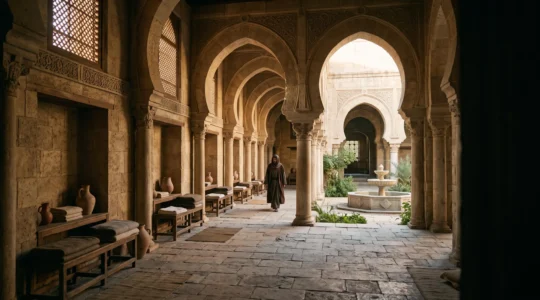
Why Did Arab Hospitals Establish Specialised Wards Centuries Before European Institutions?
The superiority of medieval Arab hospitals was not merely architectural, but rooted in an operational system designed to manage risk, validate outcomes, and institutionalise knowledge. Patient separation functioned as a sophisticated form of risk stratification, based on observable contagion patterns…
Read more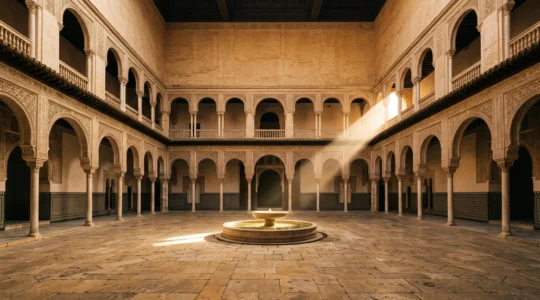
How Did Spiritual Sanctuaries Combine Architecture, Water, and Light To Induce Contemplation?
The architecture of spiritual sanctuaries is a sophisticated technology of perception, engineered not just to represent contemplation but to physiologically induce it. Water is used as a primer, creating a cognitive threshold that separates the worldly from the spiritual through…
Read more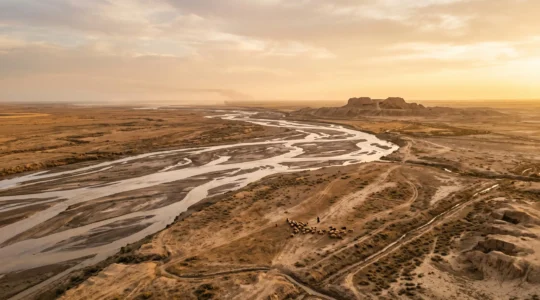
Why Did the First Cities Arise in Mesopotamia, and Not Elsewhere?
The world’s first cities were not a natural evolution of farming, but a high-risk social gamble in a uniquely challenging environment. Mesopotamia’s unpredictable rivers forced a level of social cooperation and technological innovation unseen elsewhere, creating immense agricultural surplus. This…
Read more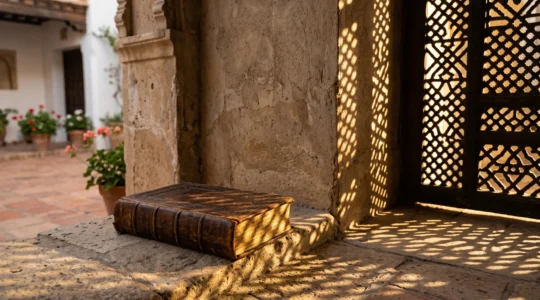
How Did Arab Manuscripts Spark the European Renaissance 200 Years Later?
The European Renaissance wasn’t a sudden awakening, but the culmination of a 200-year intellectual transfer fueled by a massive influx of scientific and philosophical knowledge from the Arab world. Intellectual hubs like 12th-century Toledo, Spain, acted as crucial knowledge conduits,…
Read more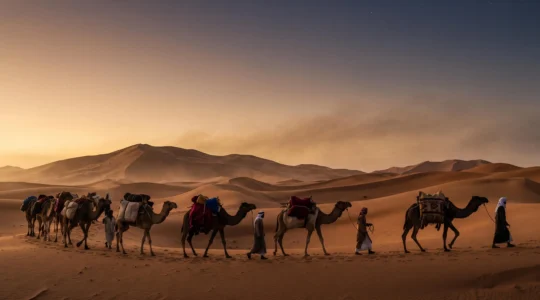
How Did the Silk Road Transform a Luxury Fabric Into Global Cultural Currency?
Imagine a bolt of Chinese silk, shimmering in the muted light of a Roman villa. For the patrician who owned it, this fabric was the ultimate symbol of wealth and exoticism, a mystery from a land beyond the known world….
Read more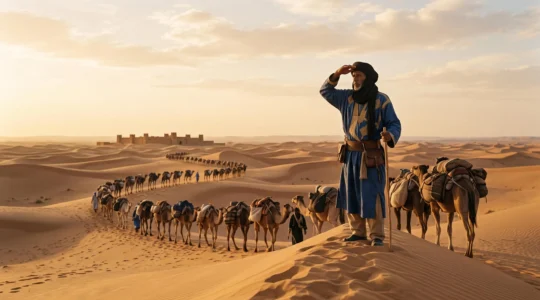
How Did Ancient Trade Routes Transform Desert Kingdoms Into Global Economic Powers?
The success of ancient Arabian trade was not a geographic accident, but the result of mastering a sophisticated ‘soft infrastructure’ of logistics, technology, and information that out-competed rivals like Rome. Instead of relying on military conquest, Arab networks thrived on…
Read morePalais abbassides : vestiges du pouvoir à bagdad la légendaire
Imaginez une Bagdad d’antan, la “Ville de la Paix”, un centre vibrant où la science, les arts et le commerce prospéraient sous l’égide du califat abbasside. Les échos de sa splendeur résonnent encore, murmures persistants d’une ère dorée. Les demeures…
Read moreIngénieurs du désert : l’art de maîtriser l’eau et le vent
Imaginez une oasis verdoyante au cœur d’un paysage aride, un témoignage de la vie qui s’épanouit là où l’on s’y attend le moins. Cette image, loin d’être un simple mirage, est le fruit d’un savoir-faire ancestral, d’une ingénierie sophistiquée mise…
Read more