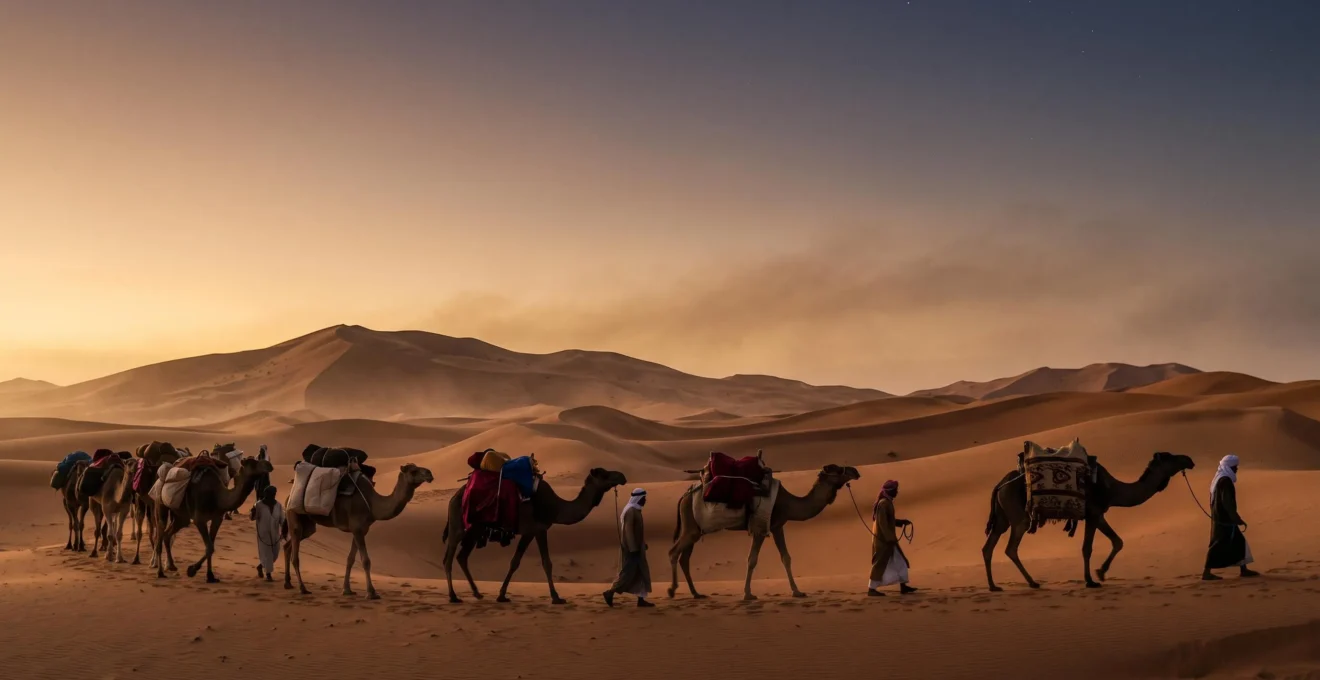
Imagine a bolt of Chinese silk, shimmering in the muted light of a Roman villa. For the patrician who owned it, this fabric was the ultimate symbol of wealth and exoticism, a mystery from a land beyond the known world. The story we often tell is a simple one of exchange: silk for Roman glass, spices for gold. It’s a narrative of objects, a ledger of physical goods traveling vast distances. But this perspective misses the most revolutionary aspect of the journey. The Silk Road’s true legacy was not written on silk, but in the invisible contracts and networks of trust that carried it.
While we focus on the tangible artifacts, the real innovation was the sophisticated “software” that ran the entire enterprise. This was an economy built on reputation, advanced financial instruments, and a logistical web so resilient it could withstand deserts, mountains, and bandits. The silk itself, while precious, was merely the catalyst. It was the high-value, low-weight asset that necessitated the invention of the world’s first truly globalized systems of finance and risk management. This fabric did more than adorn the wealthy; it forced the creation of a common commercial language across empires.
This article follows the path of that bolt of silk, not as a simple commodity, but as a key that unlocks the complex machinery of the ancient world. We will explore how financial engineering, not just camel caravans, powered this trade. We will see how risk was managed, how value was protected, and how the exchange of knowledge ultimately became far more valuable than the goods themselves. This is the story of how an ancient network didn’t just move luxury—it built the conceptual framework for the global economy we know today.
This deep dive into the mechanics of ancient trade will reveal the strategies and systems that truly powered the Silk Road. The following sections explore the economic, logistical, and cultural engines that transformed a simple trade route into a force for global change.
Summary: Unpacking the Silk Road’s Transformation of Silk into Cultural Currency
- Why Does the Silk Road Define Global Trade When Spice Routes Moved More Wealth?
- How Did Silk Survive a 7,000-Mile Journey Without Modern Packaging?
- Overland Caravans or Sea Vessels: Which Silk Route Delivered 300% Better Returns?
- The Navigation Error That Cost Merchants 40,000 Gold Dinars in Lost Silk
- When Did Expert Traders Depart: The 4 Seasonal Windows That Determined Success
- Silk Road or Sea Routes: Which Generated More Wealth for Arab Traders?
- Why Did Isfahan’s Blue Tile Work Cost More Per Square Metre Than £5,000 Of Silver?
- How Did Ancient Trade Routes Transform Desert Kingdoms Into Global Economic Powers?
Why Does the Silk Road Define Global Trade When Spice Routes Moved More Wealth?
The fixation on the Silk Road as the archetype of global trade can seem puzzling. In terms of sheer volume and profit, maritime spice routes, particularly in the Indian Ocean, often moved far greater wealth. Spices were consumed in bulk, generating consistent, high-volume demand. So why does silk, a luxury reserved for the elite, capture the historical imagination and define an entire era of commerce? The answer lies not in economic value, but in the nature of the network itself and the unique properties of its signature commodity. Silk was more than a product; it was a medium.
Unlike bulky spices, silk was exceptionally lightweight for its immense value. This made it the perfect asset for long-distance overland trade where carrying capacity was severely limited. But its true significance was symbolic and diplomatic. Silk was used as currency to pay soldiers and as tribute to nomadic tribes to prevent raids. It was a political tool, a tangible expression of power and influence that transcended simple market economics. As Yale historian Valerie Hansen notes, traders and missionaries along these routes “planted their cultures like seeds of exotic species carried to distant lands.” Silk was the fertile ground in which these seeds took root.
This cultural and political weight gave the network an incredible longevity. While other trade routes waxed and waned with shifting demand for commodities, the Silk Road endured for nearly 1,400 years as a conduit for globalization because its primary cargo wasn’t just goods, but ideas, religions, technologies, and even diseases. It created a lasting interconnectedness that the more commercially-focused spice routes never achieved. The Silk Road’s fame is a testament to the idea that cultural impact, not just profit, is the ultimate measure of a network’s historical significance.
How Did Silk Survive a 7,000-Mile Journey Without Modern Packaging?
The journey of a silk bolt from Chang’an to Rome was a 7,000-mile odyssey through some of the world’s harshest environments. How could such a delicate fabric survive scorching deserts, freezing mountains, and constant threats from bandits without the benefit of modern packaging? The answer is that the “packaging” was not a physical box, but a sophisticated, multi-layered system of logistical and financial protection. The first layer was physical: silk was often wrapped in coarse waxed cloth or leather and packed in cedarwood chests to protect it from moisture and pests. But this was the least important part of the strategy.
The true protection came from the infrastructure of the route itself. The most critical element was the caravanserai, a network of fortified roadside inns. These weren’t mere rest stops; they were secure hubs for commerce, information exchange, and defense. Historical sources show that along the most heavily trafficked corridors, there was often only 30-40 km, a single day’s journey, between each caravanserai. This network created a chain of safety that drastically reduced the risk of loss between cities.
The final, and most ingenious, layer of “packaging” was financial. Arab and Persian merchants developed innovative financial instruments to protect the *value* of the cargo, making the physical goods almost secondary. A merchant in Cairo could fund a caravan in Samarkand using a contract known as a mudarabah (a form of trust financing or partnership). This meant he didn’t need to send chests of gold alongside the fragile silk, minimizing the potential for catastrophic loss. By separating the movement of goods from the movement of capital, traders had effectively “packaged” their financial risk, ensuring that even if a caravan was lost, the entire investment was not wiped out. This financial engineering was the ultimate protection.
Overland Caravans or Sea Vessels: Which Silk Route Delivered 300% Better Returns?
Posing the question of whether land or sea routes offered better returns is a modern framing of an ancient choice. For Arab traders, the decision was less about a simple calculation of profit and more about a complex assessment of risk, time, and the type of capital involved. While maritime routes could move bulk goods more cheaply, the overland Silk Road offered unique advantages in speed, flexibility, and, most importantly, the financial instruments available. The “return” was not just measured in gold, but in the security of the investment.
The overland routes fostered the development of highly sophisticated financial tools designed to mitigate the specific risks of caravan trade. As detailed in research on medieval Islamic financial markets, merchant centers in cities like Baghdad and Aleppo functioned much like modern financial hubs. They pioneered the use of the sakk (the origin of the modern “check”) and the hawala (a system of credit transfer). These instruments allowed a merchant to deposit funds in one city and receive a letter of credit that could be cashed hundreds of miles away, eliminating the need to carry physical currency. This system was perfectly adapted to the relay-like nature of the overland caravan trade.
The sea routes, while profitable, faced different kinds of catastrophic risks—piracy, shipwrecks, and spoilage—that required different financial models, often involving larger, more centralized investments. In contrast, the overland route’s financial tools distributed risk across a network of agents and cities. As noted by financial historian Shaikh M. Ghazanfar, this era saw the rise of the bill of exchange, or suftajeh, which became a cornerstone of both state and private commerce. While it’s impossible to state a definitive “300% better return,” the advanced financial engineering of the overland routes provided a level of security and liquidity that often made it the preferred choice for high-value, low-volume goods like silk.
The Navigation Error That Cost Merchants 40,000 Gold Dinars in Lost Silk
The story of a single caravan lost to a sandstorm or a wrong turn—a “navigation error”—conjures images of catastrophic financial ruin. A cargo of silk worth 40,000 gold dinars would have been a fortune capable of building a palace. While such losses did occur, the Silk Road’s most successful participants did not view them as isolated disasters but as predictable variables in a larger system. The most crucial innovation was not a better compass, but a social and financial structure designed to absorb these shocks: the principle of distributed risk.
The primary shock absorbers were the extensive diaspora merchant communities established in key cities along the routes. Arab and Persian merchants didn’t just travel to China; they settled in port cities like Guangzhou, creating permanent communities. These networks functioned as a form of collective insurance. When a caravan belonging to a member of the community was lost, the financial blow was not borne by a single individual. Instead, the loss could be spread across the network through a series of pre-existing credit and partnership agreements. The system was resilient because no single merchant carried the full weight of the risk.
The development of financial instruments that functioned as early forms of credit was essential to reduce the risks of carrying large amounts of gold and silver on these long and perilous journeys.
– TutorChase – AP World History Notes
This social safety net was reinforced by the financial instruments discussed earlier. A merchant’s wealth was never consolidated in a single caravan. It was distributed across multiple ventures, partnerships (mudarabah), and credit notes (sakk). This diversification meant that the loss of one shipment was a manageable setback, not a bankruptcy. The apocryphal tale of the 40,000-dinar loss is therefore misleading. For a savvy trader, that loss would have already been mitigated, representing only a fraction of their total distributed portfolio. The true genius of the Silk Road was its ability to make catastrophic failure survivable.
When Did Expert Traders Depart: The 4 Seasonal Windows That Determined Success
Success on the Silk Road was a matter of meticulous timing, dictated by the unforgiving rhythms of nature. Expert traders didn’t simply depart when their goods were ready; they operated within strict seasonal windows that determined whether a journey would be profitable or fatal. Crossing the Pamir Mountains, for instance, was only possible during the late spring and summer months to avoid impassable snows. Likewise, traversing the Taklamakan Desert—the “Desert of No Return”—was best attempted in the cooler months of autumn and spring to avoid the deadly summer heat and the fierce winter cold.
These seasonal constraints created a pulsed, rhythmic flow of traffic along the route. Caravans would gather at major hubs like Kashgar, waiting for the optimal window to cross the next major natural barrier. This waiting period was not idle time; it was when information was exchanged, deals were struck, and partnerships were formed. The timing of departure was therefore a strategic decision that balanced weather, market conditions in the destination city, and the readiness of the caravan. A delay of a few weeks could mean the difference between prime market access and arriving after demand had been met by a rival.
However, the most important concept to grasp is that very few traders made the entire journey. The idea of a single merchant like Marco Polo traveling from end to end was the rare exception, not the rule. The Silk Road was fundamentally a relay system. As one historical guide explains, “an item would change owners many times and travel a little bit with each one of them before reaching its final buyer.” An expert trader’s success was not defined by their ability to cross a continent, but by their mastery of a single, specific leg of the journey and their knowledge of when to depart to meet the next trader in the chain. Success was about mastering one’s local season and handing off the baton seamlessly.
Silk Road or Sea Routes: Which Generated More Wealth for Arab Traders?
For Arab traders, the choice between the Silk Road and the maritime sea routes was not an either/or proposition. They were masters of both, using them as complementary parts of a vast commercial empire. While the sea routes of the Indian Ocean could transport bulk goods like timber and staple foods more efficiently, the overland Silk Road was the undisputed champion for generating a different kind of wealth: the creation of new, high-value luxury markets and the urban centers that grew around them.
The wealth generated by the Silk Road was not simply the sum of profits on individual transactions. It was the catalyst for entire economic ecosystems. As caravans moved goods like silk, jade, and fine ceramics, they didn’t just enrich the merchants; they fueled demand for local artisans, service providers, and financiers in the cities along the way. A historical study on luxury markets shows how this influx of high-value goods and wealthy clientele spurred significant urban growth and economic diversification. The presence of the Silk Road could transform a simple oasis town into a thriving metropolis with its own specialized industries.
It is hailed as one of the single most amazing accomplishments in world history that has been so much more than an economic trade route.
– Bhanumathi, ShodhKosh Journal (2024)
This dynamic created durable, dynastic wealth that was far more stable than the fluctuating profits from maritime commodity trading. The great merchant families of cities like Bukhara or Isfahan built their fortunes not just on trading silk, but on controlling the financial services, real estate, and local production that the Silk Road trade stimulated. Therefore, while a single sea voyage might yield a greater immediate profit on a cargo of spices, the Silk Road generated more profound and lasting structural wealth for Arab traders by allowing them to build and control the very nodes of the network.
Why Did Isfahan’s Blue Tile Work Cost More Per Square Metre Than £5,000 Of Silver?
In the grand bazaar of Safavid-era Isfahan, a merchant might inspect a bolt of the finest silk from China. But on the city’s mosques and palaces, another, even more valuable commodity was on display: the brilliant, cobalt-blue tilework. The value of this architectural marvel was not in its raw materials—clay and mineral pigments—but in the highly protected knowledge required to create it. This is the ultimate expression of “cultural currency,” where an idea, transported and refined along the Silk Road, became more precious than silver or gold.
The technology for glazed tiles originated in ancient Mesopotamia and Egypt, but it was perfected in Persia, thanks in large part to a specific ingredient: cobalt oxide. The finest cobalt came from a single source near Kashan, in modern-day Iran. This raw material was traded along the Silk Road, but it was the Persian artisans’ secret recipes for processing it into a stable, vibrant blue pigment that created its immense value. This knowledge was a closely guarded secret, passed down through guilds and families.
The exorbitant cost of Isfahan’s tilework, therefore, represented the price of unique intellectual property. While anyone with enough silver could buy a commodity, only a select few had the technical mastery to create this specific shade of blue that would not fade under the harsh Persian sun. It was the result of centuries of knowledge arbitrage—gathering techniques and materials from across the network and synthesizing them into something new and inimitable. The tiles were a permanent, public declaration of a dynasty’s wealth, sophistication, and access to the world’s most advanced knowledge networks. They were silk, transformed into architecture.
Action Plan: Auditing an Artifact’s Cultural Currency
- Origin & Material Value: First, list the raw materials of the artifact. Research their historical cost and compare it to the estimated price of the final object. A large gap often indicates high intellectual property value.
- Knowledge Transfer: Inventory the unique skills or “secret” technologies required for its creation. Trace where these techniques originated and how they might have traveled via trade routes.
- Symbolic Weight: Analyze what owning this object signified. Was it a symbol of religious piety, political power, immense wealth, or scholarly sophistication?
- Network Dependency: Document how reliant its creation and trade were on specific networks. Could the materials be sourced elsewhere, or was it dependent on a single route or relationship?
- Legacy & Influence: Identify how the artifact’s aesthetics, technology, or function influenced artistic or technological developments in other cultures it came into contact with.
Key takeaways
- The Silk Road’s true legacy is defined by its revolutionary systems of finance, logistics, and trust, not just the luxury goods it transported.
- Financial instruments like sakk (checks) and mudarabah (partnerships) were the “invisible packaging” that protected value, managed risk, and enabled secure long-distance trade.
- Cultural artifacts, such as Isfahan’s intricate tilework, represent the ultimate form of “cultural currency,” where the immense value lies in specialized knowledge transferred via the network, not just in raw materials.
How Did Ancient Trade Routes Transform Desert Kingdoms Into Global Economic Powers?
Long before the Silk Road reached its zenith, its foundational principles were being forged in the deserts of the Arabian Peninsula. The story of how desert kingdoms like the Nabataeans rose to become global economic powers is the blueprint for the entire Silk Road phenomenon. It demonstrates how geographic disadvantages can be transformed into strategic assets through engineering, control of trade, and the creation of safe, reliable networks. The Nabataeans didn’t just live in the desert; they mastered it and monetized it.
Their primary source of power came from controlling the lucrative incense trade routes running from Yemen to the Mediterranean. They established their spectacular capital, Petra, in a near-impregnable rock canyon, turning it into the world’s most secure tollbooth. But their genius lay in their ability to guarantee safe passage. As the historian group Ancient Philosophia describes, the Nabataeans “created hydraulic engineering so sophisticated that they made the desert bloom.” They built a vast network of hidden cisterns, dams, and channels to capture and store precious rainwater. This water supply not only supported their cities but also allowed them to offer water and provisions to caravans, for a price. They were selling safety and reliability.
By offering unparalleled security and logistics, they established a monopoly that was nearly unbreakable. This strategic control enabled the Nabataeans to dominate regional trade for over 400 years, a period of remarkable stability and prosperity. They perfected the model of transforming a hostile environment into a lucrative asset and leveraging network control into immense wealth. The Silk Road, in many ways, was the Nabataean model scaled up to a continental level, with the caravanserai network serving the same function as Petra’s hidden cisterns. The desert kingdoms proved that the most valuable commodity you can sell is not a good, but trust.
To truly grasp the foundations of our interconnected world, the next logical step is to explore the specific financial and cultural innovations born from these ancient routes, recognizing them not as historical relics but as the very origins of modern commerce.