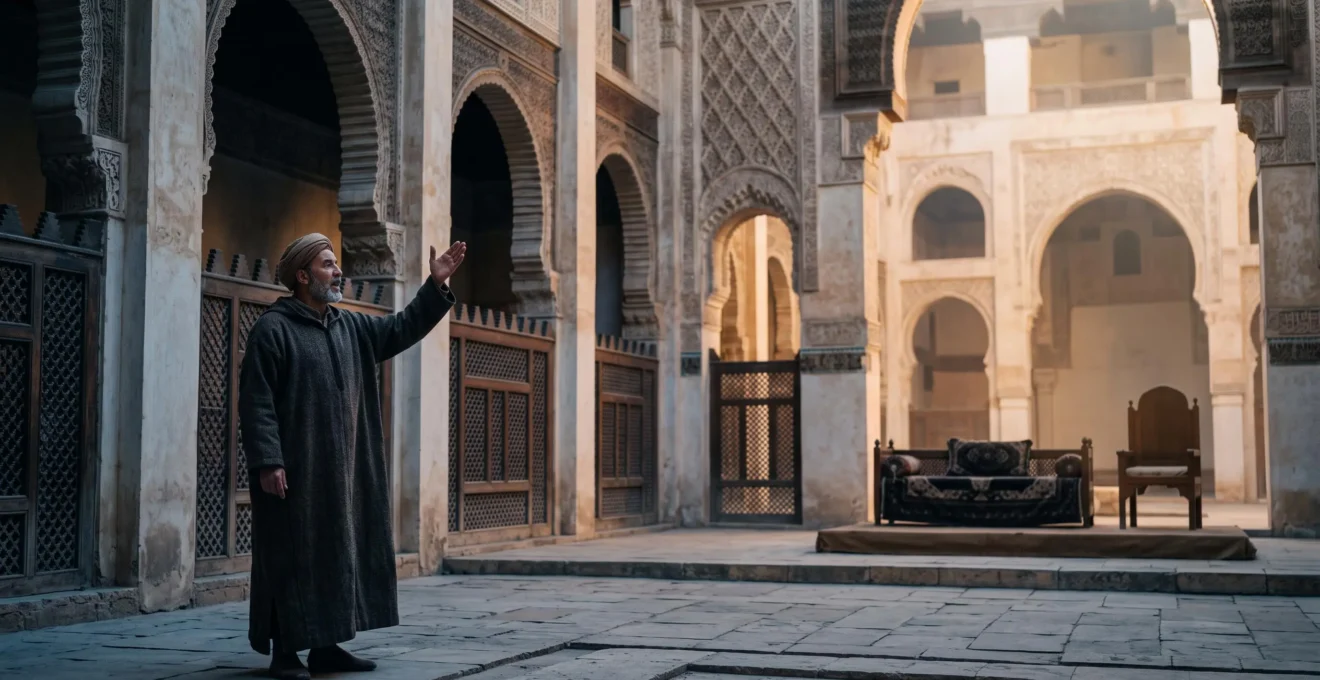
Contrary to popular belief, poets who criticized rulers didn’t just rely on clever metaphors; they survived by mastering a sophisticated system of plausible deniability that weaponized public opinion.
- Poetry operated on a dual frequency, delivering one message to the public and a deniable, alternative meaning to the court.
- Execution was often not a result of the critique itself, but a poet’s strategic miscalculation of their ruler’s tolerance or the strength of their rhetorical shield.
Recommendation: Analyze historical political verse not merely as art, but as a high-stakes strategic communication, where survival depended on controlling the narrative.
The image of a court poet walking a tightrope between patronage and peril is a familiar one. How could a single individual, armed only with words, dare to critique a caliph who held the power of life and death in his hands? The common answer points to the use of allegory and satire, suggesting a simple game of hiding insults within flowery language. This view, however, barely scratches the surface of a far more complex and dangerous political art form. These poets were not just artists; they were masters of reputational warfare and strategic ambiguity.
The true genius of their survival lay not in hiding their message, but in making it deniable. They crafted verses that operated on a dual frequency: a clear, resonant signal understood by the populace, and a static-filled, ambiguous transmission that could be explained away innocently to the court censor. This was a world where a poem could spread faster than a royal decree and where public shame, skillfully deployed, could be a more potent weapon than a sword. The fall of a poet was rarely an accident; it was almost always the result of a strategic miscalculation—a failure to read the political climate or an overestimation of one’s own rhetorical shield.
This article deconstructs the tactical playbook of these poet-strategists. We will move beyond the simple idea of “hidden messages” to explore the precise mechanisms of plausible deniability, the role of poetry as a tool for political reform, and the critical inflection points that could turn a favored courtier into a condemned man. Understanding this high-stakes game reveals why, for centuries, the power of a poet’s words was considered as formidable as a general’s army.
To fully grasp the intricate strategies employed by these masters of verse, this article examines the key tactics and historical turning points that defined the relationship between poetry and power. The following sections break down how allegorical language shaped policy, how subversive messages were encoded in plain sight, and why poetry often proved a more influential—and dangerous—form of social criticism than direct prose.
Table of Contents: The Poet’s Gambit: A Study in Rhetorical Survival
- Why Did Allegorical Poetry Change More Policies Than Direct Petitions?
- How Did Poets Embed Subversive Messages That 10,000 Listeners Understood but Censors Missed?
- Poetry or Prose Treatises: Which Form of Social Criticism Influenced More Political Reforms?
- The Satirical Verse That Triggered the Execution of 12 Poets in One Night
- When Did Court Poets Switch From Praise to Satire: The 3 Strategic Inflection Points?
- The Satirical Poem That Cost Its Author His Life in 750 CE
- The Logical Proof That Got 12 Philosophers Executed for Heresy
- Why Did Arab Society Value Poets as Highly as Military Leaders for 1,500 Years?
Why Did Allegorical Poetry Change More Policies Than Direct Petitions?
Direct petitions and formal complaints were easily dismissed, filed away, or rejected by a ruler. They were singular, static documents that lacked popular momentum. Allegorical poetry, however, was a living, breathing form of political pressure. It operated not by formal request but by shaping the one thing a ruler could not completely control: public opinion and his own reputation. A well-crafted satirical poem, or *hijāʾ*, did not ask for a policy change; it made the existing policy a source of public shame for the ruler.
This form of reputational warfare was devastatingly effective because it bypassed official channels and spoke directly to the people in a medium they valued and could easily memorize and repeat. As noted in a historical analysis of the form, the power of words to shame and insult was a deeply ingrained and potent force in the culture. A ruler could ignore a petition, but he could not ignore the whispers and laughter of his own subjects, or the scorn of rival tribes, all repeating a verse that mocked his greed, cowardice, or foolishness. This public humiliation could incite unrest, damage alliances, and erode authority far more effectively than a stack of written grievances.
The 40-year poetic feud between the court poets al-Farazdaq and al-Jarir serves as a prime example. Their sustained exchange of over 100 satirical poems, known as the *naqa’id*, became a public spectacle that permanently defined the honor and reputation of both men and their patrons. It demonstrated that a prolonged poetic battle could shape public perception more durably than any single edict. Ultimately, a poem succeeded where a petition failed because it transformed a political issue into a personal contest of honor, a battleground where the ruler’s legitimacy was at stake.
How Did Poets Embed Subversive Messages That 10,000 Listeners Understood but Censors Missed?
The key to embedding subversive messages was not simply hiding them but constructing them with plausible deniability. The poet created a work that operated on two frequencies simultaneously. For the general audience, familiar with the political context and cultural cues, the critical meaning was crystal clear. For the censor or the ruler, the poet always maintained a defensible, “innocent” interpretation. This was achieved through several sophisticated rhetorical techniques.
Irony was a primary tool. A poet might praise a ruler’s “generosity” with such exaggerated language or in a context of known stinginess that the entire audience understood it as a critique of his greed. Another technique was the use of the “distant target,” where a poet would viciously satirize a historical figure or a rival clan, but the parallels to the current ruler’s actions were so obvious that the critique was unmistakable. When confronted, the poet could simply feign surprise: “My lord, I was speaking of the ancient tyrant X, not your magnificent self. How could anyone confuse the two?” This forced the ruler into a corner: to punish the poet would be to admit that the criticism fit.
However, this strategy was a high-wire act. Ambiguity could be turned against the poet. The case of Bashshar ibn Burd is a stark illustration. His relentless satirical attacks on Caliph al-Mahdi were thinly veiled. His enemies, unable to trap him on the ambiguous political content, reframed the attack. They seized upon his more controversial verses and had him charged with *zandaqa* (heresy). As one analysis details, his enemies capitalized on the controversy to secure his execution under a religious guise. By shifting the accusation from politics (which was deniable) to religion (which was not), they successfully eliminated a threat, proving that even the most skillful poet could make a fatal strategic miscalculation.
Audit Checklist: Deconstructing Poetic Subversion
- Points of contact: Identify the poem’s dual audiences (the public vs. the ruler) and the intended message for each.
- Collecte: Inventory the specific allegorical devices, ironic statements, and ambiguous phrasing used by the poet.
- Cohérence: Confront the verse with the known political context. Which of the ruler’s recent actions or known flaws is being targeted?
- Mémorabilité/émotion: Analyze the meter and rhyme. Is the structure engineered for easy memorization and oral transmission?
- Plan d’intégration: Map the poet’s network and the poem’s reception. Who amplified the message, and what was the ultimate outcome—reward, warning, or execution?
Poetry or Prose Treatises: Which Form of Social Criticism Influenced More Political Reforms?
While prose treatises offered space for detailed, logical arguments, it was poetry that wielded far greater influence over political realities and social reform. The reasons for this disparity are rooted in accessibility, dissemination, and the legal exposure of the author. A prose treatise was a weapon of the elite, for the elite. Poetry was a weapon of the masses, delivered by an expert.
The very nature of Arab society, with its strong oral tradition, gave poetry an unparalleled advantage. A couplet could be memorized by a traveler in a Damascus market in the morning and be recited in a desert camp hundreds of miles away by evening. It required no literacy, only a good memory. A prose treatise, on the other hand, was a cumbersome manuscript that had to be painstakingly copied by hand, its distribution slow and its audience limited to a small, literate class of scholars and administrators. The speed and reach of poetry made it an infinitely more effective tool for mobilizing public sentiment.
Most importantly, poetry offered a shield of ambiguity that prose lacked. A political treatise makes direct claims and presents evidence, leaving its author completely exposed. As one academic source notes, for writers of prose, direct, provable charges of zandaqa (heresy) were common. Poetry, with its layers of metaphor and irony, provided the author with plausible deniability. This critical difference is best summarized in a direct comparison.
| Criterion | Poetry (Hija’ / Qasida) | Prose Treatises |
|---|---|---|
| Audience reach | Oral, memorizable, accessible to Bedouin and courtier alike | Restricted to the literate elite |
| Speed of dissemination | A couplet could spread across a city within a day | Circulation took months or years to copy and distribute |
| Legal exposure of the author | Shielded by ambiguity and plausible deniability | Direct, provable charges of zandaqa (heresy) were common |
| Historical documentation value | Considered one of the most direct sources for the propaganda and polemics of the revolutionary era | Fewer surviving critical political treatises due to systematic destruction |
The Satirical Verse That Triggered the Execution of 12 Poets in One Night
The title’s dramatic scenario of “12 poets executed in one night” serves as a powerful metaphor for the collective peril faced by satirists, even if historical records tend to focus on high-profile individual cases rather than mass executions. The underlying truth is that a single, poorly calculated verse could indeed be a death sentence. The line between celebrated critic and executed traitor was perilously thin, and crossing it was a matter of strategic miscalculation. The fate of the famous poet al-Mutanabbi is a classic example.
Al-Mutanabbi was a master of both praise and invective, but his sharp tongue ultimately led to his demise. After composing a particularly vicious satirical poem lampooning a tribal leader named Dabbah al-Asadi, he later had the misfortune of encountering the man and his retainers while traveling. According to legend, al-Mutanabbi initially tried to flee, but was shamed by his servant who reminded him of his own boastful verses about courage. Bound by his own poetic honor, he turned to fight and was killed. His death, as historian Tam Hussein notes, was a direct result of being “killed by a tribal leader whom he had previously lampooned.” He miscalculated the long-term consequences of his words and the likelihood of a personal, violent reprisal.
Similarly, the execution of Bashshar ibn Burd under Caliph al-Mahdi in 784 CE demonstrates a different kind of miscalculation. Bashshar’s satire was aimed at the highest level of power, and he likely believed his blindness and poetic genius offered him a degree of protection. But he underestimated the political shift under al-Mahdi, who was formalizing inquisitions to purge perceived threats to orthodox narratives. The Caliph used the pretext of heresy (*zandaqa*) to eliminate a politically troublesome poet. In both cases, the execution was not random but a direct consequence of the poet underestimating his target’s ruthlessness or the changing political landscape.
When Did Court Poets Switch From Praise to Satire: The 3 Strategic Inflection Points?
A court poet’s decision to switch from lucrative praise to risky satire was never arbitrary. It was a strategic choice driven by specific political and personal triggers. We can identify three primary inflection points where a poet might pivot from panegyric to polemic.
The first was the breakdown of the patron-client contract. A poet’s loyalty was often tied to the rewards and protection offered by their patron. If the patron failed to pay, offered insufficient rewards, or withdrew their protection, the poet might feel the contract was void. The pre-Islamic poet Tarafa is a cautionary tale. After gaining a position with a Lakhmid king, his “loose tongue” and critical nature soured the relationship, ultimately costing him his safety. Satire in this context becomes a tool of revenge or a warning to other potential patrons: “This is what happens when you fail to honor your poets.”
The second inflection point was dynastic change or political revolution. When a new power rose, poets were essential tools of propaganda. A poet formerly loyal to the Umayyad dynasty, for instance, might secure a position with the new Abbasid rulers by composing vicious satires against his former masters. As described by Arab America, a poet like al-Akhtal could be a fervent “propagandist of this dynasty,” who “praised the princes of Umayya and satirized their enemies.” The switch from praise to satire (or vice-versa) was a pragmatic career move, demonstrating loyalty to the new regime by attacking the old.
The third and most common trigger was inter-court rivalry. The court was a hotbed of factionalism, and poets were the primary weapons in these internal power struggles. A poet would rarely attack their own patron, but they would be handsomely rewarded for composing brilliant satires against their patron’s rivals, whether other courtiers, viziers, or even other poets. The legendary feud between al-Jarir and al-Farazdaq was fueled by the support of their competing patrons. Here, satire was not a rebellion against the system, but a vital, functioning part of it—a way of waging political battles without drawing swords.
The Satirical Poem That Cost Its Author His Life in 750 CE
The year 750 CE marks one of the most violent political transitions in Islamic history: the fall of the Umayyad Caliphate and the rise of the Abbasids. This was not a peaceful transfer of power but a bloody revolution where poetry played a central role as both an instigator and a justification for violence. For a poet aligned with the losing Umayyad side, a satirical verse aimed at the triumphant Abbasids was not just an act of defiance; it was suicide.
The Abbasid revolution had been fueled by a masterful propaganda campaign in which poetry was a key weapon. As historian Tam Hussein explains, the movement “had started with people reciting invective verses against the Umayyad dynasty.” These poems painted the Umayyads as decadent, impious, and illegitimate, paving the way for a new, righteous leadership. The Abbasid leader who seized power, Abu al-Abbas, was given the epithet al-Saffah, “the Blood-Shedder,” a title he earned by systematically eliminating his predecessors.
The climax of this purge was the infamous “Massacre at the Banquet.” Al-Saffah invited the remaining eighty leading members of the Umayyad clan to a banquet under the guise of reconciliation. Partway through the meal, his soldiers entered, clubbed the Umayyads to death, and laid leather sheets over their still-groaning bodies to continue his own feast. In this atmosphere of near-total extermination, any poet who dared to satirize the new regime was not making a political statement but signing their own death warrant. Their art, which had been a tool of power for the Umayyads, now marked them for death. To satirize al-Saffah was to fundamentally misread the man and the moment, a fatal error in a zero-sum game of dynastic survival.
The Logical Proof That Got 12 Philosophers Executed for Heresy
While the title speaks of “12 philosophers,” it points to a crucial distinction that often meant the difference between life and death: the difference between ambiguous poetry and direct prose. While poets could often talk their way out of trouble, prose writers who engaged in direct political criticism found themselves with no rhetorical shield. Their logical proofs became their indictments.
The case of Ibn al-Muqaffa’, executed around 759 CE, is the archetypal example. He was not a poet but a brilliant translator, scholar, and high-level administrator who wrote influential treatises on statecraft and ethics. His writing was clear, logical, and direct. In his role as an advisor, he advocated for reforms and offered critiques of power that, while elegantly phrased, were unambiguous. This transparency was his undoing. Under Caliph al-Mansur, Ibn al-Muqaffa’s influence and critical stance were perceived as a political threat. The Caliph couldn’t execute him simply for giving advice, so he used a more powerful tool: the charge of *zandaqa*.
As legal history scholars have noted, while poets might treat the accusation of heresy with a certain frivolity, in the hands of the state, to be a zindiq was an offense punishable by death. For a prose writer like Ibn al-Muqaffa’, there was no allegorical interpretation to fall back on. He could not claim his carefully constructed arguments were merely “entertainment” or “irony.” His logic was the proof of his crime. The charge of heresy was simply a legal pretext to eliminate a political opponent whose criticism was too direct and too effective. His fate sent a clear message to other would-be reformers: logic and reason are no defense against absolute power. For that, you need the ambiguity of a poem.
Key Takeaways
- Poetic critique was a form of reputational warfare, using public shame as a political lever more effective than formal petitions.
- The survival of a satirical poet depended on their mastery of plausible deniability, creating a dual-frequency message for the public and the court.
- Execution was often a consequence of a poet’s strategic miscalculation of their target’s ruthlessness or the political climate, not just a response to the satire itself.
Why Did Arab Society Value Poets as Highly as Military Leaders for 1,500 Years?
The immense value placed on poets in Arab society for over a millennium stems from their original role, which was far more than a mere entertainer or artist. In the pre-Islamic era, the poet, or *sha’ir*, was considered a shamanic figure, a conduit to the supernatural world. This perception laid the foundation for the poet’s enduring status as a vital strategic asset to the tribe, on par with its greatest warriors.
According to the Literature and History podcast, the pagan Arab poet was believed to be in contact with a spirit or *jinn*, enabling him to create what was called *al-sihr halal*, or “legitimate magic.” This “magic” was the power of the word: to bless the tribe and ensure its prosperity, to curse its enemies and bring about their ruin, and to immortalize the tribe’s great deeds in verses that would be remembered for generations. The poet was the tribe’s chief propagandist, historian, and moral authority rolled into one. A powerful poet could enhance a tribe’s prestige more than a thousand camels.
This valuation was formalized in institutions like the great festival at ‘Ukaz, which functioned as a kind of poetic olympics where tribes showcased their best poets to win prestige. As society evolved and empires rose, the form changed but the function remained. The caliph’s court replaced the tribal gathering, but the poet’s role as a weapon in political and reputational warfare continued. They were the shapers of public opinion, the kingmakers and the king-breakers. A general could win a battle, but a poet could win the war for legitimacy that followed. This deep cultural reverence for the power of the spoken word is why the poet’s voice was, and often still is, considered as mighty as the sword.