Contrary to the belief that they were mere storytellers, the great pre-Islamic poets were social engineers wielding verse as a formidable technology of power.
- The most celebrated poems, the Mu’allaqat, were not just artistic triumphs but a curated canon that formed the bedrock of Arabic literary identity.
- Poets like Imru’ al-Qais and al-Khansa could forge immortal legacies, alter political alliances, and command a level of influence comparable to military leaders.
Recommendation: To truly grasp their significance, one must view their poetry not as passive chronicles, but as active instruments that shaped the history and cultural consciousness of the Arab world.
In the vast, shifting sands of pre-Islamic Arabia, long before the written word became the vessel of history, a different kind of power held sway. This was the age of the poet, a world where memory was the only archive and the spoken word was the ultimate currency. It is easy to think of these figures as simple bards or entertainers, chronicling the life of the tribe. This view, however, misses the profound reality of their role. These were not just artists; they were the architects of society, the guardians of lineage, and the wielders of a potent force that could build reputations, shatter alliances, and grant a form of immortality that has endured for over a millennium.
The true genius of these poets lay in their mastery of a sophisticated “poetic technology.” Their verses, meticulously crafted and delivered with immense gravitas, were functional tools. A poem could be a declaration of war, a peace treaty, a legal argument, or a branding campaign for an entire tribe. But what of the works that transcended their immediate context? This brings us to the legend of the Mu’allaqat, the seven “Hanging Odes” said to have been so perfect they were inscribed in gold and suspended within the Kaaba at Mecca. While the historical accuracy of this tale is debated, its symbolic power is undeniable. It speaks to a body of work so foundational, so revered, that it became the constitutional document of the Arabic literary soul.
This exploration will delve into the lives and legacies of these masters of the spoken word. We will uncover how a failed prince like Imru’ al-Qais engineered his own legend to become the archetypal poet-king, and how a poetess like al-Khansa commanded a different, but equally potent, emotional authority. We will examine the very mechanisms by which a single poem could function as an instrument of statecraft, capable of preventing wars or redrawing the political map. By understanding these poets, we understand not just the origins of Arabic literature, but the deep cultural DNA that continues to value the power of the word as highly as the power of the sword.
This article examines the lives, works, and enduring influence of these foundational figures. The following sections will guide you through the world of the pre-Islamic poets, from the canonization of their greatest works to their living legacy in the 21st century.
Summary: Who Were the Pre-Islamic Poets Whose Works Remained Sacred for 1,400 Years?
- Why Were the Mu’allaqat Considered the Greatest Poetry Ever Written in Arabic?
- How Did Imru’ al-Qais Transform From Failed Prince to Arabia’s Most Famous Poet?
- Al-Khansa or Imru’ al-Qais: Which Poet Wielded Greater Cultural Influence?
- The Poetry Contest That Prevented a War Between 20,000 Warriors
- When Did Poets Perform Original Compositions: The 3 Occasions That Demanded Novelty?
- Why Could a Single Poem Change Political Alliances and Start Tribal Wars?
- Why Did Allegorical Poetry Change More Policies Than Direct Petitions?
- Why Did Arab Society Value Poets as Highly as Military Leaders for 1,500 Years?
Why Were the Mu’allaqat Considered the Greatest Poetry Ever Written in Arabic?
The legendary status of the Mu’allaqat, or “The Suspended Odes,” is often attributed to the romantic tale of them being hung in the Kaaba. However, their true sacredness in the literary canon stems from a more deliberate act of cultural preservation. They represent the first and most influential attempt to create a definitive anthology of pre-Islamic poetic genius, a “greatest hits” collection that would define the aesthetic and thematic standards of Arabic poetry for all time. These poems, or *qasidas*, were not chosen at random; they were seen as the unparalleled exemplars of the form, mastering complex meters, rich imagery, and profound emotional depth.
The act of canonization is largely credited to the 8th-century scholar Hammad al-Rawiya (“Hammad the Reciter”). His authority to undertake such a monumental task was legendary in itself. Early Islamic accounts claim that, when tested by the Umayyad caliph, Hammad could recite an astonishing 2,900 qasidas from the pre-Islamic era from memory. This feat established him as the ultimate living archive of an oral tradition on the verge of being lost. As the 10th-century grammarian Ahmad ibn Muhammad al-Nahhas explained, this curation was a conscious act to combat cultural amnesia.
“when Hammad al-Rawiya saw how little men cared for poetry, he collected these seven pieces”
– Ahmad ibn Muhammad al-Nahhas, Commentary on the Mu’allaqat
This image of intricately woven golden threads evokes the legend of the Mu’allaqat being written in gold, a metaphor for their immense value.
Therefore, the Mu’allaqat were not just considered great; they were strategically positioned as the foundational pillars of a literary civilization. They were the benchmark against which all future poets would be measured, a perfect distillation of the Jahiliyyah (pre-Islamic) spirit—its fierce pride, its deep melancholy, its reverence for the desert, and its obsession with honor and legacy. Their greatness lies as much in their intrinsic quality as in their role as the curated starting point of Arabic literary history.
How Did Imru’ al-Qais Transform From Failed Prince to Arabia’s Most Famous Poet?
Imru’ al-Qais ibn Hujr al-Kindi is more than a historical figure; he is the archetypal poet of the Jahiliyyah, the “Wandering King” whose life of tragedy, exile, and poetic brilliance became a legend in itself. His transformation from a disgraced prince of the Kindah tribe to Arabia’s most celebrated poet is a masterclass in using verse to engineer one’s own immortality. Cast out by his father for his scandalous poetry and lifestyle, he roamed the deserts of Arabia, seeking alliances to avenge his father’s later assassination and reclaim his lost kingdom. He ultimately failed as a prince, but his journey of hardship became the raw material for his poetic triumphs.
His Mu’allaqa, which famously begins with the line “Halt, you two, and let us weep, for the memory of a beloved and her abode,” established the quintessential structure of the *qasida*. It moves from the melancholic remembrance of a lost love’s abandoned campsite (*nasib*) to descriptions of his horse, the hunt, a stormy night, and his own amorous exploits. This wasn’t just a poem; it was a carefully constructed persona. He presented himself as a defiant, tragic, yet heroic figure, a man who had lost everything but his honor and his unparalleled gift for words. It was this self-mythologizing that captured the imagination of the Arab world.
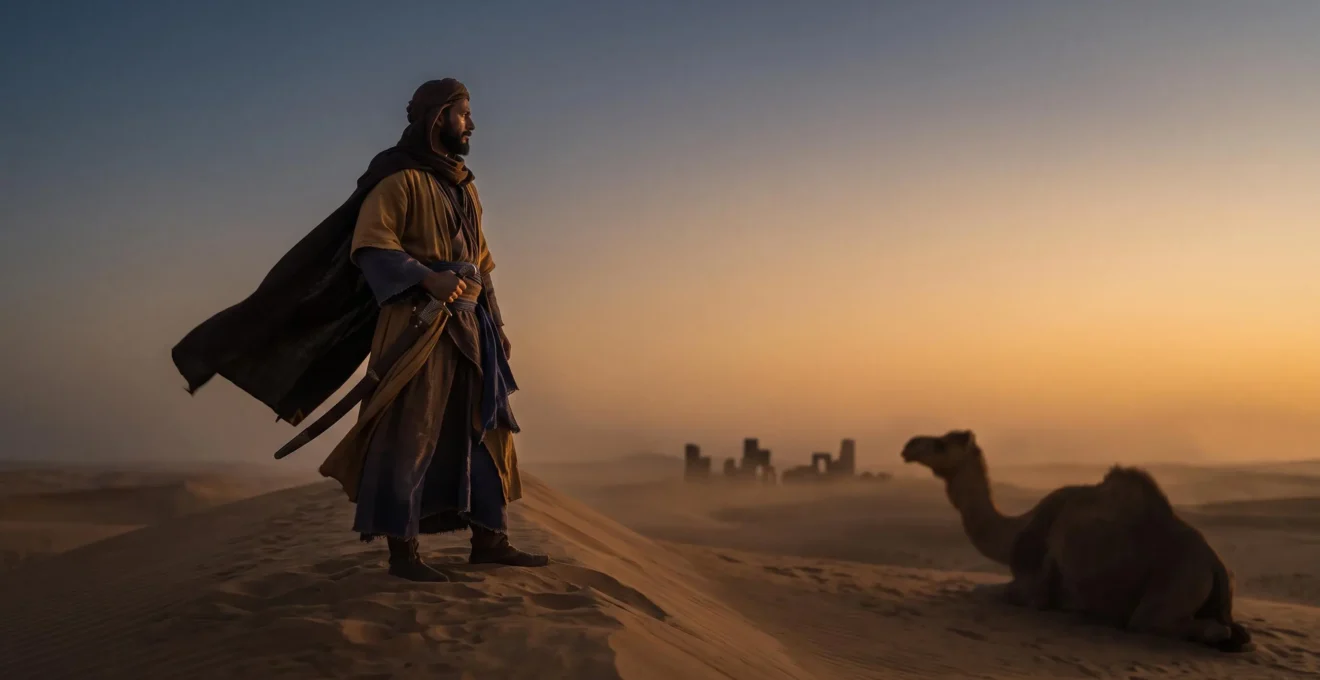
The portrait of a solitary, defiant figure in the desert captures the essence of Imru’ al-Qais’s legendary persona as the ‘Wandering King’.
The success of this “poetic technology” is staggering. Imru’ al-Qais crafted a narrative so powerful that it transcended his own culture and lifetime. His legend outgrew his failures, becoming a symbol of poetic genius itself. This is a clear case of a poet using his art not just to reflect his life, but to actively shape how he would be remembered for eternity.
The Legend Beyond Arabia: Imru’ al-Qais in Tuareg Tradition
An academic study on archaic Arabic poetry notes that the semi-legendary figure of the pre-Islamic poet Imru’ al-Qays is known among the Sahelian Tuareg, who quote him in their poems and stories as a cultural hero credited with inventing poetry and the Tuareg alphabet. This demonstrates how his self-constructed legend as the ‘Wandering King’ outgrew Arabia itself, traveling across cultures and centuries as a testament to the power of his engineered immortality.
Al-Khansa or Imru’ al-Qais: Which Poet Wielded Greater Cultural Influence?
Comparing the influence of Imru’ al-Qais and Tumadir bint ‘Amr, known as al-Khansa, is to compare two different models of poetic power. Imru’ al-Qais represents the *fakhr* (boasting) and adventurous spirit of the Jahiliyyah, a builder of personal and tribal myth. Al-Khansa, on the other hand, stands as the undisputed master of *ritha’*, the elegy. Her influence was not one of political maneuvering or epic narrative, but of profound emotional authority that resonated so deeply it is said to have moved the Prophet Muhammad to tears.
Al-Khansa’s life was defined by the loss of her two brothers, Sakhr and Mu’awiya, who were killed in tribal conflicts. She channeled her immense grief into her poetry, dedicating almost her entire output to mourning them. Her elegies were not merely personal laments; they became the gold standard for the genre, perfecting its themes of noble loss, the virtues of the deceased, and the unflinching expression of sorrow. The sheer volume of her work that has been preserved is a testament to her dominance; of her poetic output, it is estimated that nearly 1,000 surviving lines are almost all elegies. She did not just participate in the genre of elegy; she owned it.
While Imru’ al-Qais’s influence was extensive, shaping the very structure of the *qasida*, al-Khansa’s was intensive, defining the emotional core of an entire genre. Accounts from early Islamic tradition highlight the immense respect she commanded. One of the most powerful testaments to her impact is found in a frequently cited account of the Prophet Muhammad’s reaction to her work: “He (PBUH) cried when he listened to her elegies she wrote for her two brothers.” This emotional validation from the central figure of the new Islamic era solidified her legacy in a way that was unique and arguably more intimate than the heroic legends of her male counterparts.
So, who wielded greater influence? It is a matter of perspective. Imru’ al-Qais built an empire of the imagination, a sprawling legend of the poet-adventurer. Al-Khansa, however, conquered the human heart. She demonstrated that the power of poetry lay not just in boasting of glory but in giving voice to the most universal of human experiences: grief. In this, her influence is perhaps more timeless and deeply felt.
The Poetry Contest That Prevented a War Between 20,000 Warriors
The great annual fairs, such as the one at Souk Okaz near Ta’if, were the epicenters of pre-Islamic cultural, economic, and political life. These were not mere marketplaces but grand arenas where treaties were made, alliances were forged, and, most importantly, poets battled for supremacy. A poetry contest at Souk Okaz was the Arabian equivalent of the Olympic Games and a Supreme Court rolled into one. The winning poem would be celebrated across the peninsula, and its author would bring immense honor—a form of cultural capital—to his tribe. This reputational economy was so powerful that it could even serve as a substitute for armed conflict.
The 40-year-long War of Basus, a devastating conflict between the Bakr and Taghlib tribes, is a prime example of poetry’s role in both fueling and resolving conflict. The war left an indelible mark on the Arab consciousness; a peer-reviewed study of Arabic poetry found the conflict was referenced across a corpus of roughly 27,000 poems from the pre-Islamic era to the fifteenth century. Yet, it was often at gatherings like Souk Okaz that such tensions could be channeled into non-violent contests. Legend holds that on the brink of a major battle, with tens of thousands of warriors assembled, a poetic duel was proposed. The poets of the opposing tribes, including the great Amr ibn Kulthum and al-Harith ibn Hilliza, recited their Mu’allaqat. The power of their verse and the judgment of the arbiters were so respected that they were able to de-escalate the situation and prevent further bloodshed, at least temporarily.
The vast, open setting of an ancient marketplace gathering illustrates the public stage upon which poets performed and shaped tribal destinies.
This demonstrates that poetic duels were not entertainment; they were a form of verbal warfare and high-stakes diplomacy. A poet’s ability to praise his own tribe’s virtues (*fakhr*) and satirize its enemies (*hija’*) was a direct assault on the rival’s honor and standing. Winning a poetic contest could achieve what a military victory could: an enhancement of status and a demoralization of the enemy. In a society built on honor and reputation, losing a war of words could be as devastating as losing a battle of swords.
How Poetic Feuds Reshaped Tribal Power
The long-term impact of conflicts like the Basus War went beyond simple casualties. Historical retellings of the conflict note that the war contributed to changing the balance of power among the Arab tribes, as some tribes became more powerful and influential as a result of their alliances during the war. The poetic duels and rallying verses tied to such conflicts did more than entertain—they were instruments that redrew the map of tribal alliances for generations to come, illustrating the real-world political consequences of this poetic technology.
When Did Poets Perform Original Compositions: The 3 Occasions That Demanded Novelty?
In an oral culture, repetition is key to preservation. Poets would recite their masterpieces and those of their predecessors time and again. However, certain high-stakes occasions demanded not the recitation of a classic, but the composition of a completely new, original poem tailored to the moment. The poet’s ability to improvise or quickly compose a powerful new piece was a critical measure of his skill and value. Three specific occasions, in particular, called for this novelty, where a “stock” poem would be seen as inadequate or even insulting.
The first was for a praise poem (*madih*) celebrating a new tribal chief or a new political alliance. When a leader ascended or a crucial pact was made, the tribe’s poet was expected to commemorate the event with a fresh composition. This poem would extol the virtues of the new leader, articulate the benefits of the alliance, and broadcast the tribe’s strength and wisdom to all who listened. It was a public relations act and a historical record rolled into one, and its originality signaled the unique importance of the event.
The second occasion was the elegy (*ritha’*) for a recently fallen leader or hero. While a poet might have a repertoire of general elegies, the death of a prominent figure demanded a personalized lament. This new poem had to capture the specific qualities and deeds of the deceased, magnifying the tribe’s sense of loss while cementing the hero’s honorable legacy. To use an old poem would be to diminish the individual’s significance. Al-Khansa’s fame, for instance, was built on the powerful, original elegies she composed for her brothers.
Finally, a novel composition was required for a direct poetic challenge or rebuttal (*hija’*). If a rival poet insulted one’s tribe or leader, a response was non-negotiable. This response had to be swift, sharp, and custom-made to dismantle the specific arguments and insults of the opponent. It was a live debate where the poet acted as the tribe’s champion. Failing to produce a compelling, original rebuttal was a sign of weakness and a victory for the rival, with tangible consequences for the tribe’s reputation and honor.
Why Could a Single Poem Change Political Alliances and Start Tribal Wars?
To understand how a mere sequence of words could ignite wars or broker peace, one must grasp the concept of *’asabiyya’*. Popularized later by the historian Ibn Khaldun but a core principle of pre-Islamic life, *’asabiyya* refers to social solidarity, group consciousness, and the powerful bonds of loyalty within a tribe. It was the engine of tribal identity and survival. And the primary fuel for this engine was poetry. The poet was the chief custodian and promoter of his tribe’s *’asabiyya*.
A poet’s verse functioned as a powerful technology for social engineering. Through praise poems (*fakhr*), a poet would construct and broadcast his tribe’s public image. He would artfully list its military victories, the generosity of its chiefs, the purity of its lineage, and the bravery of its warriors. This wasn’t just empty boasting; it was a strategic act of nation-branding in an oral culture. A strong reputation, built and maintained by a skilled poet, attracted allies, deterred enemies, and ensured the tribe’s honorable place in the complex social hierarchy of the peninsula.
Conversely, the genre of satire (*hija’*) was a weapon. A powerful satirical poem could dismantle a rival tribe’s *’asabiyya* by mocking its ancestry, accusing it of cowardice or stinginess, or highlighting a past humiliation. Such an attack was not a personal insult but an assault on the collective honor of the entire group. In a society where honor was the most valuable commodity, such a public shaming demanded a response—often a violent one. A single, devastatingly effective poem could so damage a tribe’s standing that war became the only means to restore its lost honor.
Poetry as the Engine of Tribal Identity and Rivalry
A scholarly analysis of pre-Islamic poetic tradition explains that classical Arabic poetry played a powerful social role in Arab society, particularly during the pre-Islamic period, due to its high level of eloquence. *’Asabiyya* occupied a central position as a means of constructing and preserving tribal identity through language, as poets exalted their own tribes and disparaged rival ones through persuasive, emotionally charged expression. This confirms that verse functioned as a genuine instrument of political alignment and conflict, not mere entertainment.
Thus, a poem could change alliances because it could fundamentally alter a tribe’s perceived value and strength. A masterful poem could persuade a neutral tribe that an alliance would be beneficial, or it could so thoroughly disgrace an opponent that its existing allies might abandon it. The poet was not just a reporter of political reality; he was a creator of it.
Why Did Allegorical Poetry Change More Policies Than Direct Petitions?
While the bold satire of *hija’* was effective between rival tribes, a different, more subtle tool was required when a poet wished to influence his own leader or a powerful patron: allegory. Directly petitioning or criticizing a king or tribal chief was fraught with peril. It could be perceived as insolence, a challenge to authority that could result in punishment or exile. Allegorical poetry offered a brilliant solution, allowing a poet to deliver a critical message or unwelcome advice without causing the leader to lose face. This was a sophisticated form of political communication.
An allegorical poem would use a symbolic narrative—a story about animals, a journey through a mythical landscape, or a fable—to mirror the political situation at hand. For example, instead of telling a chief that his top advisor was treacherous, a poet might compose a tale about a noble lion being misled by a cunning jackal. The parallels would be clear to the discerning listener, especially the chief himself, but they were not explicit. This indirection was crucial. It gave the leader the space to understand and act on the advice without having to publicly admit he was being corrected or criticized.
This method was effective because it respected the rigid hierarchies of honor. The poet was not seen as insubordinate, but as a wise counselor offering a riddle for the chief to solve. It flattered the leader’s intelligence while delivering the necessary critique. This “plausible deniability” allowed a ruler to change a policy or dismiss a courtier based on the poet’s allegorical warning, while outwardly claiming the decision was his own initiative. It was a political masterstroke that preserved the honor of all involved, making the advice far more likely to be accepted than a blunt, direct petition.
The poet, in this role, acted as a “loyal opposition,” using the artifice of poetry to navigate the treacherous currents of court politics. Allegory was a technology of influence, a way to speak truth to power in a society where a direct confrontation could be fatal. It was the subtlest weapon in the poet’s arsenal, and often the most effective for enacting internal change.
Action Plan: Auditing a Message for Allegorical Potential
- Core Message: Clearly identify the sensitive policy or behavior you wish to critique and the powerful individual it concerns.
- Symbolic Vehicle: Brainstorm a suitable allegorical framework (e.g., a natural phenomenon, an animal fable, a historical parallel) that can carry the message without being too obvious.
- Weave Parallels: Map the key elements of the real situation (people, events, consequences) onto the characters and plot points of your chosen allegory.
- Ensure Deniability: Review the allegory to ensure the parallels are subtle enough to be denied if challenged. The message should be a discovery for the listener, not an accusation.
- Assess Impact: Consider if the allegorical conclusion gently guides the target toward the desired policy change or action, presenting it as a wise and natural outcome.
Key takeaways
- The Mu’allaqat are not merely legendary poems but a deliberately curated canon, an anthology designed by scholars like Hammad al-Rawiya to establish a definitive foundation for Arabic literature.
- Poets like Imru’ al-Qais were masters of self-mythology, using their verse as a technology to engineer an immortal legacy that transcended their personal failures and geographical borders.
- Poetry was a functional political and social tool; through concepts like ‘asabiyya’, a single poem could construct a tribe’s reputation, destroy a rival’s honor, and directly influence war and peace.
Why Did Arab Society Value Poets as Highly as Military Leaders for 1,500 Years?
The valuation of the poet as a figure equal to—and at times more critical than—a military leader is one of the most defining characteristics of Arab civilization. This was not a romantic notion but a practical reality rooted in the function of the poet within the tribe. While a general could win a battle, only a poet could ensure that the victory would be remembered for generations. In an oral society, memory is power, and the poet was the master of that domain. He was the tribe’s historian, propagandist, and chief diplomat. A military leader controlled the present; a poet controlled the past and, therefore, the future.
The poet’s verse was the tribe’s living archive and its public voice. A victory forgotten was a victory that never happened. A lineage not praised in verse was a lineage without honor. A tribe without a great poet was invisible and vulnerable, regardless of its military strength. This deep-seated belief in the tangible power of the word has not vanished with the pre-Islamic era. It has evolved, adapted to new media, but its core principle remains astonishingly intact. The reverence for the poet is a continuous thread running through 1,500 years of history.
Perhaps the most vivid modern illustration of this enduring legacy is the Emirati reality television show, *Million’s Poet*. This competition, where poets compose and recite Nabati (vernacular) poetry, is not a niche cultural program. It is a primetime phenomenon. The show’s grand prize is substantial, but the true reward is the title of “Poet of the Millions.” Demonstrating the immense cultural weight this role still carries, the long-running Million’s Poet competition draws about 17 million TV viewers across the region.
A Modern Souk Okaz: The ‘Million’s Poet’ Competition
The format of the ‘Million’s Poet’ show is explicitly rooted in ancient practice. The show is a Nabati vernacular poetry competition in which participants compose and recite poems, funded by the Abu Dhabi Authority for Culture & Heritage and inspired by the pre-Islamic poetry festival at Souk Okaz. This direct institutional lineage is not accidental; it is a conscious revival of the poet’s public, competitive role, showing that the poet’s status as a cultural champion is a living tradition, actively nurtured in the 21st century.
This modern spectacle is a direct descendant of the contests at Souk Okaz. The medium has changed from the desert encampment to the television studio, but the function is the same: to identify and celebrate the individual who can best capture the spirit of the people through the power of verse. This unbroken line shows that for 1,500 years, Arab society has continued to recognize that while armies can defend borders, it is the poets who define and defend the nation’s soul.
To truly understand the foundations of Arab culture, one must listen to the echoes of these ancient voices. Exploring the works of the Mu’allaqat and the poets of the Jahiliyyah is not just a literary exercise; it is an essential journey into the heart of a civilization that has always revered the power, beauty, and permanence of the spoken word.