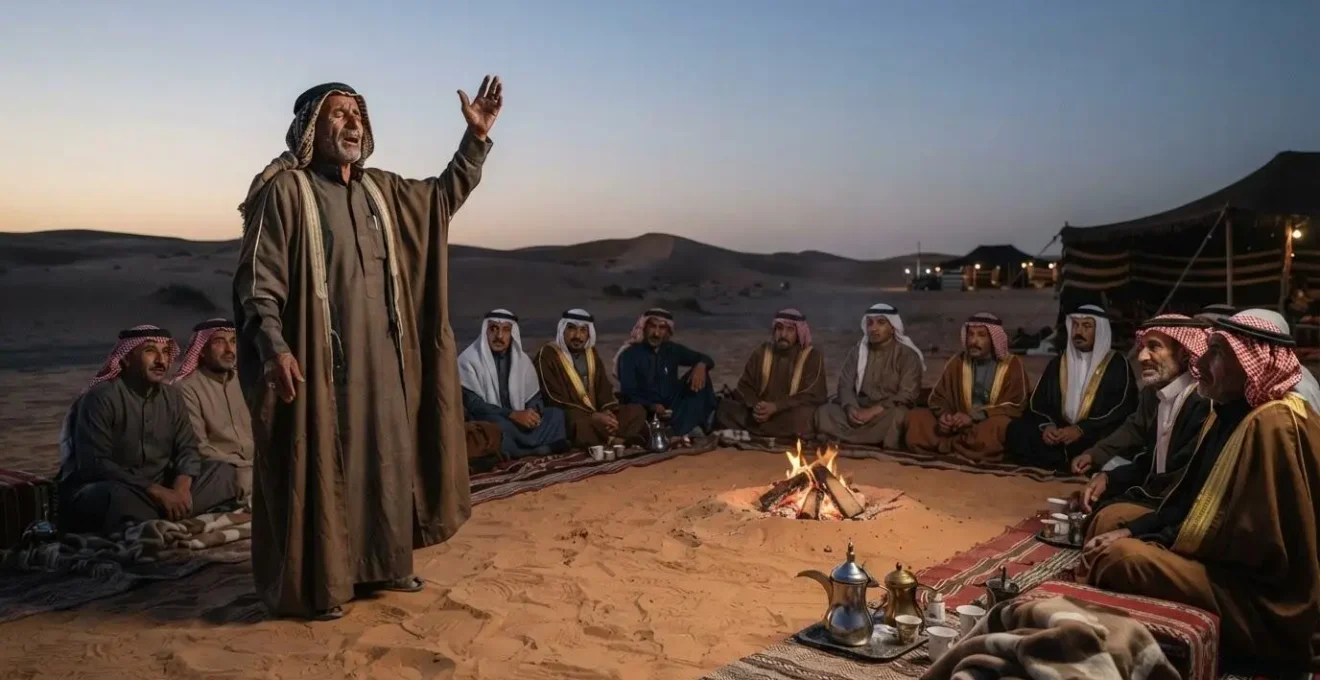
Contrary to the modern view of poetry as mere art, in Arab society it was a sophisticated social technology. For centuries, poets were not just entertainers; they were living archives, political negotiators, and weapons of psychological warfare whose words could build dynasties or shatter a tribe’s reputation. This article unpacks the functional, strategic power of verse that made a master poet as indispensable as a general.
In the modern world, we think of poets as solitary artists, crafting verses for personal expression or quiet appreciation. It’s difficult to imagine a poem starting a war or a poet being a king’s most trusted political advisor. Yet, for over 1,500 years in the Arab world, this was the reality. The poet, or shāʿir, was a central figure of immense power, a public voice whose words carried the weight of law, history, and destiny. Their social standing often equaled or even surpassed that of military commanders. To understand this phenomenon is to look past the aesthetics of rhyme and meter and see poetry for what it truly was: the primary information and social technology of its time.
This wasn’t simply about beautiful language. In a largely pre-literate society, a poet’s mind was the most reliable hard drive. Their mastery of complex meters was not just for show; it was a powerful mnemonic system, a cognitive archive capable of storing thousands of lines of tribal genealogy, battle histories, and legal precedents. Their public recitations were the era’s mass media, shaping public opinion and defining a tribe’s identity and honour. The idea that “poetry is the compendium of the Arabs,” or ash-shiʿr dīwān al-ʿarab, is not a metaphor; it’s a literal job description.
This guide delves into the mechanisms of that power. We will explore how a single satirical verse could be more devastating than a raid, how poets composed epics without writing, and how the shift from oral to written culture transformed poetry from a memory aid into a complex imperial art. Understanding this history reveals a world where language was not just descriptive but deeply functional, wielding a power we can barely comprehend today.
This article explores the specific functions and historical moments that defined the poet’s unique role in Arab culture. The following sections will guide you through the strategic, political, and technical dimensions of this powerful literary tradition.
Summary: The Poet’s Sword: Deconstructing the Strategic Power of Verse in Arab History
- Why Could a Single Poem Change Political Alliances and Start Tribal Wars?
- How Did Poets Memorize 10,000 Lines of Verse Without Writing Them Down?
- Pre-Islamic Orality or Abbasid Written Poetry: Which Era Produced More Formal Innovation?
- The Satirical Poem That Cost Its Author His Life in 750 CE
- When Did Poets Deploy Satire Versus Praise: The 4 Strategic Moments?
- Why Were the Mu’allaqat Considered the Greatest Poetry Ever Written in Arabic?
- Why Does Arabic Prosody Distinguish 16 Meters While English Uses Only 5?
- Who Were the Pre-Islamic Poets Whose Works Remained Sacred for 1,400 Years?
Why Could a Single Poem Change Political Alliances and Start Tribal Wars?
In the pre-Islamic Arabian Peninsula, a poet’s tongue was his tribe’s most potent weapon. A poem wasn’t just a collection of words; it was a public act with real-world consequences, capable of cementing an alliance or destroying a rival’s reputation. This power was most evident in the genre of satirical poetry, known as hijāʾ. Far from simple mockery, hijaʾ was a form of reputational warfare designed to dishonor an opponent, question their lineage, accuse them of cowardice, or expose their weaknesses to a wide audience. In a culture built on honor (sharaf) and public standing, this was a devastating blow.
This is because poetry served as the primary medium for public relations and political discourse. A praise poem (madih) could elevate a sheikh to legendary status, while a well-aimed satire could render him a laughingstock, making it impossible to command respect or forge alliances. As one analysis notes, in the context of intertribal strife, the satire (hijāʾ) was the shāʿir’s most potent form of magic and was considered “equivalent to warfare itself.” A tribe’s military strength was of little use if its social standing had been publicly dismantled by a rival poet.
The poet was, in essence, a minister of information and a weapon of psychological operations rolled into one. Their verses could incite a tribe to battle by reminding them of past glories (fakhr) or shame them into action. Conversely, a poem could de-escalate a conflict by providing a non-violent outlet for aggression. Contests between poets at annual fairs like ‘Ukaz were a substitute for armed conflict, allowing tribes to test their strength and assert dominance through verbal, rather than physical, combat.
The impact of these verbal battles was lasting. A successful satire would be memorized and spread across the peninsula, permanently damaging a tribe’s legacy. Therefore, a poet capable of defending his tribe’s honor and attacking its enemies was not a mere luxury but a strategic necessity, as vital to survival as a strong warrior. A single, powerful poem could achieve what an army could not: the complete social and political neutralization of an enemy.
How Did Poets Memorize 10,000 Lines of Verse Without Writing Them Down?
The image of a pre-Islamic poet holding a vast library of verse in their mind seems almost superhuman today. This feat was not a product of simple rote memorization but of a sophisticated cognitive and social system built for an oral culture. The core of this system was the relationship between the master poet (shāʿir) and their apprentice, the rāwī (reciter). According to the Encyclopaedia Britannica, the rāwī’s role was clear: one or more rāwīs attached themselves to a particular poet and learned his entire body of work by heart, ensuring its transmission to the next generation.
However, this was not just about memorizing a fixed text. Groundbreaking research applied the Parry-Lord oral-formulaic theory to classical Arabic poetry, revealing a more dynamic process.
Michael Zwettler’s Study on Oral Tradition
In his landmark work, Michael Zwettler argued that early Arabic poetry was not recited from a static, memorized script. Instead, he proposed that poets engaged in oral-formulaic composition. This means they constructed verses in real-time during a performance, drawing from a shared cultural reservoir of metrical patterns, stock phrases, and thematic structures. This “toolbox” of formulas allowed for both improvisation and adherence to tradition, making each performance unique yet recognizable. The poet was less a walking book and more a master improviser working within a complex rule set.
This system was enabled by the rigid structure of Arabic prosody. The complex meters and monorhyme scheme of the classical ode (qasida) acted as powerful mnemonic devices. The strict rhythm and repetitive end-rhyme created a predictable framework, making it easier to compose, remember, and identify errors in transmission. This structure was the “software” that ran on the “hardware” of the human mind, creating a highly effective system for storing and retrieving information without the need for writing.
Therefore, the memorization of thousands of lines was a combination of three key elements: the dedicated apprenticeship of the rāwī, the cognitive scaffolding provided by strict metrical and rhyme schemes, and the dynamic process of composing-in-performance using a shared set of oral formulas. It was a living, breathing tradition, not a static archive.
Pre-Islamic Orality or Abbasid Written Poetry: Which Era Produced More Formal Innovation?
Comparing the formal innovation of the pre-Islamic (Jāhiliyyah) oral era with the literate Abbasid period is a complex task, as each was innovative in its own right, driven by different social and technological contexts. The pre-Islamic period saw the perfection of the qasida, a highly structured polythematic ode that was a marvel of mnemonic engineering. Its rigid monorhyme, strict meters, and conventional thematic progression (from the abandoned campsite to the final boast or praise) were innovations designed for performance and memorization in a world without text.
However, the advent of literacy and the urban, imperial context of the Abbasid Caliphate (c. 750–1258 CE) triggered a different kind of innovation. Poetry was no longer solely a tool for memory and tribal propaganda; it became a written art form, studied and refined in the salons of Baghdad. As a study on the development of satire notes, the new context of Islamic civilization and the procedure of urbanization provided a fresh impetus for poets like Jarīr and al-Farazdaq to compose their famous poetic duels (naqā’iḍ).
This shift from ear to eye fundamentally changed the nature of poetic craft. Rhetorical devices that once served a practical, mnemonic purpose were now free to evolve into purely aesthetic and intellectual ornaments.
From Jāhiliyyah to Badīʿiyyah: The Impact of Literacy
Research on Arabic rhetoric highlights how literacy transformed the art. In the oral era, figures of speech helped make verses memorable. Under the Abbasids, these same devices were “retooled” into the incredibly complex style known as badīʿ (“the new style”). This style was characterized by its dense use of puns, antitheses, and elaborate metaphors. Innovation was no longer about effective oral delivery but about demonstrating intellectual virtuosity and rhetorical complexity on the written page, reflecting the prestige of the Islamic empire.
While the pre-Islamic poets innovated the foundational structure of Arabic poetry, the Abbasid poets built upon that foundation to create a new kind of literary sophistication. The oral era’s innovation was functional and structural, perfecting a form for maximum impact in performance. The written era’s innovation was rhetorical and ornamental, exploring the full intellectual potential of the language itself. One created the engine; the other designed the intricate chassis.
The Satirical Poem That Cost Its Author His Life in 750 CE
While pre-Islamic poets engaged in fierce poetic battles, the conflicts rarely resulted in the execution of the poet. The shift to a centralized, imperial court under the Abbasid Caliphate changed the stakes. A poet’s satire was no longer directed at a rival tribe but could be aimed at the most powerful man in the empire: the Caliph himself. The case of Bashshar ibn Burd (d. c. 784 CE) is a stark illustration of how lethal this new form of political satire could be.
Bashshar was a brilliant and controversial poet of Persian origin, known for his modern style and sharp, often obscene, wit. He lived and wrote in Basra and Baghdad, and his talent earned him patrons, but his arrogance and relentless satire also made him powerful enemies. His fate was sealed when he turned his poetic attacks toward the ruling elite.
The Execution of Bashshar ibn Burd
Historical accounts confirm that the primary catalyst for Bashshar’s execution was his unceasing hijaʾ (satire) aimed at the Caliph al-Mahdi and his influential vizier, Ya’qub ibn Dawud. While his verses were politically damaging, his enemies cleverly used his more controversial and allegedly blasphemous lines to build a case against him not for treason, but for heresy (zandaqa). This strategy converted a political attack into a capital religious crime, leading to his flogging and death. It demonstrates a crucial shift: satire against the ruler’s inner circle could be lethally reframed as an attack on the faith itself.
This incident highlights a key difference between the tribal and imperial contexts. As Dr. Cory Jorgensen of George Washington University notes, in the pre-Islamic era, you worried about tribes fighting over poetry. In the Caliphate, however, the dynamic was different; satire became an intra-court political weapon. As he states, “In that era, in that place, you weren’t worried about tribes breaking out into open warfare over poetry.” The threat was no longer a tribal feud but a state-sanctioned execution for overstepping political boundaries.
Bashshar ibn Burd’s story is a powerful testament to the perceived power of poetry even in a literate, imperial age. His verses were seen as so dangerous to the stability and dignity of the regime that the only solution was to silence the poet permanently. A single man’s words were a threat to an empire.
When Did Poets Deploy Satire Versus Praise: The 4 Strategic Moments?
In the high-stakes world of tribal Arabia, the deployment of praise (madih) and satire (hijaʾ) was not a random artistic choice but a calculated strategic decision. These two forms of poetry were two sides of the same coin, used to manage a tribe’s most valuable asset: its reputation. In fact, a foundational text on the subject suggests that the two oldest kinds of verse were the hija’ (satire) and the fakhr (self-glorification), both born from the aggressive spirit of tribal life known as hamas.
Praise poetry was used to build social capital. A poet would compose a madih to extol the virtues of his own tribe’s chief—his generosity, courage, and wisdom—thereby enhancing the tribe’s collective honor. It also served as a diplomatic tool, offered to potential allies to forge bonds and signal respect. Satire, on the other hand, was a weapon used to deplete an enemy’s social capital. It was deployed to question a rival’s lineage, mock their lack of bravery, or ridicule their stinginess, effectively weakening them before any physical conflict could occur.
The annual fair at ‘Ukaz, near Mecca, was the primary theater for this poetic warfare. Here, tribes gathered not just for trade but to engage in public poetry contests that often substituted for open battle. The strategic deployment of poetry in this arena can be broken down into a clear sequence of actions.
Strategic Checklist: Poetic Warfare at the ‘Ukaz Fair
- Pre-emptive Strike: Compose and disseminate lampoons (hija’) to denigrate a rival tribe’s standing and morale before any direct confrontation.
- Enter the Public Arena: Exhibit poetic craftsmanship at organized contests, such as the ‘Ukaz fair, to reach the widest possible audience.
- Engage in Mock Battles: Use “mock battles in poetry” to escalate conflict and assert superiority in front of a shared audience, without resorting to bloodshed.
- Achieve War by Other Means: Leverage these poetic contests as a direct substitute for real wars, settling disputes and establishing dominance through verbal victory.
This framework shows that the choice between satire and praise was dictated by the strategic moment. Praise was for consolidation and alliance-building. Satire was for attack and dismantlement. The poet, as the master of both, was the tribe’s chief strategist, capable of waging and winning a war for reputation that was often more decisive than a war of swords.
Why Were the Mu’allaqat Considered the Greatest Poetry Ever Written in Arabic?
The Mu’allaqat, or “The Suspended Odes,” are a collection of pre-Islamic qasidas (odes) that have been revered for centuries as the pinnacle of Arabic poetry. The name is said to derive from the legend that these poems were so esteemed they were written in gold ink and hung on the walls of the Kaaba in Mecca. While the historicity of this legend is debated, it speaks to the immense cultural value placed upon them. They became the ultimate benchmark for linguistic purity and poetic excellence.
Their greatness stems from several factors. First, they represent the complete maturation of the oral qasida form. Each poem is a masterclass in structure, moving seamlessly through conventional themes—the lament at an abandoned campsite (nasib), the perilous desert journey (rahil), and the final boast (fakhr) or praise (madih). They are technically flawless, showcasing a total command of the complex meters and monorhyme that defined the oral tradition. The collection was a curated anthology, designed to preserve what was seen as the very best; its goal was to capture only a single example of the work of each of the so-called ‘seven renowned ones’.
Second, and perhaps more importantly, their status was cemented by a conscious act of canonization in the early Islamic era. This process was crucial for establishing a “linguistic gold standard” for the Arabic language, which was now the sacred language of the Quran.
Hammad al-Rawiya’s 8th-Century Canonization Project
The scholar Hammad al-Rawiya (d. 772 CE) was a pivotal figure in compiling and promoting the great odes of the pre-Islamic era. By creating this collection, he effectively fixed a body of work as the definitive model of poetic and linguistic perfection. This act of curation distinguished “pre-Islamic” poetry from the “Islamic” poetry of his own time and created a canon. This canon then became the central exhibit in later debates among Abbasid-era critics over whether the ancient desert poets or their contemporary, urban counterparts were superior.
The Mu’allaqat are not just great poems; they are cultural artifacts that stand at the very foundation of Arabic literary identity. They are considered the purest expression of the Bedouin spirit and the ultimate repository of the classical Arabic language in its most powerful form. Their canonization ensured they would be studied, emulated, and revered for the next 1,400 years as the sacred scripture of Arabic verse.
Why Does Arabic Prosody Distinguish 16 Meters While English Uses Only 5?
The difference in metrical complexity between Arabic and English poetry reveals a fundamental distinction in how each language structures rhythm. English meter is qualitative or accentual-syllabic, based on the pattern of stressed and unstressed syllables. This system gives rise to about five principal meters (iambic, trochaic, anapestic, dactylic, spondaic). In contrast, classical Arabic prosody, known as ʿarūḍ, is quantitative, based on patterns of long and short syllables, regardless of stress. This system is far more granular, allowing for a much larger number of distinct rhythmic patterns.
This highly sophisticated system was not a gradual development but was scientifically codified by the 8th-century linguist, Al-Khalil ibn Ahmad al-Farahidi. His analysis of pre-Islamic poetry was a monumental intellectual achievement. Al-Farahidi identified 15 distinct meters (buḥūr, lit. “seas”), and his student later added a 16th, creating the canonical 16 meters that have been the foundation of Arabic poetry ever since. This act of codification turned prosody into a genuine linguistic science.
Al-Farahidi’s Linguistic Science
A 2023 case study of Al-Farahidi’s work documents how he pioneered the field of phonology by systematically studying the constituent sounds of the Arabic language. As the study notes, his innovations in prosody and rhyme formed a genuine linguistic science built directly on the analysis of classical poetry. He didn’t invent the meters; he discovered and systematized the underlying mathematical and phonetic principles that the great oral poets had used intuitively for centuries. His work transformed an oral art into a formal, analyzable system.
The reason for this complexity lies in the function of poetry in an oral culture. The 16 distinct meters provided a rich and varied set of rhythmic templates that served as powerful mnemonic aids, making it possible to compose and retain vast quantities of verse. This complexity was not an arbitrary decoration but a functional requirement of the “cognitive archive” that poetry represented. The table below outlines the core differences between the two systems.
| Feature | Arabic Prosody (ʿArūḍ) | English Meter |
|---|---|---|
| Basic Unit | Long/short syllable patterns (sabab, watid) | Stressed/unstressed syllables |
| Measurement Type | Quantitative (duration-based) | Qualitative (stress-based) |
| Number of Canonical Patterns | 16 meters (buḥūr) | Commonly around 5 major meters (e.g. iambic, trochaic, anapestic, dactylic, spondaic) |
| Codifier | Al-Khalil ibn Ahmad al-Farahidi (8th century), completed by Al-Akhfash | Developed gradually through classical and Renaissance prosodic tradition |
Key Takeaways
- Poetry in Arab culture was a functional “social technology,” not just an art form, serving as a tool for political warfare, historical record-keeping, and social negotiation.
- The poet’s power stemmed from their role as a living “cognitive archive” in a pre-literate society, using complex meters as a mnemonic system to store vast amounts of information.
- Satirical poetry (hijāʾ) was a form of reputational warfare equivalent to military conflict, capable of dismantling a tribe’s honor and political standing.
Who Were the Pre-Islamic Poets Whose Works Remained Sacred for 1,400 Years?
The pre-Islamic poets, or the poets of the Jahiliyyah, are not just literary figures; they are the foundational patriarchs of Arabic literature. Their work established the themes, forms, and linguistic standards against which all subsequent poetry was measured for over a millennium. They were the original masters who perfected the qasida and whose names became synonymous with poetic genius. To speak of this era is to speak of titans whose legacy is woven into the fabric of the Arabic language itself.
Among the most celebrated of these figures is Imru’ al-Qais, often hailed as the father of Arabic poetry. According to tradition, he was the “first major poet in the pre-Islamic era” and the last king of the Kindah kingdom. His Mu’allaqa is a quintessential example of the form, a vivid and personal account of love, loss, and survival that set the template for generations to come. Other luminaries of this period include Tarafa, Zuhayr, and Antara ibn Shaddad, a warrior-poet whose life and verses became the stuff of legend.
These poets were more than just authors; they were the chroniclers and conscience of their people. Their collected works formed a comprehensive record of tribal life, capturing its values, conflicts, and worldview with unparalleled richness. This vital archival function is perfectly encapsulated in a famous Arabic saying.
There is a saying in Arabic – that ash-shiʿr dīwān al-ʿarab, or ‘poetry is the compendium of the Arabs.’
– Literature and History Podcast, Episode 112: Pre-Islamic Arabic Poetry
This statement is the key to understanding their sacred status. They were not merely artists but the creators and custodians of the collective memory of an entire people. Their verses contained everything: the genealogies of tribes, the details of famous battle-days (ayyām al-ʿarab), the nuances of desert life, and the moral codes that governed society. When Islam emerged, the Quran itself was revealed in a language that had been polished to perfection by these very poets. Their work thus became an indispensable resource for understanding the linguistic and cultural context of the holy text, granting them a form of protected, almost sacred, status that has endured for 1,400 years.
The enduring legacy of these poets is a testament to a time when words held tangible power and a single voice could shape the destiny of a people. Comprehending this tradition is not just a literary exercise; it is an insight into a worldview where art and strategy were one and the same, and the master of language was a true leader of men.