Arabic quarter tones are not an ornamental feature but a structural necessity, forming a psychoacoustic system that organises melody to evoke precise emotional states unattainable through Western harmony.
- The Maqam system uses 24 micro-intervals to build specific melodic pathways (jins), each with a distinct emotional character.
- Perceived “dissonance” is culturally conditioned; EEG studies show trained and untrained listeners process these intervals differently.
Recommendation: Musicians and researchers should analyse maqamat not as scales, but as modular emotional frameworks built on a different acoustic logic.
For a musician trained in the Western tradition, the sound of an Arabic quarter tone can be jarring. It exists in the space between the keys of a piano, a pitch that 12-tone equal temperament defines as an error. Yet, in the hands of a master oud player or vocalist, these micro-intervals are not mistakes; they are the very source of a profound emotional depth. The central question for any serious musician or acoustician is not *if* they sound different, but *why* they function so effectively as a vehicle for emotion, where Western music relies on other tools.
The common understanding is that Arab music simply has “more notes.” This view misses the fundamental point. The issue is not one of quantity but of systemic purpose. While Western music since the Baroque period has prioritised the vertical axis of harmony—using chord progressions to build and release tension—Arabic classical music has perfected the horizontal, melodic axis. Quarter tones are the foundational technology for this melodic system, known as the maqam (plural: maqamat).
This article moves beyond the surface-level observation that quarter tones exist. We will deconstruct the system they enable, comparing its psychoacoustic principles to those of Western chromaticism. We will analyse how these micro-intervals are not merely decorative but are the structural basis for a sophisticated technology of emotional expression. This is not about “exotic” sounds, but about a different, equally valid, and highly structured approach to organising musical sound to move the human spirit.
This exploration will provide a comparative framework, analysing how these two major musical traditions solve the same problem—the evocation of emotion—with fundamentally different acoustic and structural toolkits. The following sections break down this complex relationship between micro-intervals, musical structure, and emotional response.
Summary: Why Quarter Tones Are a Foundational Musical Technology
- Why Do Quarter Tones Evoke Emotions That Western Equal Temperament Cannot Reach?
- How Do String Players Adjust Finger Placement for Quarter-Tone Intervals?
- Quarter-Tone Scales or Western Chromaticism: Which Offers Greater Expression?
- The Intonation Error That Turns Quarter Tones Into Sour Dissonance
- When Should Musicians Use Quarter Tones Rather Than Standard Semitones?
- Why Does the Oud Produce Quarter-Tone Overtones Western Guitars Cannot Capture?
- Why Does Each Maqam Evoke a Precise Emotional State Instead of Generic Mood?
- How Does the Maqam System Organise Musical Emotion Into Structured Scale Families?
Why Do Quarter Tones Evoke Emotions That Western Equal Temperament Cannot Reach?
The emotional power of Arabic quarter tones stems from their ability to create shades of feeling that are simply unavailable in the 12-tone equal temperament system. While Western music conveys emotion primarily through harmonic tension and release (e.g., a dominant seventh chord resolving to a tonic), the maqam system uses melodic contour and micro-interval relationships to achieve a similar, yet more nuanced, effect. This cultivation of a specific emotional state through melodic development is known as tarab, a form of musical ecstasy or enchantment that is the aesthetic goal of performance.
This isn’t merely a subjective cultural phenomenon; there is a neurological basis for it. Research has shown that the brain processes microtonal intervals differently from the familiar semitones of the Western scale. For instance, a behavioural and EEG survey found that the processing of these sounds differs significantly between musicians accustomed to them and those who are not, suggesting a learned neural pathway for interpreting their emotional content. The quarter tone isn’t just a different frequency; it’s a trigger for a distinct psychoacoustic response.
The emotional palette is expanded from the primary colours of “happy” or “sad” (often associated with major and minor keys) to include complex states like yearning, nostalgia, wistfulness, or profound contemplation. A quarter tone can make a note sound “heavy” with sadness or give it a questioning, unresolved quality that a standard semitone cannot replicate. It allows a melody to lean into a pitch, creating a tension that is resolved melodically, not harmonically. As ethnomusicologist Anne K. Rasmussen notes, this is central to the entire aesthetic.
The concept of tarab gets to the very heart of Arab musical aesthetics.
– Anne K. Rasmussen, Worlds of Music, cited in ‘Music is Feeling: Tarab, a Phenomenon of Arab Musical Culture’ (Darin Kahel)
This microtonal vocabulary provides access to a higher resolution of emotional expression, built directly into the melodic structure itself, rather than being layered on top through harmony or dynamics.
How Do String Players Adjust Finger Placement for Quarter-Tone Intervals?
Executing quarter tones accurately on a string instrument demands a level of physical precision and aural skill fundamentally different from that required by fretted instruments. On fretless instruments like the oud or violin, the musician’s finger acts as a moveable fret. Finding a standard pitch in equal temperament is already a challenge of muscle memory and ear training; locating a quarter tone requires dividing that already small space with even greater accuracy.
The technique is not about finding one new, fixed point between two semitones. Instead, it involves a continuous muscular control over pitch, allowing for subtle slides (glissandi) and pitch bends that are integral to the melodic expression. The player doesn’t just land on a quarter tone; they often approach it from below or above, creating a sense of tension and emotional “weight” in the musical line. This requires an intimate, tactile knowledge of the fingerboard, where millimetres of movement translate into significant changes in intonation and emotional colour.
This physical act is guided by an internalised auditory map of the specific maqam being performed. The musician is not thinking “E-quarter-tone-flat” in the abstract. They are hearing the specific sound of that note within the context of the scale’s melodic pathway and reproducing it physically. The pressure, angle, and vibrato of the fingertip all contribute to the final expressive quality of the note. It is a deeply embodied form of musicianship where the physical gesture and the resulting sound are inextricably linked.
For Western musicians accustomed to the clear grid of a fretted guitar or a piano keyboard, this can be the greatest barrier. It requires abandoning the digital certainty of “on/off” pitches for an analogue world of continuous, nuanced intonation. The focus shifts from hitting the right notes to shaping the right melodic contours, with quarter tones serving as critical waypoints in that journey.
Quarter-Tone Scales or Western Chromaticism: Which Offers Greater Expression?
To compare the expressive potential of Arabic quarter-tone systems and Western chromaticism is to compare two different philosophies of musical organisation. It is not a question of which is “better,” but rather how they allocate their expressive resources. Western music organises its 12 semitones primarily for vertical (harmonic) expression, while the maqam system uses its 24 quarter tones for horizontal (melodic) expression.
Case Study: The 1932 Cairo Congress of Arab Music
To understand that micro-intervals are a core feature, one can look to historical analysis. An open research dataset from the 1932 Cairo Congress was used for a tuning analysis across various maqamat. The findings demonstrated that the microtonal intervals are not mere ornamental deviations from a simpler scale. Instead, they are a fundamental structural feature that defines the identity of each maqam and dictates its unique modulation patterns, operating on a logic entirely distinct from Western harmonic organisation.
In the West, emotion is often driven by the tension and release of chords. A simple C major melody can be made to sound joyful, melancholic, or tense depending on whether it is harmonised with C major, A minor, or G7 chords. The expressive power is located in the harmonic context. In the maqam system, the emotional character is built into the scale itself through its unique sequence of intervals, including quarter tones. The melody alone, through its specific contour and use of microtonal tension, carries the primary emotional weight.
This fundamental difference is best illustrated by a direct comparison of the two systems’ features.
| Feature | Arabic Maqam / Quarter-Tone System | Western Chromaticism |
|---|---|---|
| Octave division | 24 equal quarter-tone steps of 50 cents each | 12 equal semitone steps of 100 cents each |
| Primary expressive axis | Horizontal (melodic nuance within a single line) | Vertical (harmonic tension/release between simultaneous notes) |
| Typical performance context | Improvisation (Taqsim) built on a modular jins system | Structured composition and harmonic modulation |
| Notation precision | 24-tone notation is a practical approximation; finer microtonal nuance is passed down orally | Fully exact under 12-tone equal temperament |
Ultimately, neither system has a monopoly on expression. Western chromaticism excels at creating complex harmonic textures and large-scale architectural structures. The maqam system, conversely, excels at exploring the subtle, introspective emotional territory of a single melodic line, a journey made possible by the higher resolution of the quarter-tone scale.
The Intonation Error That Turns Quarter Tones Into Sour Dissonance
For an ear trained exclusively in 12-tone equal temperament, the first encounter with a quarter tone is often perceived as a mistake—a “sour” or “out-of-tune” note. However, the concept of “in tune” is not a universal acoustic absolute; it is defined by the internal logic of a musical system. In the Western system, being “in tune” means conforming to the precise frequencies of the 12-tone grid. In the maqam system, it means correctly navigating the specific melodic pathway (the sayr) of a given maqam, with its unique set of intervals.
A true intonation error in Arabic music is not the use of a quarter tone, but rather the misplacement of one. Playing a quarter tone where a semitone is expected, or playing a 60-cent interval instead of the prescribed 50-cent quarter tone, would be perceived as an error by a trained listener. Dissonance, in this context, is a deviation from a culturally learned expectation. This is supported by modern research.
For example, a clinical trial examining EEG responses to Maqam Saba, which is known for its tension-laden quarter tones, found that listeners from different cultural backgrounds process its intervals differently. What one listener perceives as a “sour” or dissonant sound, another, familiar with the maqam’s conventions, perceives as a source of powerful emotional tension and aesthetic beauty. The “error” is not in the soundwave itself, but in the listener’s interpretive framework.
Action Plan: Training Your Ear for Quarter-Tone Nuance
- Isolate the Interval: Listen to a quarter-tone drone against a root note, not in a complex melody, to familiarise your ear with the raw sound.
- Identify the ‘Lean’: Determine if the quarter tone pulls upward towards the next semitone or falls downward from it. Note the direction of its melodic tension.
- Vocalise the Pitch: Attempt to sing the micro-interval. Your vocal cords are inherently fretless and can help internalise the precise pitch.
- Contextualise in a Jins: Listen to the same quarter tone within its native 4-note tetrachord (jins). Observe how its emotional quality changes within this melodic context.
- Compare with Error: Use a digital tuner to play a note that is 20 cents sharp versus one that is 50 cents sharp (a true quarter tone). Train your ear to distinguish accidental error from intentional microtonal colour.
Therefore, a musician aiming to understand this music must retrain their ear to accept a new set of rules for consonance and dissonance. The sourness transforms into expressive tension once the listener understands the melodic grammar and learns to anticipate the resolution that follows.
When Should Musicians Use Quarter Tones Rather Than Standard Semitones?
The decision to use quarter tones is not an aesthetic choice layered on top of a melody; it is a foundational requirement for performing within a specific musical tradition. A musician uses quarter tones when they intend to perform music based on the maqam system, just as a jazz musician uses blue notes and swing rhythms to play jazz. To remove the quarter tones from a maqam is to destroy its identity.
Quarter tones are employed whenever the music aims for cultural and emotional authenticity within traditions like Arabic, Turkish, or Persian music. Each of these systems, while related, has its own unique set of scales (maqam, makam, dastgah) whose defining characteristics are their specific microtonal intervals. Performing Maqam Bayati without its characteristic neutral second (a three-quarter tone) would be like playing a minor scale with a major third; it would cease to be what it is.
The celebrated Iraqi musician Munir Bashir, known as the “King of Oud,” provides a compelling example. He built his international career as a solo concert artist by showcasing the expressive capabilities of the oud’s fretless neck. For Bashir, the ability to produce quarter tones was not a technical curiosity but the very heart of the instrument’s power to convey the deep emotional content of the maqamat. His performances demonstrated that these intervals are essential for conveying the authentic character of the music.
In a contemporary context, a composer or performer might choose to incorporate quarter tones for several reasons:
- To perform traditional repertoire: Authentically playing music from the Middle East, North Africa, and parts of Asia requires their use.
- For cross-cultural composition: Composers may use micro-intervals to fuse different musical languages, creating new hybrid sounds.
- To expand the emotional palette: Any musician seeking to break free from the constraints of 12-tone equal temperament can use quarter tones to introduce new shades of melodic expression, even in a non-traditional context.
The core principle remains: quarter tones are used when the musical goal is to access the specific melodic and emotional language that they uniquely enable.
Why Does the Oud Produce Quarter-Tone Overtones Western Guitars Cannot Capture?
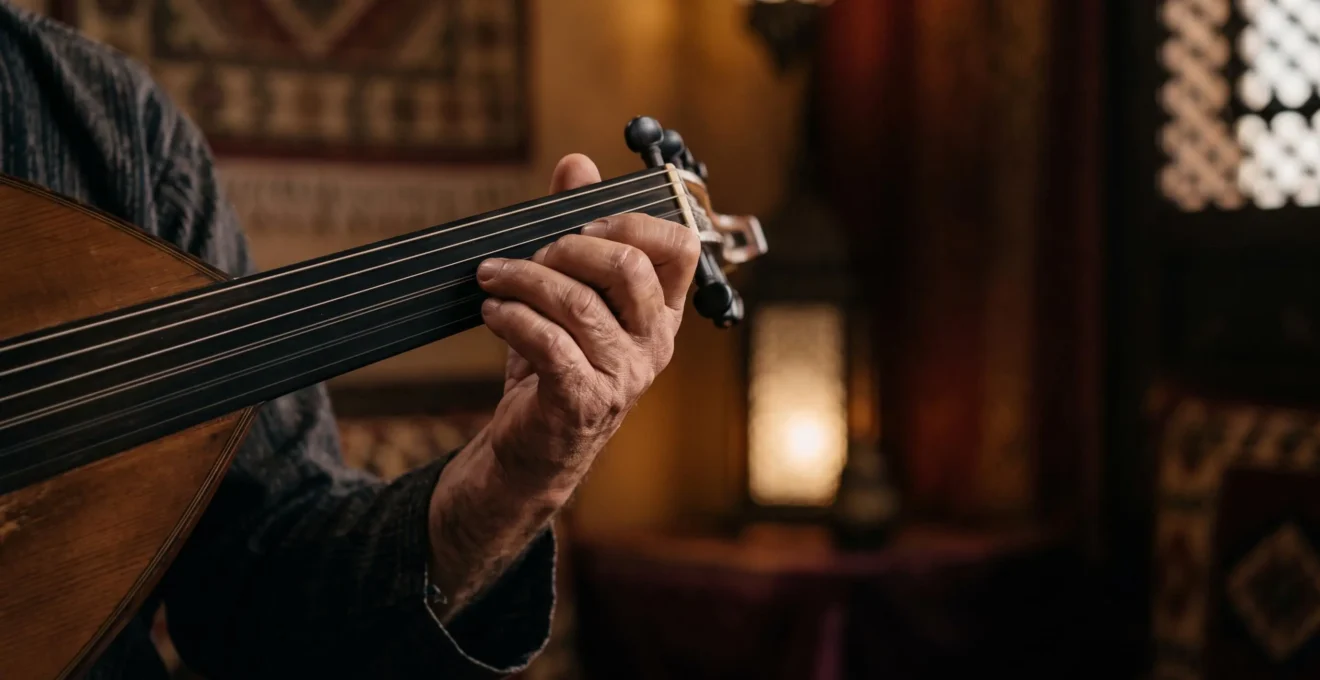
The ability of the oud to be the primary vehicle for quarter-tone music is not accidental; it is a direct result of its co-evolution with the maqam system. The most critical design feature is its fretless neck. Unlike a fretted guitar, which imposes the fixed grid of equal temperament onto the strings, the oud’s smooth fingerboard grants the player complete freedom over intonation. This design is not merely a feature but a prerequisite for a musical system built on microtonal nuance.
A Western fretted guitar is physically incapable of producing a true quarter tone on an open string or without bending the string. Bending allows for some pitch variation, but it is an unstable and imprecise method for the consistent, controlled micro-intervals required by maqam music. The oud, by contrast, is designed for this precision. The player’s finger can land on any point along the string, making the 50-cent interval as accessible as the 100-cent interval. This turns the entire neck into a continuous spectrum of pitch rather than a discrete set of notes.
Furthermore, the very concept of “tuning” an oud is different from a guitar. While guitars are standardized to E-A-D-G-B-E to facilitate common chord shapes, oud tunings are incredibly diverse and regionally specific. Arabic and Turkish traditions use different tunings, each optimised for the most common maqamat in their respective repertoires. This demonstrates a deep symbiosis: the instrument is tuned to serve the melodic needs of the system, and the system evolved to leverage the unique capabilities of a fretless instrument. The lack of frets is not a limitation but a liberation, enabling a different kind of musical complexity.
It’s important to note that the term “overtones” in the question’s context is slightly misleading. While the oud’s construction (pear-shaped body, floating bridge) does produce a rich and distinct timbre, the quarter tones themselves are fundamental pitches, not overtones. The instrument’s design is not about creating unique harmonics but about giving the musician direct, unmediated control over the fundamental frequency of the vibrating string.
Why Does Each Maqam Evoke a Precise Emotional State Instead of Generic Mood?
The remarkable emotional specificity of each maqam arises from its construction. A maqam is not simply a collection of notes like a Western scale; it is a set of rules for melodic development, built from smaller melodic units called jins (plural: ajnas). Each jins is a tetrachord (four notes) or pentachord (five notes) with its own unique sequence of intervals and, crucially, its own distinct emotional character.
For example, the jins that defines the Rast family of maqamat is considered to evoke feelings of pride, power, and soundness. The jins that defines the Bayati family is associated with joy, vitality, and femininity. The emotional character of a full maqam is created by combining two or more of these jins in a specific order. The starting jins (root jins) sets the primary emotional tone, and the subsequent jins create a melodic journey with a developing emotional narrative.
This modular structure is what allows for such precision. Instead of the broad-stroke moods of “major” (happy) and “minor” (sad), the maqam system offers a combinatory palette. A maqam might begin with a jins that feels grounded and stable, then modulate to one that is yearning and melancholic, before resolving back. The emotional journey is encoded directly into the melodic DNA of the maqam.
This is documented in resources cataloguing the system. For example, documentation by the National Library of Israel describes how specific maqamat are consistently associated with distinct qualities. This association is not arbitrary; it is a direct consequence of the psychoacoustic effect of their unique interval structures, which are built from these emotionally-charged jins. The quarter tones are essential here, as they are often the very intervals that give a jins its defining character, distinguishing it from all others.
Key Takeaways
- Quarter tones are the building blocks of the Maqam system, a framework for melodic development, not just a scale.
- The emotional goal of this system is tarab, a state of musical ecstasy achieved through melodic nuance.
- The perception of quarter tones as “dissonant” or “out of tune” is largely a culturally learned response to an unfamiliar tuning system.
How Does the Maqam System Organise Musical Emotion Into Structured Scale Families?
The Maqam system organises musical emotion by treating melodic fragments as modular building blocks. As discussed, these units are called jins. Rather than viewing an octave as a single, monolithic scale, the system sees it as a composite structure, typically formed by a lower jins and an upper jins. The genius of the system lies in how these blocks can be combined and interchanged to create a vast network of related melodic pathways.
It is a network rather than a scale.
– Johnny Farraj & Sami Abu Shumays, Inside Arabic Music: Arabic Maqam Performance and Theory in the 20th Century
A “family” of maqamat, such as the Rast family or the Nahawand family, is defined by a shared root jins. Maqam Rast, Maqam Suznak, and Maqam Mahur are all different, but they are all in the Rast family because they all start with Jins Rast on the tonic. They differ in their upper jins or other melodic characteristics, giving each a unique flavour while retaining the foundational “Rast” character. This creates a highly organised yet flexible system for navigating musical emotion.
This modularity makes a complex oral tradition more learnable. Modern educators have even developed visual systems to map this network. For example, oud educator Ramy Adly’s “Maqam Framework” assigns colours and codes to each jins, allowing students to visually track how these emotional “blocks” are used to construct different maqamat. This transforms the memorisation of hundreds of melodies into a pattern-recognition exercise.
To make this tangible, consider the distinct character of some of the most common root jins, which form the basis for entire maqam families.
| Jins (Tetrachord) | Associated Emotional Character | Typical Maqam Family Role |
|---|---|---|
| Nahawand | Deep emotion and passion | Root jins defining the Nahawand maqam family |
| Kurd | Open, airy, yearning quality | Root jins defining the Kurd maqam family |
| Bayati | Warmth associated with love and joy | Root jins defining the Bayati maqam family |
| Rast | Balanced, foundational, often ceremonial | Root jins defining the Rast maqam family |
The maqam system is thus an elegant solution to a complex problem: how to create a vast and emotionally specific musical language that is both highly structured and profoundly improvisational. It achieves this by organising emotion at the micro-level of the jins, allowing for near-infinite combinations at the macro-level of the performance.
To truly integrate this understanding, musicians and researchers must shift their perspective from the fixed pitches of a scale to the dynamic, emotionally-charged pathways of the maqam, a world where the notes between the notes tell the most important stories.