The Maqam system’s emotional power stems not from mystical moods but from a prescriptive musical grammar that dictates how feelings are developed, modulated, and resolved.
- Each maqam’s unique emotional character is encoded in its foundational building blocks (jins) and melodic pathway (sayr).
- Modulation between maqamat follows strict rules based on shared intervallic structures, creating a coherent narrative arc rather than a random sequence of scales.
Recommendation: To understand Arabic music, analyse a performance not for its scale, but for how the performer navigates the grammatical rules of its chosen maqam to build an emotional journey.
For students of music theory accustomed to the Western diatonic system, the first encounter with the emotive power of Arab music—perhaps through a classic Umm Kulthum performance—can be profound. The depth of feeling conveyed seems to transcend the technical; it feels raw, immediate, and deeply specific. It is common to hear that each maqam (the modal system underpinning the music) corresponds to a particular mood: Bayati for melancholy, Rast for pride, Saba for intense sadness. While a useful starting point, this “mood map” overlooks the sophisticated architecture at play.
This approach fails to answer the critical questions: How does a maqam generate such a precise emotional state? Why does a transition from one mode to another feel like a seamless narrative development rather than an abrupt key change? The answer lies in moving beyond the idea of maqam as a simple scale or mood. Instead, it must be understood as a complete, prescriptive grammar for melodic expression. This system provides a set of rules, building blocks, and pathways that guide composers and performers in constructing a coherent and powerful emotional arc.
This article deconstructs that grammar. We will explore how the intervallic “DNA” of each maqam defines its character, how performers navigate transitions using shared structural logic, and why certain melodic choices are considered grammatically correct while others are deemed errors. By analysing the system’s internal mechanics, we can begin to understand Arab music not as a collection of evocative sounds, but as a highly structured language of emotion.
This exploration will provide a clear analytical framework, moving from the specific emotional identity of a single maqam to the complex art of modulation and the foundational role of microtonality. The following sections break down this musical grammar piece by piece.
Summary: The Grammar of Emotion: How the Maqam System Structures Musical Affect
- Why Does Each Maqam Evoke a Precise Emotional State Instead of Generic Mood?
- How Do Performers Transition Between Related Maqams Without Losing the Audience?
- Maqam Bayati or Maqam Kurd: Which Fits a Melancholic Lyric Better?
- The Sudden Modulation Error That Breaks a Maqam’s Emotional Arc
- When Should Composers Introduce a New Maqam During Performance?
- Why Does the Oud Produce Quarter-Tone Overtones Western Guitars Cannot Capture?
- Quarter-Tone Scales or Western Chromaticism: Which Offers Greater Expression?
- Why Did Arab Musicians Develop Quarter Tones That Western Scales Reject?
Why Does Each Maqam Evoke a Precise Emotional State Instead of Generic Mood?
The specificity of a maqam’s emotional impact is not an abstract cultural association; it is a measurable phenomenon rooted in its unique structure and the listener’s cultural familiarity. A maqam is far more than a collection of pitches like a Western scale. It is defined by its sayr, or the prescribed melodic pathway a performer must follow. This pathway dictates which notes to emphasize, the typical melodic phrases to use, and the overall direction of the melodic contour, effectively creating a blueprint for expressing a specific affective state.
Scientific evidence confirms this is not mere subjective feeling. In a fascinating clinical trial, researchers used EEG to measure the brain activity of Arab and non-Arab listeners while they heard a classic melody in Maqam Saba. The results were telling: the culturally-familiar Arab listeners exhibited brain patterns consistent with sadness and deep emotional processing. In contrast, non-Arab listeners showed patterns suggesting a merely calming or relaxing response. This study, centered on Umm Kulthum’s “Howa Sahih El Hawa Ghalab,” provides quantifiable proof that a maqam’s structure can trigger measurably distinct neurological and emotional responses depending on the listener’s learned understanding of its musical grammar.
Therefore, the precision of a maqam’s emotion comes from this combination of a unique intervallic structure and a culturally ingrained understanding of its melodic grammar. The sayr acts as a set of instructions for navigating the scale’s notes to build a specific, recognisable emotional narrative. It’s the difference between having a vocabulary (the scale) and having grammar rules that allow you to form a coherent, meaningful sentence (the sayr).
How Do Performers Transition Between Related Maqams Without Losing the Audience?
Seamless modulation between maqamat is a hallmark of masterful Arab music performance, creating a rich and evolving emotional journey. This is not achieved by chance but through the logical manipulation of the system’s core building blocks. Each maqam is constructed from smaller melodic units of three, four, or five notes, known as a jins (pl. ajnas). A complete maqam scale is typically formed by stacking two of these ajnas on top of each other.
The key to smooth modulation lies in this shared “intervallic DNA.” Maqamat are grouped into families that share the same root jins. A performer can pivot from one maqam to another by treating a jins from the current maqam as the starting point for a new one. This shared melodic fragment acts as a bridge, making the transition feel like a logical development rather than a jarring shift. The pivot note where the lower and upper ajnas meet, known as the ghammaz, often serves as a natural point for such modulations.
A supreme example of this technique is found in Umm Kulthum’s monumental 1966 performance of “Al-Atlal” (The Ruins). The composer, Riad Al Sunbati, masterfully weaves a narrative that travels through a multitude of maqamat. An analysis of the composition shows how this epic journey unfolds: starting in Maqam Rast, it transitions to Hazzam, then Awj, before moving through a qanun solo in Rahat Al-Arwah and on to Bayati. Later, the piece shifts again from Nahawand back to Rast, then to Suznak, Shahnaz, and Kurd. This is not a disjointed medley but a continuous emotional narrative, made possible by the underlying grammatical logic of shared ajnas that connects each mode to the next.
Maqam Bayati or Maqam Kurd: Which Fits a Melancholic Lyric Better?
While both Maqam Bayati and Maqam Kurd can convey sadness, they do so with different shades of meaning, making the choice between them a crucial compositional decision. The selection depends on the specific character of melancholy the composer wishes to express, a choice deeply informed by the maqam’s intervallic structure and typical melodic development (sayr).
Maqam Bayati is perhaps the quintessential mode of intense, passionate, and often raw emotion. Its defining feature is the neutral second degree—a quarter-tone that lies between a minor and major second. This unstable, yearning interval gives Bayati its characteristic quality of longing and emotional gravity. It is the natural choice for lyrics expressing deep, painful yearning. For instance, in a famous ṭaqṭūqa performed by Umm Kulthum, the lyricist Ahmad Rami writes, “Longing has increased and separation hurts,” a sentiment perfectly matched by the intense, pleading character of Maqam Bayati, which is built on the foundational Jins Bayati.
In contrast, Maqam Kurd offers a different flavour of melancholy. Built on Jins Kurd, which is identical to the first four notes of the Western Phrygian mode, it has a more grounded, introspective, and sometimes gentler feel. While it can certainly be dark, it is also frequently used for feelings of romance and tenderness. A landmark example is Mohammed Abdel Wahab’s composition for Umm Kulthum, “Inta Omri.” This celebrated love song is composed in Maqam Kurd, typically used for feelings of freedom and romance. This demonstrates that Kurd’s structure does not lock a composer into a single register; its stable, minor-like foundation can support tender longing just as effectively as deep introspection, depending on how the composer shapes the melodic arc around it.
Ultimately, the choice is not about which is “more” melancholic, but which kind of melancholy is required. Bayati is for raw, visceral longing; Kurd is for a more introspective, tender, or even romantic sadness.
The Sudden Modulation Error That Breaks a Maqam’s Emotional Arc
In Arab music, a “wrong note” is often not just a matter of pitch but of grammar. A sudden or illogical modulation that breaks the established emotional arc is known as nashaz. This is not merely dissonance in the Western sense, but a structural violation that shatters the integrity of the maqam’s narrative. To a trained ear, it registers as a fundamental error in musical syntax.
The rules governing “legal” modulation are rooted in the system of maqam families. As previously discussed, maqamat are classified into families based on their shared root jins (the first tetrachord or pentachord). This root jins is the primary determinant of a maqam’s character. Smooth and grammatically correct modulations almost always occur between maqamat within the same family or to closely related families that share a common jins. The modulation typically pivots on the ghammaz, the final note of the first jins which also serves as the starting note of the second.
According to the grammatical framework of the system, maqamat are traditionally classified into families based on sharing the same root jins, which plays the largest role in defining their character. A nashaz error occurs when a performer abruptly jumps to a maqam from an unrelated family, ignoring the shared-jins logic. This is like changing the subject of a sentence mid-thought; the listener is left confused because the narrative continuity has been broken. This is why fretless instruments like the oud and ney are so central to this tradition; their ability to produce microtonal intervals is essential for navigating the specific intervallic pathways required for correct modulation.
Action Plan: Auditing Modulations for Structural Integrity
- Identify the Jins: Before modulating, clearly identify the upper and lower ajnas of both the source and target maqam.
- Find the Bridge: Locate the common jins that can act as a pivot point. Does the upper jins of your current maqam match the lower jins of your target maqam?
- Check the Ghammaz: Confirm that your modulation point is a logical pivot, typically the ghammaz of the source maqam. Avoid jumping from an arbitrary note.
- Analyse the Narrative Arc: Does the emotional character of the target maqam logically follow the source maqam? A shift from joy (Ajam) to deep sadness (Saba) needs careful preparation to avoid nashaz.
- Test the Transition: Improvise a short melodic phrase that explicitly connects the two maqamat through their shared jins to ensure the transition feels fluid and intentional.
When Should Composers Introduce a New Maqam During Performance?
In the maqam system, the timing of a modulation is dictated by narrative and emotional logic, not by the rigid metrical structures common in Western music. A new maqam is introduced at the precise moment the emotional arc of the piece demands a shift in feeling or perspective. This approach treats the musical work not as a static composition but as a dynamic, evolving entity.
This concept is eloquently described by Layth Sidiq, a Grammy-nominated violinist and composer. He explains that a fixed Western scale is a static set of pitches, whereas a maqam like Nahawand should be thought of as a living organism that develops and changes over the course of a performance. This powerful metaphor highlights why the introduction of a new maqam is an organic event. The composer or performer senses the moment when the current emotional state has been fully explored and a change is needed to advance the story, whether it’s a shift from introspection to passion, from joy to longing, or from tension to release.
This is the fundamental distinction between a pitch collection and a complete melodic system. As one resource succinctly puts it:
It’s a complete melodic framework, not a pitch set.
– Ethnic Musical, Maqam Explained: Arabic & Turkish Scales for Beginners
This framework includes not just the notes, but the rules for their use over time. Therefore, the decision of *when* to modulate is one of the highest arts of the tradition. It is not about reaching the end of a 16-bar phrase; it is about feeling the culmination of one chapter of the emotional story and knowing it is time to begin the next.
Why Does the Oud Produce Quarter-Tone Overtones Western Guitars Cannot Capture?
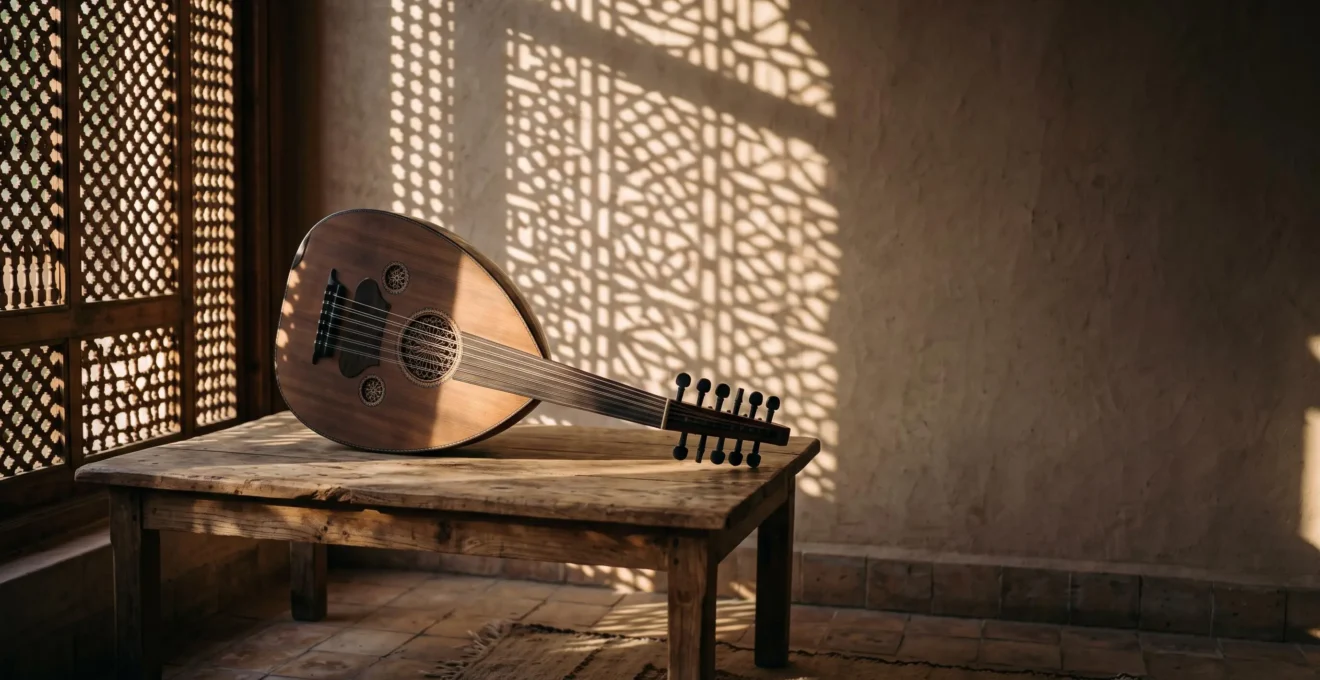
The ability of the oud to produce the subtle microtonal intervals essential to the maqam system is a direct result of its most defining physical characteristic: its fretless neck. Unlike a Western guitar, which has metal frets that predetermine a 12-tone equal-tempered scale, the oud’s smooth fingerboard allows the performer to stop the string at any point, enabling the precise intonation of intervals smaller than a semitone, commonly known as quarter-tones.
This design is not an accident but the result of a long co-evolution between the instrument and the musical theory it serves. The oud is an ancient instrument, with its origins tracing back over 5,000 years to Mesopotamia. This long history has been inextricably linked with the development of Middle Eastern modal systems. The very structure of the oud—its pear-shaped body, short neck, and most importantly, its fretless design—was refined over millennia to meet the expressive demands of maqam music. A case study on the instrument’s history notes that this design allows musicians to play microtones, giving them the ability to perform the wide range of maqamat that form the basis of Arab music.
As the image above illustrates, the unbroken surface of the fingerboard gives the musician complete control over intonation. This is why instruments with fixed pitches, like a standard piano or fretted guitar, “cannot faithfully reproduce the microtonal details of the maqam scale.” While they can approximate the general contour of a melody, they inevitably miss the specific intervallic shades of meaning that are encoded in the quarter-tones. The oud, therefore, is not just a tool for playing maqam music; it is an instrument whose very form is a physical manifestation of the musical system’s theoretical principles.
Quarter-Tone Scales or Western Chromaticism: Which Offers Greater Expression?
The question of whether quarter-tone systems or Western chromaticism offer greater expression is not a simple matter of counting the number of available notes. It is a debate about two fundamentally different philosophies of musical organization: one prioritizing expressive depth within a modal framework, and the other prioritizing harmonic breadth and standardized modulation.
The argument for quarter-tone systems, as used in maqam, is that the microtonal intervals are not merely decorative but are primary carriers of emotional identity. These subtle shades of pitch—the neutral seconds and thirds that fall between the cracks of the piano—are what give each maqam its unique character and expressive potential. They enable a richness and complexity of melodic nuance that is central to the Arab musical aesthetic. A reliance on a 12-tone equal-tempered system, by its very nature, smooths over these essential details.
This tension came to a head at the historic 1932 Cairo Congress of Arab Music. During this event, European and Arab musicians and theorists debated the future of Arab music theory. One of the key topics was the proposal to adopt a standardized 24-tone equal temperament system as a compromise between Arab tradition and Western influence. The fact that this system was even discussed, and faced both support and opposition, reveals the core of the debate. As one analysis of the period notes, while the use of intervals smaller than a semitone is a fundamental difference contributing to the unique qualities of Arab melodies, the growing influence of Western musical thought pushed for standardization. The debate, therefore, was between preserving the microtonal depth that gives each maqam its soul and adopting a standardized system that could more easily accommodate Western-style harmony and instrumentation.
Neither system is inherently “better,” but they are optimized for different goals. Western chromaticism excels at creating complex harmonic structures and facilitating modulation to any key. The maqam system, with its quarter-tones, excels at creating profound melodic depth and highly specific emotional narratives within a modal framework.
Key Takeaways
- Grammar over Mood: The maqam system is a prescriptive grammar for melodic development, not just a map of emotional moods.
- Jins as DNA: The emotional character of each maqam is encoded in its foundational building blocks (ajnas), which also provide the logic for modulation.
- Sayr as a Pathway: The prescribed melodic path (sayr) dictates how a maqam’s emotion is expressed over time, making it a dynamic framework, not a static scale.
Why Did Arab Musicians Develop Quarter Tones That Western Scales Reject?
The development of quarter-tones in Arab music was not a casual folk evolution but the result of a long and sophisticated intellectual tradition of mathematical and philosophical inquiry. While Western music evolved towards equal temperament to solve the problem of harmonic modulation, Arab music theory was focused on perfecting a system of melodic and rhythmic modes. This led theorists to systematically explore and codify the subtle intervallic relationships that lie between the notes of the Western chromatic scale.
This scholarly lineage dates back over a millennium. Figures like Al-Fārābī in the 10th century, hailed by some as a theorist who “remains unequalled,” laid the groundwork by applying principles of Greek mathematics and philosophy to the analysis of music. This tradition was formalized further by theorists who created complex, mathematically precise tuning systems. For instance, Safi al-Din al-Urmawi developed, in the thirteenth century, a 17-tone scale that became a theoretical standard across the Islamic world for centuries. This was not a primitive scale, but a highly sophisticated system derived from mathematical ratios.
This intellectual project continued into the modern era. In the 19th century, theorists like Mīkhāʾīl Mušāqa were instrumental in establishing the 24-tone equal temperament system that is now the theoretical standard for modern Arab music. This system was a deliberate effort to systematize the various neutral intervals used in practice into a coherent, overarching framework. The development of quarter-tones, therefore, should be seen as the product of centuries of sustained scholarly systematization aimed at maximizing melodic nuance, in direct contrast to the Western path of temperament which optimized for harmonic possibilities at the expense of pure intervals.
In essence, Arab musicians developed quarter-tones because their musical philosophy—focused on the expressive power of melody within a modal framework—demanded a higher degree of intervallic resolution than the 12 tones of the Western system could provide.
By understanding the maqam system as a prescriptive grammar, music theorists and performers can move beyond simple mood associations to a deeper appreciation of its structural elegance. The next logical step is to apply this framework by analysing specific performances, identifying the ajnas, tracking the modulations, and deconstructing how master musicians construct their profound emotional narratives.