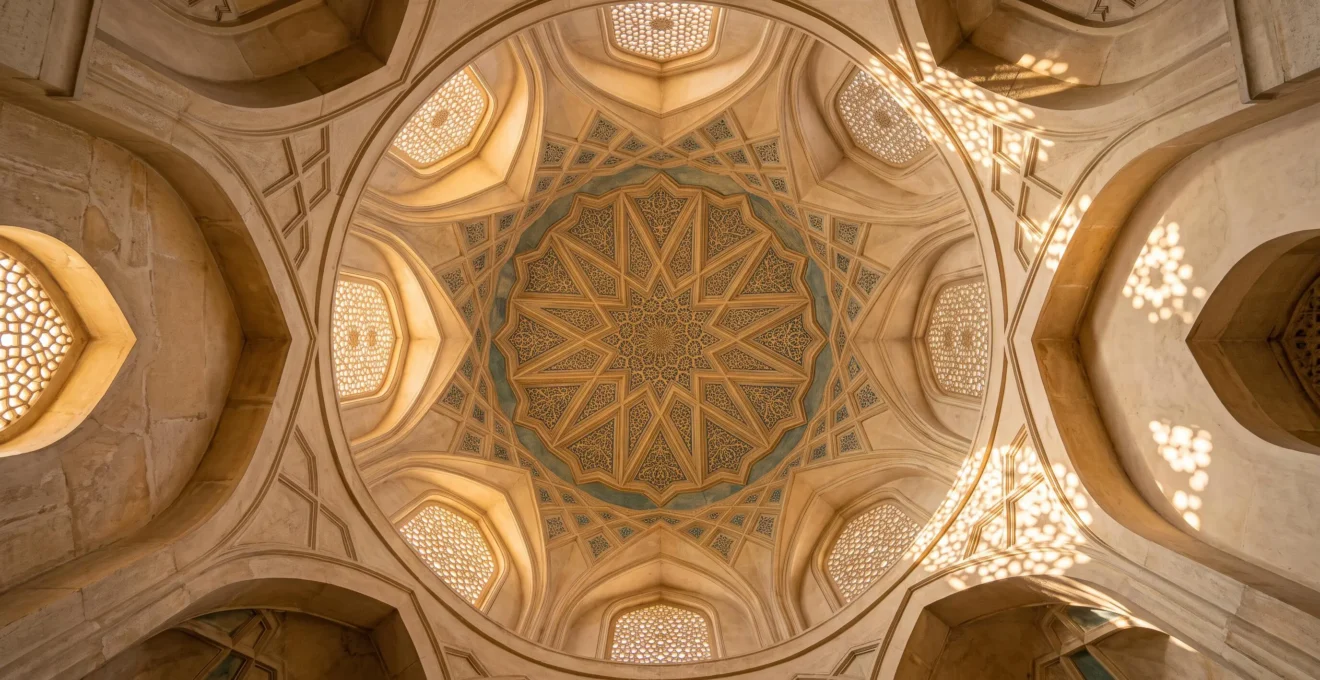
Islamic geometric patterns are not just decoration; they are a visual technology for mapping the infinite, using a mathematical grammar that pre-dates Western discovery by 500 years.
- They bypass the theological prohibition on figuration by using universal, abstract principles to represent the nature of divine unity.
- The system relies on a conceptual breakthrough using ‘girih tiles’, allowing for the creation of infinitely scalable, non-repeating patterns like quasi-crystalline tilings.
Recommendation: UK designers can study this living tradition at London institutions like The King’s Foundation or the V&A to create spaces of profound cultural and spiritual resonance.
To stand within the Jameel Gallery at the V&A or the Albukhary Foundation Gallery at the British Museum is to be confronted by a profound question. Before you, a wall of ceramic tiles from 15th-century Isfahan erupts into a starburst of breathtaking complexity. Your eye follows the lines, trying to find a beginning or an end, but there is none. The pattern repeats, yet feels infinite. It is purely mathematical, yet it evokes a deep sense of the spiritual. How can a system of lines and shapes, products of a compass and straightedge, achieve a sense of the divine that a depiction of the human form often cannot?
The common explanation points to aniconism—the avoidance of figural images in many Islamic contexts. While this is a foundational principle, it is not the complete story. This avoidance is not a creative restriction but a conceptual liberation. It forced artists and thinkers to develop an alternative visual language capable of expressing the ineffable, one grounded not in the transient forms of the created world, but in the eternal, universal truths of mathematics. These patterns are not merely ‘non-figurative’; they are ‘trans-figurative’, pointing towards a reality that figures cannot capture.
This article decodes this sophisticated visual system. We will explore the theological choice for abstraction, examine the precise craft behind its creation, and uncover the conceptual breakthrough that allowed medieval artisans to construct patterns of infinite complexity. For the UK-based designer, architect, or curious visitor, this is not just a history lesson; it is an introduction to a living design language, a visual technology for encoding spiritual mathematics into the very fabric of our built environment.
This exploration will delve into the specific principles and applications of this unique art form. The following sections will guide you through its theological underpinnings, its practical construction, its comparative strengths, and its relevance in contemporary architecture, offering a comprehensive view of why these patterns remain so powerful.
Summary: Decoding the Visual Language of Divine Unity
- Why Do 32-Point Star Patterns Symbolise Infinite Unity More Than Human Figures?
- How Do Craftsmen Build 32-Point Star Patterns Without Computer Tools?
- Geometric Patterns or Floral Arabesques: Which Decoration Lasts 500 Years Longer?
- The Compass Mistake That Ruins an Entire 16-Point Geometric Mosaic
- When Should Architects Apply Complex Patterns Versus Simple Grids?
- Why Did Islamic Artists Choose Mathematical Patterns Over Human and Animal Forms?
- Arabesques or Geometric Patterns: Which Decorates a Mosque Interior Better?
- How Do Geometric Patterns Express Infinite Divine Unity Through Finite Mathematics?
Why Do 32-Point Star Patterns Symbolise Infinite Unity More Than Human Figures?
The choice to prioritise geometric patterns over human figures is rooted in a profound theological concept: Tawhid, the indivisible oneness of God. A human figure, by its very nature, is finite, individual, and subject to time and decay. It represents a single, created being. To depict a sacred story through figures is to particularise it. In contrast, a 32-point star pattern offers a visual metaphor for the nature of God Himself: it is unified, infinitely extensible, and governed by principles that are eternal and universal. Each line and intersection is interdependent, forming a whole that is greater than the sum of its parts. There is no central focus, no narrative hierarchy; there is only the holistic and harmonious interplay of the entire system.
This abstraction avoids the theological problem of idolatry. As a guiding principle, Islamic ornament tends to avoid using figurative images, as it is forbidden to create a representation of an important Islamic figure according to many holy scriptures. This doctrine led artisans to a visual language that did not attempt to replicate the created world but instead pointed to the underlying order of the creator. A 32-point star is not a picture *of* something; it is a diagram *about* the nature of unity. It demonstrates how a single central point can radiate outwards, generating complexity and beauty while remaining intrinsically connected to its origin, a powerful metaphor for the relationship between the One and the many.
The resulting visual experience is one of intellectual and spiritual contemplation rather than emotional narration. Unlike a figurative scene that tells a specific story, the geometric pattern invites the viewer to meditate on the concepts of harmony, order, and infinity. It transcends cultural and temporal specificity, speaking a universal language of mathematics. This is why a star pattern on a 14th-century Mamluk minbar can feel just as relevant and powerful today—its message is not bound by the historical context of its creation, but by the timeless truths it represents.
How Do Craftsmen Build 32-Point Star Patterns Without Computer Tools?
The creation of these intricate patterns without digital aid seems almost miraculous to the modern eye, but it relies on a mastery of two simple tools: the straightedge and the compass. The process is not one of freehand drawing but of rigorous geometric construction. It begins with a circle, the symbol of unity, which is then divided into a set of equal points along its circumference—for example, 8, 10, 12, or 16. From these divisions, a foundational grid of intersecting lines and circles is generated. This grid, often invisible in the final work, contains all the information needed to outline the final star shapes and interlacing strapwork.
This is not merely a historical craft; it is a living tradition. In London, institutions like The King’s Foundation School of Traditional Arts carry this knowledge forward. Originally emerging from the Royal College of Art’s Visual Islamic and Traditional Arts programme, the school treats geometry as the absolute foundation of sacred craft. According to its philosophy, geometry sits at the heart of artistic traditions from around the world, and the School recognises geometry as the link between all the sacred and traditional arts. Students are trained not in software, but in the hands-on, methodical process of using a compass and ruler to build patterns from first principles, just as artisans have for centuries.
This methodology ensures perfect symmetry and proportion. Every angle and line segment is not arbitrarily chosen but is a direct consequence of the initial geometric divisions. The craftsman’s skill lies not in invention, but in the precise execution of this established grammar. This rigorous, rule-based approach is what gives the patterns their sense of inevitable, crystalline order. It’s a discipline of the hand and the mind, where the artisan becomes a participant in revealing the inherent order latent within the geometry itself.
Geometric Patterns or Floral Arabesques: Which Decoration Lasts 500 Years Longer?
Within the vocabulary of Islamic decoration, geometric patterns (girih) and floral arabesques (islimi) are two distinct but often intertwined modes of expression. While both are abstract and can be endlessly repeated, they operate on different conceptual registers. Arabesques are stylised representations of nature—vines, leaves, and flowers—symbolising growth, life, and the promise of paradise. Geometric patterns, by contrast, are born from pure mathematics and logic, symbolising the intellect, underlying cosmic order, and infinity.
The question of longevity is less about physical material and more about conceptual adaptability. While a floral motif is tied to a particular stylistic interpretation of nature, which can appear dated over time, a geometric pattern is based on universal mathematical truths. As a case in point from the V&A’s Jameel Gallery collection demonstrates, a contemporary mosque designer took the geometric design of historic tiles and played with the scale of its details, creating something entirely modern yet recognisably part of the same tradition. This ability to be reinterpreted without losing its core identity gives geometry a unique timelessness. The mathematical grammar remains the same, even if the accent changes.
This table summarises the fundamental differences in their conceptual basis and application, which are often found together in practice. Geometric designs in Islamic art are often built on combinations of repeated squares and circles, which may be overlapped and interlaced, as can arabesques, to form intricate tessellations, appearing in everything from tilework to metal screens.
| Dimension | Geometric Patterns | Floral Arabesques |
|---|---|---|
| Underlying basis | Universal mathematics (squares, circles, tessellation) | Stylised natural/plant forms |
| Typical combination | Often overlapped and interlaced with arabesques | Often combined with geometric frameworks |
| Materials seen in practice | Zellij tilework, muqarnas vaulting, jali screens | Carved plaster, woodwork, ceramics |
| Psychological register | Intellect, order, infinity | Growth, nature, paradise |
The Compass Mistake That Ruins an Entire 16-Point Geometric Mosaic
The sublime order of a finished geometric mosaic belies the unforgiving precision required at every stage of its construction. Unlike other art forms that might allow for expressive imprecision, a geometric pattern is a system. A single error at the foundational stage does not remain isolated; it cascades exponentially, throwing the entire composition into disarray. The most common and catastrophic failure occurs at the very beginning, with the master tools: the compass and the straightedge. A slipped compass, an inaccurate bisection of an angle, or an unequal division of the initial circle will result in lines that fail to meet and shapes that refuse to tessellate.
This isn’t just a problem for medieval artisans; the logic holds true in digital workflows. A misaligned vector node in Adobe Illustrator can create the same cascading failure as a physical compass point that has slipped by a fraction of a millimetre. The integrity of the entire pattern depends on the absolute accuracy of the initial grid. For any designer or architect attempting to work with this visual language, understanding these critical failure points is paramount. The beauty is not in the lines themselves, but in their perfect, mathematically determined relationships.
Mastering this craft involves internalising a strict sequence of operations where verification is key. Before a single piece of tile is cut or a final line is inked, the underlying construction grid must be flawless. The following checklist outlines the foundational steps where precision is non-negotiable, whether working on paper or on screen.
Your Action Plan: Foundational Steps Where Precision Cannot Be Skipped
- Begin with the mother circle: As classical methods show for a decagonal star, a circle is divided equally into 10, and every third vertex is connected by a straight line to create the star. This initial division is the pattern’s DNA.
- Verify all divisions: Before drawing any connecting lines, check that every division of the circle is perfectly equal. An error here will multiply across every subsequent star point.
- Lock and re-check the compass: A slipped compass radius is the most common source of error. Re-check it against the original circle’s radius before drawing each new arc.
- Bisect angles only after verification: Only bisect angles once the foundational grid is confirmed to be perfect. Bisection errors compound multiplicatively in a 16-point construction.
- Treat digital anchors with rigour: In digital workflows, treat the anchor points of the initial grid as you would a physical compass point; a single misaligned node will cause the same cascading failure.
When Should Architects Apply Complex Patterns Versus Simple Grids?
The choice between a complex, multi-pointed star pattern and a simpler, more regular grid is an architectural decision about the intended psychological effect of a space. It is not a question of ‘more is better’, but of ‘what is appropriate for the function?’ A simple grid of squares or orthogonal lines can create a sense of calm, stability, and rational order. It is grounding and easily comprehensible. A complex, radiating star pattern, however, does something different: it encourages the eye to wander, to get lost in its intricacies, and to contemplate the infinite. This makes it ideally suited for spaces intended for reflection, meditation, or spiritual gathering.
A superb contemporary example in London is the Aga Khan Centre in King’s Cross, designed by the celebrated Japanese architect Fumihiko Maki. Across its vast 11,000 m² across 10 storeys, the building masterfully employs geometric patterns not as surface-level decoration, but as an integral part of its architectural identity, creating a series of sheltered courtyards and terraces. These spaces are designed to be oases of calm within the bustling city. As noted by Wallpaper* magazine, the building’s design serves a clear purpose:
With its light-coloured limestone facade, modern engineering and unique sheltered spaces for reflection, the architecture promotes openness and contemplation through its form.
– Wallpaper* Magazine, on the Aga Khan Centre by Maki & Associates
Here, the complexity of the patterns serves a function. The intricate jali screens filter light, create privacy, and provide a visual focus for contemplation. The architect’s decision to use them is a strategic choice to foster a specific mental and emotional state in the visitor. A simple grid would have felt static and mundane; the complex geometry elevates the space, transforming a simple courtyard into a sanctuary for the mind. Therefore, the rule for architects is to apply complexity where the goal is to lift the spirit and encourage introspection, and to use simplicity where the goal is to ground and order.
Why Did Islamic Artists Choose Mathematical Patterns Over Human and Animal Forms?
Revisiting the foundational choice for mathematical abstraction, the ‘why’ goes deeper than simple prohibition. It reflects a philosophical decision to use a language that is perceived as more universal and closer to the divine than the flawed, transient world of appearances. Mathematics was seen not as a human invention, but as a divine principle, a blueprint for the cosmos that humans could discover. To create a pattern based on geometry was to partake in an act of revealing this pre-existing, perfect order. It was an intellectual and spiritual exercise, a way of aligning the human mind with the mind of the Creator.
This choice for a pure, logical language has a powerful resonance with modern design movements, particularly Minimalism. The reduction of form to its essential geometric components, the focus on structure and system, and the removal of superfluous ornament are all principles that connect 12th-century tile-makers with 20th-century modernists. This connection is not lost on contemporary artists and prize committees. For example, a significant moment in this dialogue was the 2018 V&A Jameel Prize, the premier international award for contemporary art and design inspired by Islamic tradition.
In a landmark decision, the prize was awarded jointly. According to the V&A, the joint winners of Jameel Prize 5 were Mehdi Moutashar, recognised for his minimalist abstraction rooted in Islamic geometry, and Marina Tabassum for her visionary Bait ur Rouf mosque. Moutashar’s work, in particular, creates a direct bridge for a UK design audience. His stark, elegant compositions demonstrate how the ancient philosophical choice for mathematics over figuration finds a powerful echo in the language of modern abstract art. It validates the idea that this is not an archaic or merely ‘ethnic’ style, but a timeless and intellectually rigorous approach to form and space.
Arabesques or Geometric Patterns: Which Decorates a Mosque Interior Better?
The question of which is ‘better’ for a mosque interior is misleading; it assumes they are in competition. In reality, they are two complementary parts of a sophisticated decorative and symbolic system, each with its own role and optimal placement. Master designers historically used them in a hierarchical fashion to guide the worshipper’s experience. Geometric patterns, with their intellectual rigor and sense of infinite order, are often used for structural and framing elements: on floors, lower wall panels (dadoes), minbars, and ceilings. They create the foundational sense of stability and cosmic order for the entire space.
Arabesques, with their flowing, organic forms, are typically used for more decorative, surface-level applications. They fill the spaces within the geometric framework, adorning wall surfaces, spandrels of arches, and dome interiors. Their function is to evoke the beauty of nature and the gardens of Paradise, creating a feeling of life, grace, and divine bounty. The two work in symbiosis: the geometry provides the intellect and structure (the skeleton), while the arabesque provides the soul and beauty (the flesh).
For UK-based designers tasked with creating a new mosque, a multi-faith prayer room, or any space intended for spiritual reflection, understanding this traditional zoning is crucial. There is no better place in London to study this in person than the V&A. As the museum itself notes, the Jameel Gallery at the V&A holds around 400 treasures from across the Islamic Middle East, produced between the 8th century and our own time. Walking through this gallery allows a designer to observe firsthand how master artisans have historically balanced the intellectual order of geometry with the lyrical beauty of the arabesque, creating interiors of profound harmony and meaning.
Key Takeaways
- Beyond Prohibition: The use of geometry is not just about avoiding figures; it’s a positive choice for a universal language to express divine unity (Tawhid).
- A Living Craft: The techniques of compass and straightedge construction are not lost arts but are actively taught and practised in institutions like London’s King’s Foundation.
- The Girih Tile Breakthrough: The most complex patterns were not drawn line-by-line but were conceived as tessellations of a specific set of tiles, a conceptual leap that pre-dated similar discoveries in the West by centuries.
How Do Geometric Patterns Express Infinite Divine Unity Through Finite Mathematics?
The ultimate genius of this artistic tradition lies in its solution to a profound metaphysical problem: how to represent the infinite and eternal using finite and repeatable means. The answer, discovered by medieval artisans, was a conceptual breakthrough that Western mathematics would only formalise centuries later. For years, the conventional view was that these complex patterns were drafted directly with a compass and straightedge in a ‘strapwork’ method. However, seminal research by Peter J. Lu and Paul J. Steinhardt has revealed a far more sophisticated system at play.
Their 2007 paper in Science revealed a crucial innovation. They showed that by 1200 C.E., a conceptual breakthrough occurred in which girih patterns were reconceived as tessellations of a special set of equilateral polygons (‘girih tiles’). This set of five tiles, decorated with lines, could be assembled like a puzzle to create increasingly complex patterns. This ‘girih tile’ system was a powerful toolkit. By the 15th century, artisans were using it to create stunningly complex, non-repeating ‘quasi-crystalline’ patterns, the very same structures that were famously described by Western mathematician Roger Penrose in the 1970s. The discovery was so significant that it was reported widely.
Islamic Artisans Constructed Exotic Nonrepeating Pattern 500 Years Before Mathematicians.
– Scientific American, reporting on Lu & Steinhardt’s findings
This is the secret: the patterns express infinity not by being literally endless, but by being built from a finite set of rules that generates infinite, non-repeating complexity. The girih tiles act as a form of ‘code’ or ‘visual grammar’. Once you have the five tiles, you can arrange them in ways that never repeat, yet are always perfectly ordered. This provides a breathtakingly elegant metaphor for divine unity: from a limited set of divine laws, an infinitely diverse and harmonious universe is generated. The pattern is a tangible demonstration of the principle of “unity in diversity”.
For architects and designers today, this discovery transforms Islamic geometric patterns from a mere historical style into a profound design methodology. The next logical step is to move beyond appreciation and begin incorporating this mathematical grammar into contemporary projects to create spaces of order, beauty, and contemplation.