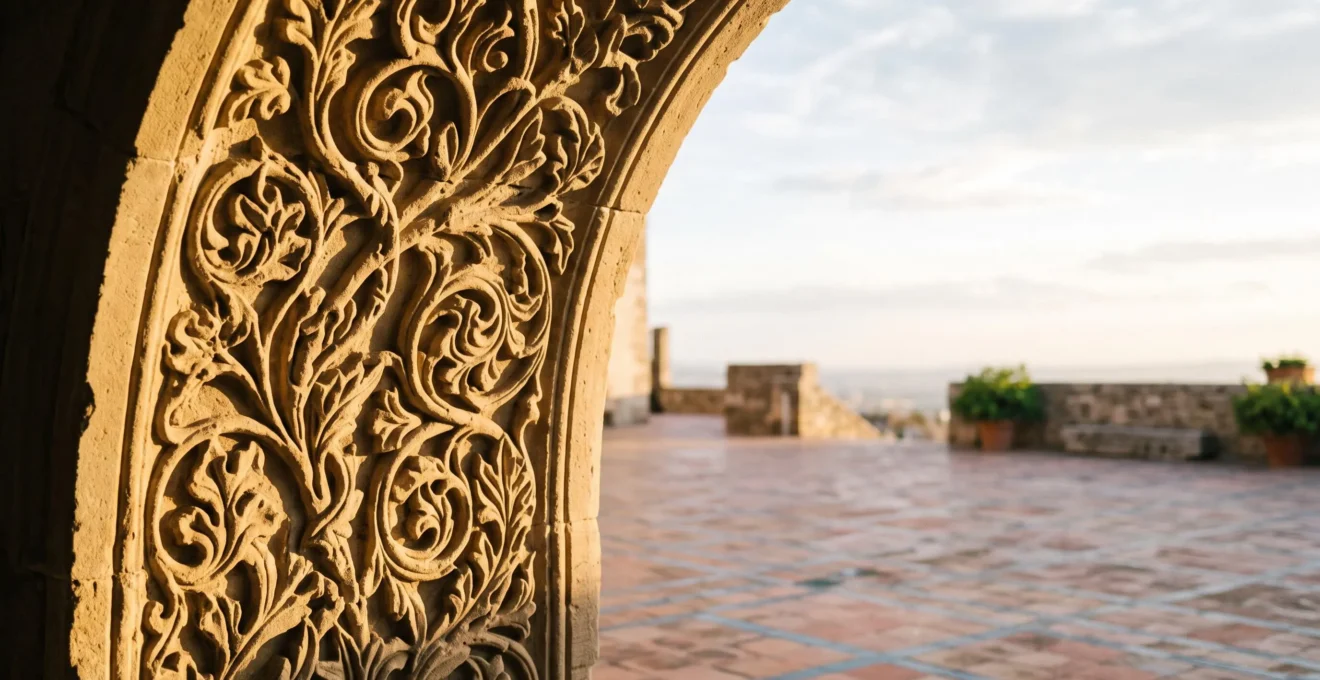
The Islamic arabesque is not a simple decoration of plant life but a sophisticated philosophical engine. It employs a precise mathematical grammar to deconstruct the finite, organic forms of nature, transforming them into a visual theorem that expresses the abstract and infinite nature of divine unity. This process prioritises the underlying structure and rhythm over literal representation, creating an endlessly unfolding field of spiritual contemplation.
In the galleries of the V&A, one is often confronted by the mesmerising flow of the arabesque. On panels of carved stucco, inlaid wood, or lustrous ceramic tiles, vegetal forms—vines, leaves, and split palmettes—repeat and unfold with a logic that seems both organic and rigorously mathematical. The casual observer sees decoration. The student of art, however, poses a more profound question: how, precisely, does a simple plant become a conduit for the concept of infinity?
The conventional answer often points towards aniconism—the avoidance of figural imagery in many sacred Islamic contexts. While this is a crucial part of the story, it is not the full picture. The turn towards vegetal and geometric motifs was not merely a substitution born from prohibition. Instead, it catalysed the development of a unique visual language, one with its own complex grammar and syntax. This artistic evolution, while having roots in Late Antique scrollwork, reached an unparalleled level of intellectual and spiritual sophistication within Islamic civilisation, later influencing even Renaissance ornament.
The true genius of the arabesque lies not in what it depicts, but in how it thinks. It is a system of deconstruction. It takes the worldly, perishable plant and subjects it to the eternal, unchanging laws of mathematics, abstracting its form to reveal a higher truth. The goal is no longer to represent a flower, but to use the *idea* of a flower as a single note in a grand, harmonious composition that speaks of unity, rhythm, and the infinite. This is the arabesque’s visual theorem.
This exploration will trace the mechanics of this remarkable transformation. We will examine the theological imperatives, the mathematical tools, and the aesthetic choices that allow Islamic artists to turn flora into a profound form of mathematical and spiritual poetry. We will deconstruct the very logic that governs these timeless patterns.
Summary: The Arabesque as a Visual Theorem
- Why Do Arabesques Avoid Human Figures While Embracing Infinite Plant Life?
- How Do Carvers Maintain Perfect Symmetry Across 20 Metres of Stucco?
- Arabesques or Geometric Patterns: Which Decorates a Mosque Interior Better?
- The Overcrowding Mistake That Destroys Arabesque Harmony
- When Did Arabesques Replace Simple Patterns: The 3 Historical Shifts?
- Why Did Islamic Artists Choose Mathematical Patterns Over Human and Animal Forms?
- How Do Craftsmen Cut 5mm Tesserae for Complex Curved Mosaics?
- How Do Geometric Patterns Express Infinite Divine Unity Through Finite Mathematics?
Why Do Arabesques Avoid Human Figures While Embracing Infinite Plant Life?
The common understanding of aniconism in Islamic art often frames it as a simple prohibition. However, a more precise view sees it as a powerful generative principle. The avoidance of figural representation, particularly in sacred contexts, is not an artistic vacuum but a catalyst. It redirected creative and intellectual energy towards other forms of expression, leading to the flourishing of three distinct, yet interwoven, visual languages: calligraphy, geometry, and the arabesque. A socio-theological reading of early Islamic culture reveals preferences for calligraphy, geometry, and arabesque generated by the aniconism, establishing these not as replacements, but as primary modes of artistic and spiritual articulation.
Within this framework, the choice of vegetal motifs was anything but arbitrary. Plants were not selected as mere decorative filler but as a potent symbolic vocabulary. In place of human or animal forms, which could be associated with idolatry or the creative power of God alone, artists turned to the natural world of flora. This vocabulary was imbued with specific meaning; for example, the cypress tree, with its upright form, can represent humility before God, while the endless scrolling vine can signify the life-giving nature of the divine. The plant becomes a carrier of theological concepts, a vehicle for storytelling without figures.
This embrace of the plant world serves the arabesque’s core philosophical purpose. A human or animal figure is inherently finite and individual. It tells a specific story about a specific being. A plant, however, can be deconstructed into its fundamental elements—a stem, a leaf, a spiral—and reconfigured according to a higher, abstract law. It can be endlessly repeated, bifurcated, and mirrored to create a continuous, unified field. It is this potential for infinite expansion that makes the plant form the perfect raw material for crafting a visual metaphor for the singular, eternal, and indivisible nature of God (Tawhid).
Thus, the arabesque does not simply embrace plants; it transforms them. It subordinates the individual identity of the plant to a universal, mathematical rhythm, turning a representation of worldly life into an expression of divine infinity.
How Do Carvers Maintain Perfect Symmetry Across 20 Metres of Stucco?
The breathtaking scale and perfect symmetry of monumental arabesque carvings, such as those found on the walls of the Alhambra, can seem almost miraculous. The key to maintaining this flawless harmony across vast surfaces lies not in complex modern tools, but in an unwavering adherence to a simple, yet powerful, foundational system: the underlying grid. As Islamic design expert Eric Broug explains, the entire process is governed by the discipline to “keep intact the grid underlying the whole pattern.” This grid, established at the outset with the most basic of instruments, acts as the invisible skeleton upon which the entire composition is built.
This principle is demonstrated by the fact that the same techniques used for centuries are still taught today using only a pencil, a straightedge, and a compass. A practical workshop on Islamic geometric design at MIT confirms that craftsmen can generate immensely complex patterns with this restrained toolkit. The pattern is not drawn freehand; it is constructed. Every curve and intersection is a direct consequence of the foundational geometric logic. A single repeating unit, or module, is designed within the grid. This module is then replicated—through rotation, reflection, and translation—across the entire surface. The perfection of the whole is thus guaranteed by the mathematical perfection of its constituent parts.
As can be seen in long sections of carved stucco, this modular repetition creates a powerful visual rhythm. The absolute adherence to the grid ensures that the pattern remains coherent and symmetrical whether it covers a small wooden box or twenty metres of a palace wall. There is no distortion or improvisation. The artist’s skill lies not in spontaneous invention, but in the flawless execution of this pre-determined mathematical grammar. The system itself is the source of the beauty, and the craftsman is its faithful interpreter. This disciplined approach ensures that a pattern can, in theory, extend to infinity without losing its integrity.
Arabesques or Geometric Patterns: Which Decorates a Mosque Interior Better?
Posing the question of whether arabesques or geometric patterns are “better” for a mosque interior creates a false dichotomy. Within the sophisticated language of Islamic decorative arts, these two modes are not competitors but collaborators. They represent two distinct, yet complementary, ways of expressing the relationship between the finite and the infinite, the created and the creator. Their effectiveness comes not from exclusion, but from their thoughtful integration and placement within an architectural space, each fulfilling a specific symbolic and aesthetic role.
Geometric patterns, often called *girih*, are based on tessellation—the creation of a two-dimensional plane using repeating tiles with no overlaps and no gaps. This art form expresses the principles of order, logic, and the universal laws that govern creation. It is a visual manifestation of mathematics, seen as a pure, intellectual path to understanding the divine. Arabesques, by contrast, are biomorphic, deriving their forms from the living, growing world of plants. They represent dynamism, life, and the organic unfolding of creation. They are lyrical and flowing where geometric patterns are structural and crystalline. A comparative look at their roles clarifies their distinct functions.
| Aspect | Geometric Patterns | Arabesques (Vegetal Patterns) |
|---|---|---|
| Symbolic role | Divine law, mathematical order | Life, growth, organic dynamism |
| Typical placement | Floors, foundational friezes, structural borders | Wall panels, flowing surface ornament |
| Visual rhythm | Steady, predictable, repeating tessellation | Lyrical, scrolling, continuous motion |
| Core technique | Compass, straightedge, interlacing tessellation | Carved or painted scrolling vine forms |
While both forms carry profound symbolic weight, the art historian Doris Behrens-Abouseif notes that their beauty can also be appreciated “for its own sake, without commitment to religious or moral criteria.” This highlights their aesthetic autonomy. Typically, the foundational and structural elements of a building—floors, dadoes, and borders—might be articulated with the stability of geometric patterns. The larger, more open surfaces, like wall panels or the interior of a dome, might then be filled with the continuous, flowing movement of the arabesque. One provides the structure, the other provides the life that fills it. The “better” decoration is therefore a balanced dialogue between the two.
The Overcrowding Mistake That Destroys Arabesque Harmony
A common pitfall in the contemporary application of patterned ornament is the tendency towards overcrowding, a misunderstanding of the principle of *horror vacui*, or “fear of empty space.” While arabesque designs can indeed cover vast surfaces, their harmony and contemplative power derive not from filling every void, but from the sophisticated interplay between form and emptiness. The space *between* the scrolling vines is as important as the vines themselves. This negative space is the silent ground that gives the pattern its rhythm, clarity, and breath. To eliminate it is to suffocate the design.
A fascinating historical case study is the Abbasid ‘beveled’ style, which emerged in the 9th century, particularly at the palatial city of Samarra. This style is characterized by a distinctively slanted relief and, crucially, an almost total absence of negative space. Repeated patterns of abstracted vegetal forms are compressed together, creating a dense, uniform visual texture. While a powerful aesthetic in its own right, it serves as an excellent counter-example. By deliberately suppressing the void, the beveled style transforms the meditative path of the arabesque into a wall of texture. The eye has no place to rest, no clear line to follow. It demonstrates that total surface coverage is not the same as harmonic complexity.
The most successful arabesque compositions, therefore, are those that master this delicate balance. The carved or painted line acts as a figure, and the plain ground behind it acts as a silent, yet active, participant. This void allows the underlying mathematical structure to be perceived, enabling the eye to follow the logical unfolding of the pattern. For interior designers and artists working with pattern today, this is a critical lesson. Harmony is achieved not by adding more, but by allowing what is there to resonate within a carefully considered space. The pause is as vital as the note.
Checklist for Harmonic Pattern Integrity
- Visual Pathway: Trace the main lines of your pattern. Does your eye follow a clear, uninterrupted path, or does it get lost in clutter?
- Negative Space Ratio: Assess the balance between solid form and empty space. Is the background an active participant or a forgotten leftover? Aim for a deliberate ratio.
- Rhythm and Rest: Identify the points of repetition. Are there visual “pauses” or areas of lower density that allow the eye to rest and appreciate the rhythm?
- Hierarchical Clarity: Does the pattern have a clear hierarchy? Distinguish between primary, secondary, and tertiary lines to avoid a flat, uniform texture.
- Boundary and Frame: Evaluate how the pattern meets its edge. A well-defined border or a gentle fade into emptiness is often more powerful than an abrupt stop.
When Did Arabesques Replace Simple Patterns: The 3 Historical Shifts?
The evolution of the arabesque from simple scrollwork to a complex mathematical art was not a single event but a gradual development marked by key conceptual shifts. The first major shift occurred with the establishment of the Islamic empire, which inherited the Hellenistic and Roman tradition of the vine scroll. Initially, this motif was used in a relatively naturalistic way, as seen in the mosaics of the Dome of the Rock in Jerusalem (late 7th century). The forms were clearly recognizable as plants, serving a symbolic role connected to themes of paradise and life.
The second pivotal shift occurred during the Abbasid Caliphate, particularly in the 9th century at Samarra. Here, we witness a decisive move towards abstraction. As seen in surviving stucco panels from this period, artists began to deconstruct the naturalistic plant forms. The design, known as the ‘beveled style’, features abstracted geometric forms *instead of* purely vegetal patterns. The focus shifted from representing a plant to using the idea of a plant as a component in a more abstract, rhythmic composition. This was the birth of the truly abstract arabesque, where the mathematical principle began to dominate the organic origin.
The third, and perhaps most intellectually profound, shift was the full synthesis of this abstracted vegetal ornament with advanced geometric tessellation. This was not merely placing a vine pattern next to a star pattern; it was the fusion of their underlying logics. As a peer-reviewed study in *Science* confirms, a major conceptual breakthrough had occurred by 1200 C.E., when artisans were using a sophisticated understanding of tessellation to create breathtakingly complex patterns. This development saw the arabesque’s flowing lines become fully integrated into the rigorous grid of geometric construction. The result was a hybrid form where the lyrical, biomorphic quality of the arabesque was governed by the unyielding logic of mathematical tiling, allowing for the creation of infinitely expandable and perfectly coherent visual fields. This synthesis marks the maturation of the arabesque into the sublime visual theorem we know today.
Why Did Islamic Artists Choose Mathematical Patterns Over Human and Animal Forms?
While the theological principle of aniconism is the most cited reason for the turn towards geometric and vegetal art, it is not the only one. Deeper cultural and scientific drivers were at play. The historian Terry Allen proposed a compelling socio-political argument: because early “Islamic civilization was a supraethnic one,” it required a universal visual language that could transcend local cultures and traditions. A figural painting of a person from one region might feel alienating to someone from another. Mathematical patterns, however, speak a language of pure logic and order. They are culturally neutral and universally legible, capable of uniting a diverse empire from Spain to Central Asia under a shared aesthetic and intellectual framework.
Furthermore, this choice was not a retreat from the world but a proactive engagement with a different kind of truth. In the medieval Islamic world, mathematics and geometry were not seen as dry, secular disciplines. They were considered sacred sciences, pathways to understanding the divine mind and the very structure of the cosmos. The patterns found in nature were seen as evidence of God’s perfect design. By mastering geometry, the artist could emulate this divine order, creating a microcosm of the universe that was both intellectually rigorous and spiritually uplifting. The pattern was a form of active contemplation.
This pursuit led to astonishing discoveries. A study by Harvard and Princeton physicists found that by the 15th century, Islamic craftsmen were creating complex quasi-crystalline patterns that followed the same principles as mathematical discoveries made in the West in the 1970s. The research concluded that Islamic artisans had anticipated Penrose quasi-crystalline geometry by 500 years. This was not a happy accident. It was the result of a sustained, sophisticated, and deliberate exploration of mathematical possibilities. They chose this path not only because of what they sought to avoid, but because of the profound intellectual and spiritual truths they sought to find.
How Do Craftsmen Cut 5mm Tesserae for Complex Curved Mosaics?
The creation of intricate mosaic arabesques, known as *zellige* or *kashikari*, requires a level of precision that is almost microscopic. To form the fluid curves of a vine or the delicate outline of a palmette, artisans must work with tiny fragments of glazed tile, or tesserae, sometimes as small as 5mm. This process, perfected over centuries, relies on specialized tools and an intimate knowledge of the material. It begins not with cutting curves, but with creating a palette of geometric shapes—squares, diamonds, stars—from larger fired tiles. These shapes will be the building blocks of the final design.
The primary tools are a specialized hammer, often with one chisel-like edge (*martelina*), and a stationary blade set into a wooden block, the hardie (*tagliolo*). The craftsman holds the glazed tile and carefully strikes it against the hardie with the hammer, using practiced force to split it along a desired line. To create smaller or more complex shapes, the tile is first scored. Then, with remarkable precision, the craftsman nibbles away at the edges with the hammer and hardie, shaping the piece. This is a process of controlled fracture, not smooth cutting. The slight irregularities of the hand-cut edges are essential, as they catch the light and create a more vibrant surface than a machine-cut tile ever could.
Once the tesserae are shaped, they are assembled face-down on a floor pattern, a process known as the “dry method.” This allows the entire panel to be laid out like a puzzle. The artisans place each tiny piece with tweezers, ensuring a snug fit. It is here that another layer of artistry comes into play: the setting angle. Tesserae are often placed at almost imperceptible angles to one another. This technique, called undulation, ensures that as light moves across the wall, different facets will catch it, causing the surface to shimmer and appear alive. Once the panel is complete, a mortar backing is poured over it, and when set, the entire section is lifted and installed on the wall. The final result is a testament to immense patience and a mastery of material at the smallest scale.
Key Takeaways
- The arabesque is a ‘visual theorem’, using mathematical grammar to transform finite plants into a concept of infinite unity.
- Harmony in arabesque design depends on the active use of negative space; overcrowding destroys its contemplative rhythm.
- Islamic artisans mastered complex geometry, anticipating Western mathematical discoveries like Penrose tiling by centuries.
How Do Geometric Patterns Express Infinite Divine Unity Through Finite Mathematics?
The power of Islamic geometric art to evoke the infinite from finite means is perhaps its most profound spiritual achievement. It operates on a philosophical principle best summarized by the art historian Terry Allen: in these patterns, “a small segment implies the whole.” This is the concept of self-similarity, where a single, simple geometric unit—a star, a polygon—contains the DNA for an entire, infinitely expandable field. The viewer does not need to see the end of the pattern to understand that it is endless. The internal logic of the single unit guarantees its infinite potential.
This is a direct visual analogy for the theological concept of Tawhid, or the Oneness of God. Tawhid posits that all the diversity and multiplicity of creation is an emanation from a single, unified source. In the geometric pattern, the single repeating tile is the source. Its repetition, rotation, and interlacing create a complex and diverse visual field, yet every part of that field is inextricably linked back to the original unit. The pattern is thus both one and many simultaneously. The artist, using the finite tools of compass and straightedge, creates a window onto the infinite and unified nature of the divine. The mathematics are not just a tool; they are the subject itself.
Scientific analysis of historical patterns confirms this was a deliberate and highly advanced practice. The use of ‘girih’ tiles—a set of five specific polygons—enabled the creation of increasingly complex periodic patterns. By the 15th century, artisans were combining this tessellation approach with self-similar transformations to construct what are now known as quasi-crystalline Penrose patterns. These patterns never perfectly repeat themselves, yet they maintain perfect long-range order. This is a physical, documented example of a finite set of rules generating an infinitely complex and non-repeating field, perfectly echoing the theological idea that all the endless diversity of creation radiates from a single, unified origin. The finite mathematics of the craftsman’s hand become a direct expression of infinite divine unity.
For the designer, architect, or historian, the study of the arabesque offers more than a history of ornament. It provides a masterclass in the creation of meaning through structure. It teaches that a pattern’s power lies not in its complexity, but in the clarity of its underlying logic. By understanding this mathematical grammar, we can begin to apply these principles of rhythm, harmony, and infinite expansion to contemporary design, creating spaces and objects that are not merely decorated, but are imbued with a sense of order and contemplative depth.