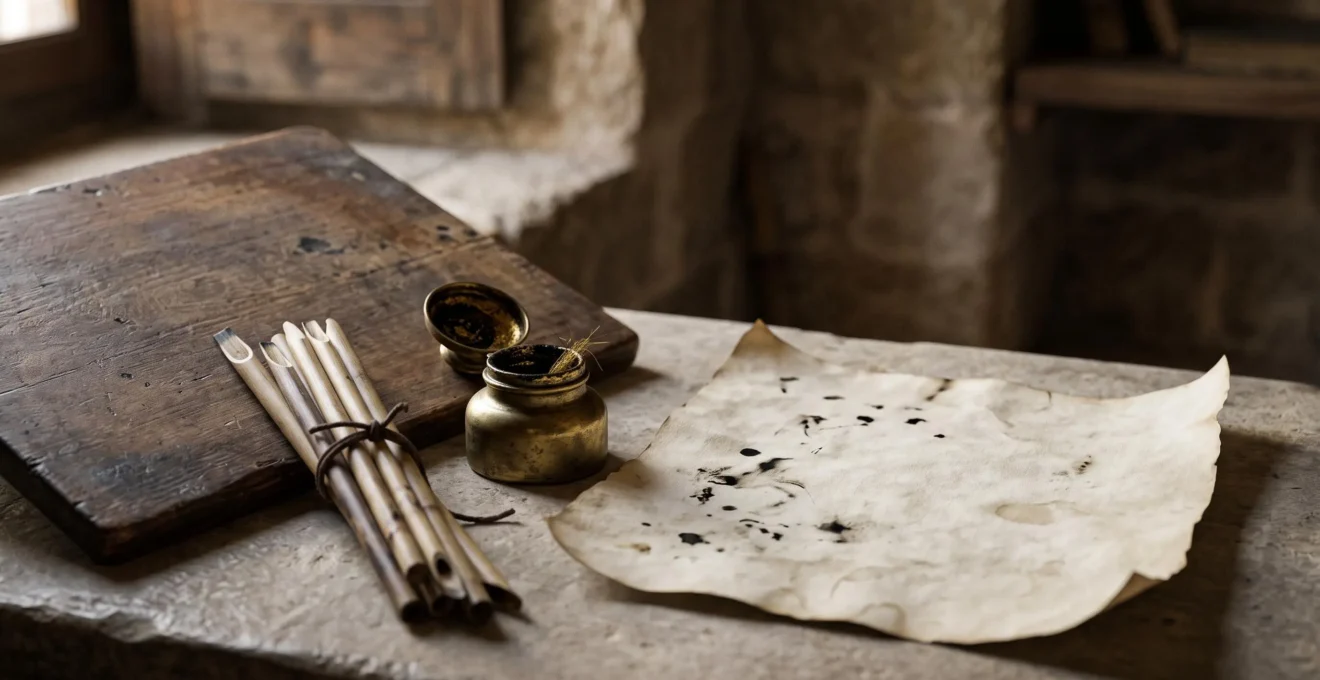
The enduring genius of Islamic master calligraphers lies not just in their beautiful writing, but in their creation of replicable systems that allowed their art to be transmitted for centuries.
- Pioneers like Ibn Muqla didn’t just invent scripts; they codified them with mathematical precision, creating a teachable canon.
- Mastery was achieved through a rigorous master-apprentice system, ensuring the faithful imitation and gradual evolution of styles over generations.
Recommendation: Appreciate Islamic calligraphy not just as an aesthetic object, but as the product of a millennium-long tradition of systemic innovation and disciplined practice.
The sublime beauty of Islamic calligraphy has captivated viewers for over a thousand years. We see it adorning the soaring domes of mosques, illuminating the pages of sacred Qur’ans, and lending poetic grace to everyday objects. It is universally recognized as the highest form of visual art in the Islamic world. But behind this vast and diverse tradition stand a handful of legendary figures—master calligraphers whose vision and discipline shaped the very way the Arabic script was written and perceived for centuries to come.
The common understanding is that these artists were simply gifted individuals with exceptionally steady hands. However, this view misses the core of their genius. The true legacy of these masters was not just their personal talent, but their ability to create robust, teachable, and scalable *systems*. They were not just artists; they were architects of the written word, establishing canons of proportion, training methodologies, and stylistic repertoires that would be studied, copied, and built upon by thousands of students across vast empires. Their work transformed calligraphy from mere penmanship into a codified science of beauty. This article explores the lives and innovations of these masters, revealing how their systemic approach, rather than just raw talent, secured their place in history.
This article will delve into the stories of these pivotal figures and their lasting impact. We will explore the proportional systems, the rigorous training, and the moments of breakthrough innovation that defined their careers and, in turn, the history of an entire art form.
Summary: The Systems of Genius Behind Islamic Calligraphy’s Greatest Masters
- Why Is Ibn Muqla Considered the Greatest Calligrapher After 1,100 Years?
- How Did Yaqut al-Musta’simi Create a Style Copied by 10,000 Students for 300 Years?
- Ottoman or Persian Masters: Which Tradition Produced More Stylistic Breakthroughs?
- The Proportional Experiment That Destroyed a Calligrapher’s 40-Year Career
- When Did Masters Innovate Rather Than Imitate: The 5 Career Moments That Permitted Experimentation?
- How Did Calligraphers Achieve Mastery After 15 Years of Daily 8-Hour Practice?
- How Did Isfahan Artisans Apply Glazes Without Firing Defects at 1,200°C?
- How Did Calligraphic Scripts Transform Writing Into the Supreme Visual Art?
Why Is Ibn Muqla Considered the Greatest Calligrapher After 1,100 Years?
To understand Islamic calligraphy is to begin with Abu Ali Muhammad ibn Muqla (d. 940). A powerful vizier in the Abbasid court of Baghdad, his name is synonymous with the single most important revolution in the history of the art form: codification. Before Ibn Muqla, scripts were largely regional and lacked a unified standard. He changed everything by developing a comprehensive system of proportion based on a circle whose diameter was the height of the letter *alif*, and a series of rhombic dots made with the nib of the reed pen.
This wasn’t just an aesthetic preference; it was a scientific approach that made beauty replicable. He is credited with standardizing the six canonical cursive scripts (the *al-aqlam al-sitta*), each with a distinct character and purpose. This systemization was so profound that it became the unshakable foundation for all subsequent generations of calligraphers. His story is also one of tragic resilience. As a high-ranking political figure, Ibn Muqla made powerful enemies. During one imprisonment, his right hand was brutally severed. Undeterred, he is said to have attached a pen to his stump or continued with his left hand with breathtaking skill, a testament to his complete internalization of the proportional system. His genius was not in his hand, but in his mind. Eventually, his tongue was cut out and he died in prison, a martyr to both politics and his art.
This table outlines the “Six Pens” that Ibn Muqla codified, demonstrating how each script was developed with a specific function in mind, a principle known as functional aesthetics.
| Script | Typical Use |
|---|---|
| Naskh | Copying books and small Qur’ans |
| Thuluth | Large Qur’ans, objects, and architectural surfaces |
| Muhaqqaq | Large Qur’ans and monumental inscriptions |
| Rayhan | Fine manuscript copying |
| Tawqi’ | Official chancery documents |
| Riqa’ | Everyday administrative writing |
How Did Yaqut al-Musta’simi Create a Style Copied by 10,000 Students for 300 Years?
If Ibn Muqla was the great lawgiver of calligraphy, then Yaqut al-Musta’simi (d. 1298) was its ultimate interpreter and refiner. Living three centuries after Ibn Muqla, Yaqut inherited the proportional system but elevated it to a new level of elegance and perfection. His life’s work was to take the Six Pens and give them their definitive, canonical form. He is famously said to have survived the devastating Mongol sack of Baghdad in 1258 by hiding in a minaret, continuing to practice his art as the city burned below, a powerful symbol of culture’s endurance against barbarism.
Yaqut’s key innovation was subtle but transformative. He is credited with perfecting the trimming of the reed pen (*qalam*), cutting its nib at an oblique angle. This seemingly minor adjustment allowed for finer, more elegant, and more dynamic strokes. His refined versions of the Six Pens were so perfectly balanced and aesthetically pleasing that they became the new gold standard. A folio from a Qur’an he penned in Baghdad became a canonical example, showcasing his mastery. His influence was cemented not just by his work, but by his teaching. Yaqut trained a generation of brilliant calligraphers who became known as the “Six Pupils of Yaqut.” These students, in turn, spread his refined style across the Islamic world. As a result, his specific interpretation of the classical scripts was used and copied for centuries, with his version dominant from the 14th to the 17th centuries. He demonstrated that true mastery wasn’t about reinventing the rules, but about achieving such a profound understanding of them that one could attain a new level of perfection within their constraints.
Ottoman or Persian Masters: Which Tradition Produced More Stylistic Breakthroughs?
After Yaqut, the calligraphic tradition flowed into two powerful streams: the Ottoman in Anatolia and the Safavid in Persia. While both revered the classical Six Pens, their distinct cultural and political needs led them down different paths of innovation, making a direct comparison of “breakthroughs” a matter of perspective. Each empire championed scripts that reflected its unique identity.
This image of two distinct palace alcoves represents the separate but equally sophisticated worlds of the Ottoman and Persian court workshops, where these calligraphic traditions were nurtured.
The Ottomans, rulers of a vast and bureaucratic empire, prized scripts that conveyed power and complexity. They developed the Diwani script for official chancery documents, a highly complex and interlaced style that was difficult to forge, acting as a form of security. The imperial monogram, or Tughra, was a masterful calligraphic composition that became the ultimate symbol of the Sultan’s authority. For the Ottomans, breakthroughs were often linked to imperial function and grandeur.
The Persian masters, on the other hand, cultivated an environment that cherished poetry and literature. Their greatest breakthrough was the development of Nasta’liq, often called the “bride of Islamic scripts.” This fluid, lyrical script, with its distinctive downward-sloping lines, was perfectly suited to transcribing the romantic and epic poetry of Firdawsi and Hafez. The value here was not bureaucratic complexity but aesthetic grace and emotional resonance. The fact that Nasta’liq has been in active use from the 14th century to the present demonstrates its profound cultural success. Ultimately, both traditions produced major breakthroughs, but they were defined by the very different values of their respective courts.
| Empire | Signature Script | Primary Function |
|---|---|---|
| Ottoman | Diwani / Tughra | Official chancery documents and imperial monograms, prized for its cipher-like complexity |
| Safavid Persia | Nasta’liq | Poetry manuscripts and courtly literature, valued for its flowing, lyrical quality |
The Proportional Experiment That Destroyed a Calligrapher’s 40-Year Career
The history of calligraphy is filled with tales of celebrated masters, but it also contains unspoken cautionary tales. Imagine a master in the 16th century, a man who had dedicated four decades to his craft. He had perfectly imitated his own master, earned his license (*ijazah*), and enjoyed the patronage of a minor prince. He had mastered the unforgiving geometry of the canon established by Ibn Muqla and perfected by Yaqut. But in his later years, a restless desire for a unique legacy began to grow.
He started to experiment, not with new materials, but with the very soul of the art: proportion. He believed he had found a “flaw” in the classical system, a way to make the *Naskh* script more “logical” or “divine.” He began to subtly elongate the vertical strokes and compress the circular ones, creating a style that was uniquely his. For a brief time, his new script was a curiosity. But when he presented his masterpiece—a Qur’an copied entirely in his new, idiosyncratic style—to a greater royal court, the reaction was not admiration, but quiet horror. The senior masters and scholars saw his work not as an innovation, but as a grotesque deformation, an act of ego that disrespected centuries of tradition. His 40 years of accrued reputation evaporated. His patronage was withdrawn, his students left him, and he died in obscurity. His story, though perhaps apocryphal, serves as a powerful reminder of the central tension in this art: the line between innovation and heresy is as fine as a calligrapher’s stroke. The canon was not just a set of rules; it was a sacred trust, and breaking it could mean professional ruin.
When Did Masters Innovate Rather Than Imitate: The 5 Career Moments That Permitted Experimentation?
In a tradition so deeply rooted in imitation and respect for the past, how did any innovation occur at all? The answer lies in specific, culturally sanctioned moments and contexts that permitted a master to move beyond pure imitation. These were not random acts of rebellion but earned rights that came with seniority and mastery.
One of the most crucial turning points was the granting of the ijazah, or license. This formal certificate, granted by a master to an apprentice after years of training, certified that the student could perfectly imitate the master’s hand. Paradoxically, the moment a calligrapher earned the right to sign his own name as a master was the moment he also earned the freedom to begin subtly developing his own style. The modern Jordanian master Nassar Mansour, for instance, was the first in his country to receive the prestigious ijazah from the great Turkish master Hasan Çelebi in 2003. This event marked his transition from student to master and opened the door for his own creative explorations.
Another powerful catalyst for innovation was a change in medium. When a calligrapher accustomed to ink on paper was commissioned to work in stone, glass, wood, or metal, the new material’s properties—its resistance, texture, and scale—naturally forced adaptations. As seen in Nassar Mansour’s later career, his work on these diverse materials pushed his style beyond what was possible or necessary on paper. Other key moments included receiving major imperial patronage, which provided resources and a mandate for grandeur; the need to create a new script for a specific function (like the Ottoman Diwani); and the simple, slow evolution of style that occurs over a long career of teaching, as a master refines his own hand to make it a better model for his students.
A Scholar’s Checklist: Identifying a Master’s Innovative Leap
- Pinpoint the Ijazah: Locate the date the calligrapher received their formal license and compare works created immediately before and after.
- Analyze Material Shifts: Document instances where the artist transitioned from paper to other media like stone, metal, or ceramics, and note stylistic changes.
- Track Patronage Changes: Identify when the artist gained or changed a major patron and look for shifts in scale, script choice, or grandeur.
- Chart the Teaching Lineage: Examine the work of the master’s most famous students. Do they show a new, evolved version of the master’s style?
- Identify Functional Demands: Look for evidence of commissions that required a new solution, such as a difficult-to-forge chancery script or a monumental inscription.
How Did Calligraphers Achieve Mastery After 15 Years of Daily 8-Hour Practice?
The path to becoming a master calligrapher was not one of innate talent alone; it was a long, arduous journey of disciplined practice and total submission to a master. The core of this education was the master-apprentice relationship, a system that ensured the faithful transmission of knowledge and skill across generations. An aspiring calligrapher would commit themselves to a single master, often for decades.
The training was based on meticulous imitation. The master would write a line of script—the *mashq* or lesson—for the student to take home and copy endlessly. The student’s goal was not to be creative but to replicate the master’s hand with absolute fidelity, absorbing the subtle rhythms, proportions, and spirit of the script. As the documentary “Performing Beauty” notes, the training proceeds with the master writing the script for the apprentice and teaching them the tools and culture behind it, after which the student practices until the master is convinced they can imitate them expertly. This could involve up to eight hours of practice daily, for ten to fifteen years, before a student was even considered for an ijazah. This immense dedication is etched into the very hands of the masters.
This image of a master’s hand captures the decades of discipline, where the reed pen becomes an extension of the body and the mind, moving with a grace born of countless hours of practice.
This rigorous process did more than just develop technical skill. It was a form of spiritual and mental discipline. The endless repetition trained the hand, the eye, and the soul. It instilled a profound respect for the tradition and an intimate, almost cellular, understanding of the rules of proportion and beauty. By the time a student achieved mastery, the canon was no longer an external set of rules to be followed but an internalized part of their very being. This is how the art form maintained its incredible consistency and quality for over a thousand years.
How Did Isfahan Artisans Apply Glazes Without Firing Defects at 1,200°C?
While calligraphy reigned supreme on paper, a parallel story of technical mastery was unfolding on the walls of Persia’s great mosques and palaces. The vibrant, jewel-like tilework of cities like Isfahan represents another pinnacle of Islamic art, one that required its own set of specialized skills and secret knowledge, particularly in the face of extreme temperatures reaching 1,200°C during firing.
The artisans of the Safavid era (1501-1736) faced a major challenge: how to apply multiple, vivid colors of glaze onto a single tile without them running together and becoming a muddy mess in the intense heat of the kiln. Their solution was a brilliant technique known as cuerda seca, or “dry cord.” This method involved a crucial preparatory step before the glazes were applied. The outlines of the design were drawn onto the bisque-fired tile using a greasy, manganese-based substance. This substance acted as a barrier, creating a “dry cord” that kept the different colored glazes separate during application and firing.
This close-up view reveals the fine, dark lines of the ‘cuerda seca’ technique, which were essential for creating the sharp, vibrant patterns of Isfahan’s famous tilework.
During the intense heat of the firing process, the glazes would melt and fuse to the tile, but the greasy outlines would burn away, leaving behind a characteristic fine, dark, and unglazed line that separated the brilliant fields of turquoise, cobalt blue, and ochre. As an article in the Tehran Times explains on Safavid tilework, “The tiles were made using a method known as cuerda seca, or dry cord, in which lines of a glaze-resistant material separated areas of different colours.” This technique allowed for complex, polychromatic designs on a single tile, a significant advancement over the more laborious mosaic techniques. It was a perfect marriage of artistic vision and chemical engineering, another testament to the systematic and scientific approach that underlies so much of Islamic art’s greatest achievements.
Key takeaways
- Systemic Genius: The most impactful masters like Ibn Muqla did not just create art; they created teachable, proportional systems that could be replicated for centuries.
- Discipline over Talent: Mastery was the result of a rigorous, multi-decade master-apprentice system based on perfect imitation, not raw, untutored talent.
- Innovation within Tradition: Change occurred not through rebellion, but at sanctioned moments—like earning an ijazah or working with new materials—that allowed masters to evolve the art without breaking its core principles.
How Did Calligraphic Scripts Transform Writing Into the Supreme Visual Art?
Ultimately, the transformation of simple writing into the supreme visual art of the Islamic world was not an accident. It was the result of a deliberate, centuries-long effort to imbue the written word with the highest levels of beauty, meaning, and spiritual significance. The masters and their systems were the vehicles for this transformation. As the scholar Efdaludin Kılıç notes, “Calligraphy has been used to preserve divine texts, philosophy or metaphysics and to make their teachings permanent in the world of words.“
The elevation of writing to art began with its sacred function: transcribing the Qur’an. The desire to give God’s word its most beautiful possible form drove the earliest innovations in script design. But the art quickly expanded beyond the religious sphere. The proportional systems established by Ibn Muqla and perfected by Yaqut provided a universal language of beauty that could be applied to any text, from a royal decree to a love poem. This gave the calligrapher a unique status, somewhere between a scribe, an artist, and a mathematician. They were architects of the page, using their knowledge of proportion and rhythm to build harmonious and moving compositions.
In the hands of a master, a text is no longer just a carrier of information; it becomes a visual experience. The energy of the Thuluth script on a mosque wall conveys majesty and power before a single word is read. The flowing grace of Nasta’liq in a poetry book evokes the lyrical emotions of the verse. This ability to convey meaning through form is the essence of calligraphy’s power. Modern masters like Nassar Mansour continue this tradition, proving that calligraphy is not limited to ink on paper. By executing works in stone, glass, and metal, they demonstrate that the calligrapher’s art is fundamentally about shaping form and space, whether on a page or in a public square. The script itself becomes a sculpture, an architectural element, the supreme and final word on visual art.
The next time you encounter a piece of Islamic calligraphy, take a moment. Look beyond the immediate beauty of the lines and see the centuries of codified genius, rigorous discipline, and systemic innovation that each stroke represents. It is in appreciating this deep history that we can truly honor the legacy of its greatest masters.