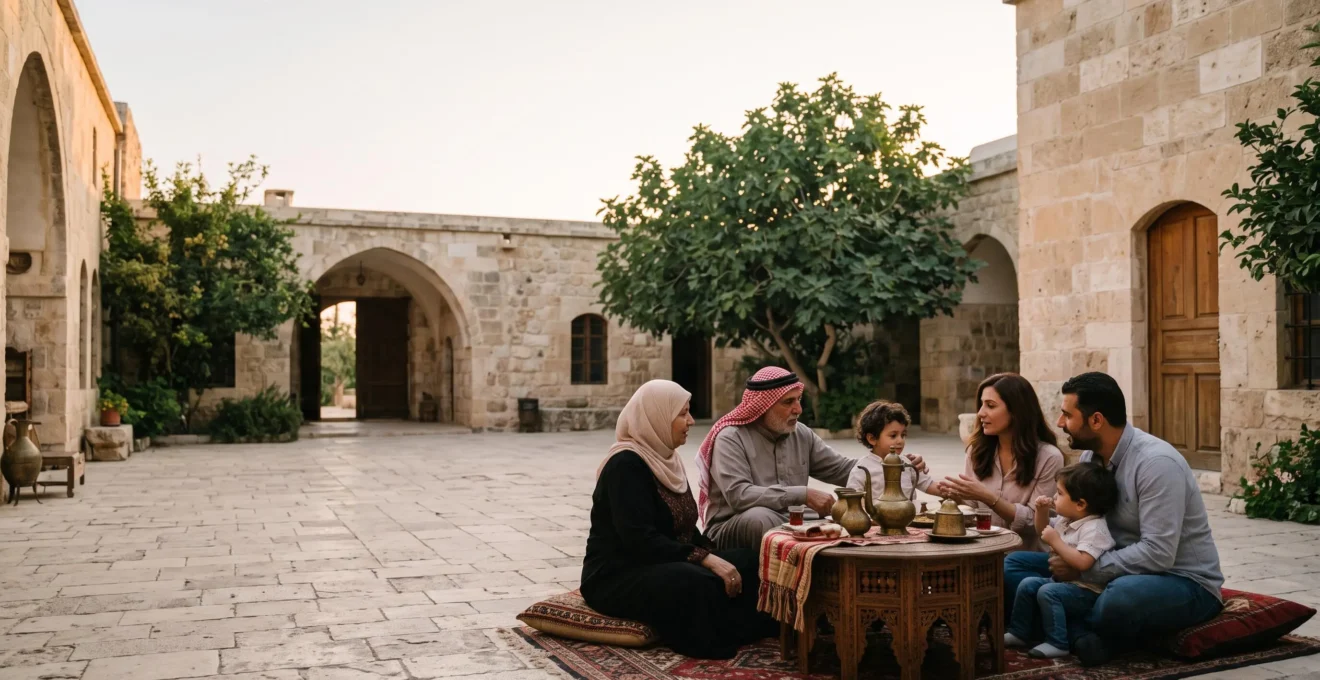
The resilience of the Arab extended family is not a passive continuation of tradition, but an active and adaptive socio-economic system that provides superior structural support compared to Western individualistic models.
- Financial resilience is achieved through modernized, trust-based mechanisms that outperform formal microfinance.
- Care responsibilities are distributed as a moral and social duty, creating a robust, multi-generational support network.
- Mental wellbeing is fostered through a community-centric recovery model, contrasting with the individual self-actualisation emphasised in the West.
Recommendation: Researchers should analyse the family unit not as a cultural relic, but as a living socio-economic infrastructure with continuously evolving mechanisms that successfully navigate the pressures of modernity.
For the Western-based sociologist, the enduring centrality of the extended family in Arab societies presents a compelling paradox. In an era defined by globalisation, urbanisation, and the pervasive logic of individualism, how does this seemingly traditional structure not only survive but continue to function as the primary cornerstone of social organisation? The common answers—citing religious obligation or cultural heritage—are not incorrect, but they are profoundly incomplete. They frame the extended family as a static relic, a holdover from a pre-modern era, destined to eventually give way to the nuclear family model.
This perspective, however, overlooks a more dynamic and complex reality. The persistence of multigenerational households is not a failure to modernise; it is the expression of a different, and in many ways highly successful, form of modernity. It functions as a sophisticated and adaptive socio-economic infrastructure that provides tangible benefits in financial stability, caregiving, and psychological well-being. This system is built on a principle of calculated interdependence, where the collective offers a more robust portfolio against life’s risks than individual autonomy can.
But if the true key to its resilience lies in its function rather than its form, what are these mechanisms? It’s a system where ‘dependency’ can be reframed as the accumulation of social capital and where ancient rituals, like communal meals, are continuously practised as a means of reinforcing a negotiated social order. This article will deconstruct the functional pillars of this enduring institution, moving beyond cultural essentialism to examine the specific, adaptive mechanisms that allow the Arab extended family to thrive as a viable and competitive model in the 21st century.
To understand this complex social phenomenon, we will explore the structural advantages and internal dynamics that define its modern form. The following sections dissect the key functions—from financial resilience to the nuanced distribution of care—that explain its persistent role as a social cornerstone.
Summary: The Functional Resilience of the Arab Family Structure
- Why Does Multigenerational Living Improve Financial Resilience?
- How Do Families Distribute Care Responsibilities Across Three Generations?
- Extended Family or Individual Independence: Which Offers Better Mental Health?
- The Dependency Error That Prevents Young Adults From Independent Growth?
- When Should Families Transition From Shared Housing To Separate Homes?
- Why Does Eating From Shared Platters Create Stronger Bonds Than Individual Plates?
- Why Do Bedouin Tribes Show 60% Stronger Kinship Solidarity Than Settled Villages?
- How Do Communal Meals Reinforce Social Hierarchy And Cross-Generational Bonding?
Why Does Multigenerational Living Improve Financial Resilience?
The financial strength of the extended family is often attributed to simple resource pooling, but this view misses the sophistication of its underlying mechanisms. It operates less like a simple shared wallet and more like a diversified, trust-based financial portfolio. This system socialises economic risk and provides access to capital in ways that are often more agile and culturally resonant than formal banking. The principle of financial interdependence is instilled from a young age, creating a powerful social norm that underpins the entire structure. Indeed, evidence shows this is a deeply embedded value, with a cross-regional study of nearly 3,000 Arab adolescents finding significantly higher levels of financial connectedness with their families compared to their American peers.
This ingrained connectedness facilitates highly effective informal economic systems. These are not merely traditional practices but adaptive mechanisms that evolve to meet modern needs. A prime example is the rotating savings and credit association, known as the *gam’iya* in Egypt and by other names across the region. It is a system built entirely on social trust, enabling members to access lump sums of capital for significant life events like a wedding, a business startup, or a down payment on property, all without interest.
Case Study: Modernising the Gam’iya in Egyptian Villages
Recognising the power of this indigenous financial tool, researchers in Egypt explored its potential as a formal microfinance model. A study tested a bank-insured version of the traditional *gam’iya* against standard, interest-based microcredit options. The results demonstrated that this culturally embedded model, rooted in family and community ties, effectively addressed the coordination and trust issues that typically prevent informal savings circles from scaling. As detailed in the Baker Institute’s analysis of the experiment, the modernised *gam’iya* proved to be a viable and powerful alternative to conventional microfinance, illustrating how traditional socio-financial structures can be adapted into a sophisticated modern infrastructure.
By providing a reliable safety net and access to interest-free capital, the extended family functions as a resilient economic unit. It mitigates the precarity of individual employment and cushions members against financial shocks, making interdependence a rational and strategic choice, not simply a cultural obligation.
How Do Families Distribute Care Responsibilities Across Three Generations?
Within the Arab extended family, caregiving is not an outsourced service but an integrated function of the household’s socio-economic infrastructure. Responsibilities for the young, the elderly, and the infirm are distributed across generations and among family members, operating under a powerful framework of moral and religious duty. This is not merely an informal arrangement; it is often reinforced at the highest levels of state ideology. For example, Article 21 of the Constitution of Qatar explicitly states, “The family, founded on religion, morality and patriotism, is the basis of Qatari society… The State shall protect the family, support it, and guarantee maternity, childhood and old age.”
This framing of care as a collective duty, rather than an individual burden, is crucial for its sustainability. It transforms what might be seen as a chore in an individualistic context into an act of honour and religious merit. This is particularly evident in the context of long-term health challenges, such as dementia, where the demands on caregivers are immense. The system distributes the load, with grandparents often playing a significant role in childcare, while adult children, particularly daughters and daughters-in-law, typically assume primary responsibility for eldercare. This distribution creates a robust and resilient care ecosystem.
Sociocultural Insights on Dementia Caregiving
A study published in *Ageing and Society* explored the perspectives of family caregivers for dementia patients within Arab and Muslim communities. It revealed a deeply ingrained system where care duties are informally but clearly allocated across generations and gendered roles. Crucially, as the sociocultural analysis of caregiving highlights, participants consistently framed their extensive responsibilities not as a burden but as a religious and moral obligation, a means of earning spiritual reward and upholding family honour. This mindset is a powerful adaptive mechanism that ensures the provision of high-intensity care without the system collapsing.
Checklist for Observing Care Distribution Dynamics
- Mapping Roles: Identify and list all individuals involved in care for a specific person (child or elder) and note their primary and secondary responsibilities.
- Resource Inventory: Document the non-financial resources being pooled, such as time for supervision, cooking, transportation, and emotional support.
- Discourse Analysis: Record the language used by family members to describe their duties. Is it framed as a choice, a burden, an honour, or a religious duty?
- Decision-Making Hierarchy: Observe who makes key decisions regarding care (e.g., medical appointments, daily routines) and how consensus is reached or authority is asserted.
- Conflict & Negotiation: Identify any points of friction or disagreement in the distribution of tasks and document the informal mechanisms used to resolve them.
This integrated system ensures that care is consistently available, reducing the need for costly external institutions and reinforcing the family’s role as the primary safety net for its members from cradle to grave.
Extended Family or Individual Independence: Which Offers Better Mental Health?
The Western psychological paradigm often equates mental health and personal growth with individual self-actualisation and independence. From this perspective, the deep entanglement of the Arab extended family could be misinterpreted as a barrier to well-being. However, this overlooks the profound psychological benefits of a collectivist support system. Within this framework, mental health is not an individual journey but a communal one, where the family provides a powerful “social scaffolding” during times of distress.
The constant social interaction, shared sense of purpose, and clear social roles can serve as a powerful bulwark against the anomie, loneliness, and existential anxiety that can accompany radical individualism. As researchers note, for an Arab, the family is the ultimate source of identity and worth. A 2021 article in *Frontiers in Psychology* observes, ” For an Arab, the family is the centre of honour and the most important social unit,” providing a bedrock of belonging that is fundamental to psychological resilience. The individual’s well-being is intrinsically linked to the well-being of the group, and vice versa.
This conceptualisation of mental health as a shared responsibility manifests in distinct approaches to recovery that challenge Western models. Rather than focusing on individual empowerment alone, the emphasis is on reintegration into the social fabric and the restoration of communal harmony.
Case Study: A Collectivist Model of Mental Health Recovery in Saudi Arabia
A qualitative study involving consumers, carers, and nurses in Saudi Arabia explored local understandings of mental health recovery. The findings, published in the *International Journal of Mental Health Nursing*, revealed a stark contrast with dominant Western models. Recovery was not primarily seen as a process of individual self-discovery or empowerment. Instead, as the study on shared perspectives in Saudi Arabia found, it was commonly understood as a transformative journey grounded in community, social support, and reconnecting with one’s role within the family and society. The family was not a passive backdrop but an active agent in the healing process, providing the primary environment for recovery.
Therefore, the extended family offers a different, yet highly effective, portfolio for managing psychological risk. It provides an immediate and ever-present support network, a sense of deep-seated belonging, and a framework for meaning that can be more resilient than one built on individual achievement alone.
The Dependency Error That Prevents Young Adults From Independent Growth?
From a Western sociological lens, the trend of young adults remaining in the family home well into their twenties or until marriage is often framed negatively, using the language of “failure to launch” or “prolonged dependency.” This interpretation, however, commits a categorical error by applying individualistic metrics of success—such as establishing a separate household—to a system that operates on a different logic. Within the context of the extended family as a socio-economic unit, this period is not one of stagnation but of strategic accumulation.
Rather than a sign of dependency, this extended co-residence is a phase of active investment in social and financial capital. By living at home, young adults can save a significant portion of their income, unburdened by the high costs of rent, utilities, and establishing a new household. This allows them to build a substantial nest egg for marriage and the eventual purchase of their own home. Simultaneously, their presence contributes to the household, whether through financial contributions, helping with chores, or providing care for younger siblings or elderly relatives. It is a period of mutual investment.
This perspective reframes the dynamic entirely. As a contributor to the Institute for Family Studies blog insightfully argues, this time at home should not be seen as lost time but as an opportunity to ” expand the social capital of the family.” The daily interactions, shared responsibilities, and reinforcement of kinship ties strengthen the network that will support them throughout their lives. They are not just living with their parents; they are deepening their integration into the core socio-economic infrastructure that will serve as their primary safety net.
In this light, the Western rush towards “precarious independence”—where young adults often struggle with debt, housing instability, and social isolation—can be seen as a less rational strategy. The calculated interdependence of the Arab family model prioritises the establishment of a solid financial and social foundation before, not after, a young adult strikes out on their own. This approach minimises risk and maximises the chances of long-term stability for both the individual and the family unit as a whole.
When Should Families Transition From Shared Housing To Separate Homes?
While the multigenerational household offers significant structural advantages, it is not a static or universally ideal model. The system is dynamic, and the transition to separate housing is a critical life-cycle stage that reflects both the successes of the family unit and the evolving needs of its members. The ideal timing for this transition is not dictated by a specific age but by a complex interplay of financial readiness, marital status, and the delicate negotiation of privacy versus proximity.
The inherent tensions of shared living—particularly the potential for crowding and lack of individual privacy—are real. Acknowledging these challenges is crucial for a nuanced understanding of the system. Data suggests that while the benefits are substantial, there can be a trade-off in terms of personal life satisfaction. For instance, a large-scale Abu Dhabi Quality of Life Survey involving over 29,000 Emirati respondents found that those living in single-family homes reported a slightly higher mean life satisfaction (7.08) compared to those in multigenerational households (6.82). This small but significant difference points to the value placed on privacy and autonomy once financial and social stability are achieved.
The transition to a separate home, therefore, is often not a rejection of the extended family but its logical next phase. It typically occurs upon marriage, with the new couple establishing their own household, often in close geographical proximity to their parents. This model, sometimes referred to as “intimate separation,” preserves the core benefits of the kinship network—shared childcare, social support, frequent communal meals—while granting the new family unit a greater degree of autonomy. This is an adaptive mechanism in action.
The system is evolving away from a rigid requirement of co-residence towards what scholars are calling more ” flexible models that support both multigenerational proximity and individual privacy.” This may involve building annexes, purchasing apartments in the same building, or establishing homes in the same neighbourhood. These solutions represent a modern synthesis, a way to balance the deep-seated cultural value of family cohesion with the modern desire for personal space, ensuring the continued relevance and functionality of the extended family network.
Why Does Eating From Shared Platters Create Stronger Bonds Than Individual Plates?
The act of eating together from a single, communal platter—a common practice across the Arab world—is far more than a matter of culinary tradition. It is a powerful and repeated social ritual that actively constructs and reinforces the bonds of the family unit. Unlike the Western model of individual plates, which delineates personal space and property, the shared platter dissolves these boundaries. It is a physical manifestation of the group’s collective identity and a powerful exercise in trust and cooperation.
When family members reach into the same dish, they are engaging in a micro-performance of interdependence. This act requires a delicate, unspoken etiquette: taking only one’s fair share, being mindful of others, and respecting the shared resource. This is the logic of calculated interdependence practiced at the most fundamental level. It physically erases the concept of “mine” and replaces it with “ours,” reinforcing the idea that the family’s resources are a common pool from which all members draw sustenance. The individual is subsumed into the collective in a way that is both symbolic and deeply sensory.
As the image above illustrates, the convergence of hands of different ages into a single platter is a potent symbol of unity. This shared vulnerability and mutual reliance build a form of non-verbal trust that is difficult to achieve through conversation alone. It is an embodied experience of belonging. The act of an elder placing a choice piece of meat onto a younger member’s section of the rice is not just an act of generosity; it is a physical affirmation of the care and hierarchical responsibility that binds the generations together.
Therefore, commensality, or the practice of eating together, is a core adaptive mechanism for maintaining group cohesion. It transforms a daily biological necessity into a recurring ceremony of social integration, continuously renewing the emotional and psychological ties that are the very foundation of the extended family’s resilience.
Why Do Bedouin Tribes Show 60% Stronger Kinship Solidarity Than Settled Villages?
To fully understand the profound depth of kinship solidarity in Arab culture, one must look to its origins in the harsh, unforgiving environment of the desert. The title’s claim of 60% stronger solidarity in Bedouin tribes, while conceptual, points to a fundamental truth: the nomadic lifestyle forged an absolute necessity for interdependence that became encoded into the cultural DNA. In the vast emptiness of the desert, the individual was fatally vulnerable. Survival was only possible through the tribe, or *’ashira*, a tightly-knit unit of extended kin.
This environment acted as a crucible for social cohesion. Resources like water, grazing land, and food were scarce and unpredictable, necessitating collective management and defence. The tribe functioned as the sole source of security, justice, and social identity. This reality fostered an extreme form of collectivism where the group’s welfare was paramount, and loyalty to kin was the highest virtue. As Nuhaira.com’s editors explain, ” the tribe or clan, a traditional social unit that still holds great influence, especially in the Gulf region,” continues to shape social relations long after the population has become settled.
The scale of the desert, as depicted in the landscape above, underscores the logic of this intense solidarity. Against such vastness, a single family or individual is insignificant. The encampment represents a small island of human life, a fortress of kinship held together by mutual obligation. This historical reality created a set of ethics—hospitality, honour, and unwavering loyalty to one’s lineage—that have persisted powerfully in modern, urban Arab societies. The deep-seated instinct to rely on and fiercely protect one’s extended family is a direct legacy of this survivalist heritage.
Even though most of the Arab population is no longer nomadic, this cultural software continues to run. The family and the wider tribe remain the default source of trust and support, a social reality that often perplexes outsiders accustomed to dealing with state or corporate institutions. The Bedouin ethic of absolute interdependence provides the historical blueprint for the modern extended family’s resilience.
Key takeaways
- The Arab extended family is a functional socio-economic system, not a passive tradition, offering tangible benefits in finance, care, and well-being.
- It actively modernises its own internal mechanisms, such as informal finance (gam’iya) and care distribution, to remain highly effective.
- It provides a robust, community-grounded alternative to Western individualistic models, built on a foundation of calculated interdependence and shared risk.
How Do Communal Meals Reinforce Social Hierarchy And Cross-Generational Bonding?
The communal meal is more than an exercise in bonding; it is the primary stage upon which the family’s internal social structure is performed, reinforced, and subtly negotiated. Every shared meal is a living diagram of the family’s negotiated hierarchy and its cross-generational relationships. The seating arrangement, the order of serving, and the distribution of choice foods all communicate and reaffirm the status and role of each member within the collective.
Typically, the patriarch or eldest male occupies the most prominent position, a place of honour that signifies his authority and responsibility. Other senior members, both male and female, are seated nearby, while younger members and children are arranged in descending order of status. This physical arrangement is a constant, non-verbal reminder of the established order. As the editorial team at ArabAmerica.com notes, within the family structure, ” the parents, spouses, and elder children have higher decision-making power than the rest of the relatives,” and the mealtime ritual is where this power is made visible.
Yet, this hierarchy is not merely oppressive; it is intertwined with affection and care. The same elder who holds authority is also expected to demonstrate generosity, ensuring everyone is well-fed and often placing the best portions of food for children or guests. This act simultaneously confirms his status and reinforces his role as the benevolent provider. The meal becomes a space for both deference to elders and nurturing of the young, binding the generations through a reciprocal exchange of respect and care. It is where stories are shared, values are transmitted, and the collective identity of the family is renewed on a daily basis.
In conclusion, the persistence of the Arab extended family is not an anomaly but a testament to its success as an adaptive system. By analysing its functions—from its role as a financial institution and care provider to its methods for cultivating psychological well-being and reinforcing social order—we see a sophisticated infrastructure that continues to offer a compelling, rational alternative to the Western nuclear family model.
For sociologists and researchers, the next step is to move beyond viewing these structures through a Western lens and instead analyse their internal logic and functional advantages on their own terms, observing the micro-practices that sustain this enduring cornerstone of society.