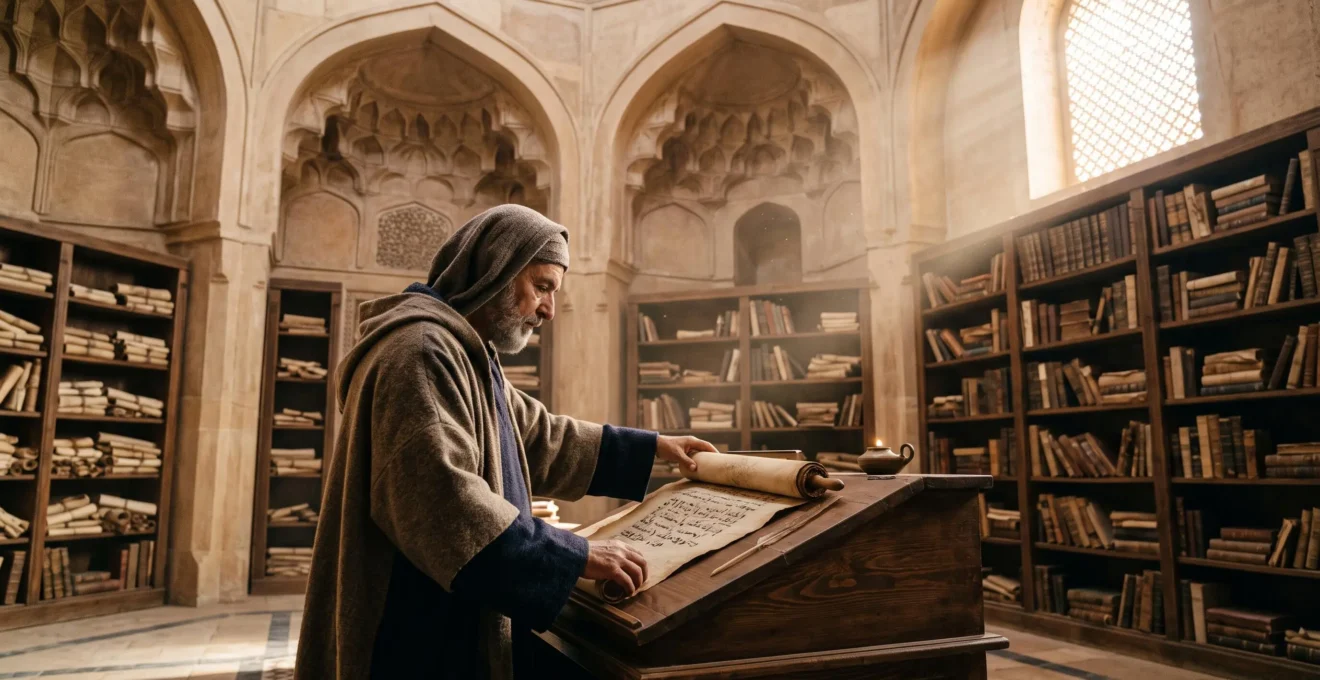
Contrary to the popular image of passive scribes, Arab scholars were active critics and architects of knowledge, engaging in one of history’s most ambitious projects of intellectual appropriation.
- They operated a state-funded “knowledge economy” to acquire texts, paying fortunes for manuscripts that contemporary Europe largely ignored.
- They didn’t just copy; they empirically tested and corrected foundational Greek theories, most famously in the field of optics.
Recommendation: View the Translation Movement not as a simple rescue mission, but as a dynamic process of critical selection, commentary, and transformative synthesis that reshaped ancient thought.
The story is often told in stark, dramatic terms: as Europe entered a period of intellectual slumber, its classical heritage—the works of Aristotle, Euclid, and Galen—teetered on the brink of oblivion. In this narrative, the saviors emerge from the East. Scholars in Baghdad, Damascus, and Córdoba, working within a flourishing Islamic civilization, are depicted as dutiful custodians, meticulously copying and translating fragile manuscripts, preserving the flame of knowledge until a resurgent Europe was ready to reclaim it during the Renaissance.
This image of a passive transfer, while comforting, obscures a far more dynamic and complex reality. The preservation of ancient wisdom was not an accident of history or an act of quiet stewardship. It was a deliberate, state-sponsored, and intensely competitive intellectual project. The fabled House of Wisdom (Bayt al-Hikma) was not merely a static library but the epicenter of a “knowledge economy,” where texts were hunted, bought, and bartered for as strategic assets. The goal was never simply to save what was old, but to absorb, challenge, and ultimately build upon it.
But what if this narrative of passive rescue is fundamentally flawed? What if this wasn’t an act of preservation, but a deliberate, high-stakes endeavor of selection, critique, and transformation? This article argues that Arab thinkers were not mere custodians; they were discerning curators, critical commentators, and bold architects of a new philosophical framework. They engaged in a process of intellectual triage, deciding which texts were worthy of survival. They practiced critical appropriation, testing ancient theories against new empirical evidence and often finding them wanting. They were engaged in a transformative synthesis that integrated Greek thought with Persian, Indian, and original Arab insights.
To understand this monumental achievement, we will explore the economic drivers that fueled this quest for knowledge, the rigorous methodologies that defined the translation process, and the pivotal moments of intellectual rebellion against the Greek masters. We will uncover the strategic choices that determined which ideas survived and how this active engagement, rather than passive preservation, truly saved ancient wisdom by forcing it to evolve.
This article delves into the specific mechanisms and critical decisions that defined this era. The following sections explore the strategic thinking, scholarly debates, and institutional frameworks that turned a collection of ancient texts into a new foundation for global thought.
Summary: The Arab World’s Critical Engagement With Ancient Thought
- Why Did Baghdad Pay 10,000 Gold Dinars for Texts Europe Considered Worthless?
- How Did Translators Process 2,000 Greek Manuscripts in Just 40 Years?
- Arab Commentaries on Aristotle vs. Original Greek: Which Offers Deeper Understanding?
- The Archive Fire That Erased 40% of Persian Medical Knowledge Forever
- How Did Scholars Decide Which 100 Texts to Translate First When 5,000 Existed?
- How Did the House of Wisdom Save 70% of Greek Philosophy From Extinction?
- Why Did Arab Scholars Invest In Greek Texts While Monasteries Ignored Them?
- How Did Arab Thinkers Preserve And Expand Greek Philosophy When Europe Had Lost It?
Why Did Baghdad Pay 10,000 Gold Dinars for Texts Europe Considered Worthless?
The vast sums of money funneled into acquiring Greek manuscripts were not a reflection of a scholarly hobby; they were a calculated state investment. In the Abbasid Caliphate, knowledge was a currency of power, prestige, and practical utility. Caliphs like al-Ma’mūn understood that mastering Greek medicine, mathematics, and engineering provided a distinct strategic advantage. A sophisticated court needed the best physicians, and a sprawling empire required advanced logistics and technology. Paying what amounted to a fortune for a single text by Euclid or Galen was a rational decision within this burgeoning knowledge economy.
This pursuit was aggressive and systematic. It wasn’t about passively receiving texts that washed ashore. Instead, it was an active hunt. Academic research shows that manuscripts were acquired through military conquests, diplomatic gifts, and specific delegations sent into Byzantine territory. The rivalry with Byzantium was not just military but cultural. Acquiring and translating the foundational texts of their rivals was a powerful statement of intellectual supremacy. This state-sponsored drive created a demand that fueled a network of collectors, translators, and scribes.
The process often involved direct, high-level diplomacy, illustrating its importance to the state. It was a far cry from the isolated copying of scripture happening in European monasteries. The historian Ibn al-Nadīm provides a vivid account of this top-down initiative:
According to Ibn al-Nadīm, al-Ma’mūn wrote to the Byzantine emperor asking him for a selection of old scientific manuscripts from Byzantium.
– Ibn al-Nadīm, cited in The Abbasid Greco–Arabic translation movement
This act of a caliph personally petitioning a rival emperor for books demonstrates that these were not dusty relics but prized geopolitical assets. The investment was immense because the perceived return—in medical innovation, engineering prowess, philosophical depth, and sheer prestige—was even greater. The value was not in the parchment but in the applicable, and often weaponizable, knowledge it contained.
How Did Translators Process 2,000 Greek Manuscripts in Just 40 Years?
The sheer velocity of the Translation Movement defies modern expectations. This was not the work of a few isolated scholars but a well-oiled, institutional machine powered by some of the most brilliant minds of the age. Central to this enterprise were polymaths like Ḥunayn ibn Isḥāq, a Nestorian Christian physician and scholar who became arguably the most important translator of the era. His work ethic and systematic approach set the standard for a generation.
The numbers associated with Ḥunayn alone are staggering. His personal catalog, the *Risāla*, documents an incredible output. A review of his work shows that Ḥunayn enumerates 129 titles, of which he himself translated about 100 into Syriac or Arabic. This wasn’t a side project; it was his life’s work, sponsored by wealthy patrons and the caliph’s court. He established a school of translators, creating a methodology and a lexicon that ensured a degree of consistency and quality across a vast body of work. This “school” acted as an assembly line for intellectual production, with students and collaborators specializing in different stages of the process, from initial Syriac drafts to polished Arabic versions.
This process began with an exhaustive search for the best available sources. Ḥunayn did not simply translate the first manuscript he found. He was a dedicated textual critic who embarked on long journeys to find the most accurate and complete versions. As the Encyclopaedia Britannica notes, “He traveled to Syria, Palestine, and Egypt to gather ancient Greek manuscripts.” This dedication to sourcing the best raw material was a critical, and often overlooked, part of the process. It ensured that the foundation upon which Arab scholarship was built was as solid as possible.
The translation itself was a multi-stage process. Often, a text was first translated from Greek into Syriac (a language with a richer philosophical vocabulary at the time) and only then into Arabic. This two-step method, while laborious, allowed for greater nuance and precision. Ḥunayn and his school were not producing literal, word-for-word copies but sought to convey the true meaning and spirit of the original—a transformative synthesis that required deep understanding of both the source and target languages and cultures.
Arab Commentaries on Aristotle vs. Original Greek: Which Offers Deeper Understanding?
The goal of the Translation Movement was never mere preservation. It was about engagement, and engagement implies critique. Arab thinkers did not treat the works of Aristotle or Ptolemy as infallible holy writ. They saw them as the best available knowledge of their time—a foundation to be tested, debated, and, if necessary, corrected. This practice of critical appropriation is perhaps the movement’s most significant legacy, elevating it from a project of transmission to one of genuine scientific and philosophical progress.
The most dramatic example of this is in the field of optics. For over a millennium, the emission theory of vision, championed by giants like Euclid and Ptolemy, held sway. It posited that the eyes emitted rays of light that illuminated objects, allowing them to be seen. It was a powerful, intuitive idea, but it was fundamentally wrong. It took the brilliant mind of Ibn al-Haytham (Alhazen) in the 11th century to dismantle it. Through meticulous experimentation, including his famous *camera obscura* investigations, he proved that vision was a passive process of light entering the eye from an external source.
This was not a minor correction; it was a scientific revolution that overturned 1,500 years of settled Greek authority. It marked a pivotal shift from philosophical speculation to empirical verification. As a research paper on his work highlights, this was a direct challenge to the masters:
Challenging the ancient Greek emission theory (postulated by Euclid and Ptolemy), which suggested that the eye emits light to perceive objects, Ibn al-Haytham advanced the intromission theory, asserting that vision occurs when external light enters the eye.
– Unani Journal research paper, Ibn al-Haytham’s optical science
Case Study: Ibn al-Haytham’s Empirical Rebuttal
The prevailing Greek theory of emission argued that human eyes worked like a torch, radiating rays of light. According to an analysis of his work by the Foundation for Islamic Culture, Ibn al-Haytham systematically vetoed this theory through rigorous experiments. He demonstrated that light travels in straight lines and that vision occurs when these light rays, reflecting off objects, enter the pupil. This move from commentary into direct empirical correction of the Greek masters shows Arab scholarship at its most innovative, establishing a new foundation for the scientific method that would later influence European thinkers like Roger Bacon and Johannes Kepler.
This willingness to challenge Aristotle or Ptolemy on the basis of evidence is what makes the Arab commentaries so vital. They are not just footnotes to the original Greek; they are a living dialogue with it. Thinkers like al-Fārābī and Ibn Sīnā (Avicenna) sought to harmonize Aristotelian philosophy with theology, while Ibn Rushd’s (Averroes’) detailed commentaries became so influential that he was known in Europe simply as “The Commentator.” These works offer a deeper understanding precisely because they are not reverential copies; they are the record of a brilliant and critical intellectual struggle.
The Archive Fire That Erased 40% of Persian Medical Knowledge Forever
The narrative of the Translation Movement often centers so heavily on Greek texts that it creates a misleading impression of a monolithic project. While Hellenistic thought was undoubtedly the primary focus, it was not the only source of ancient wisdom available. Scholars in Baghdad were at the crossroads of civilizations and had access to a wealth of knowledge from Persia and India. However, the very success and prestige of the Greek-focused translation effort created a powerful intellectual gravity, pulling resources and attention away from these other traditions. This created a form of selective preservation, where some knowledge was actively amplified while other streams were neglected and, in some cases, lost forever.
The title of this section is a provocation, a thought experiment based on a real phenomenon: the loss of knowledge that falls outside the canon. No single fire erased “40% of Persian medical knowledge,” but the cumulative effect of neglect and the destruction of libraries over centuries—like the sack of the Sasanian capital—amounted to a catastrophic loss. This fostered a kind of archival anxiety among scholars who could see these traditions fading. They knew that un-copied, un-translated, and un-commented-on texts were doomed to extinction.
One of the most heroic figures in this fight against intellectual oblivion was the 9th-century Persian physician and philosopher Muhammad ibn Zakariya al-Rāzī (Rhazes). He recognized the immense value of knowledge from all sources, not just the fashionable Greek ones. His magnum opus, *al-Ḥāwī fī al-ṭibb* (The Comprehensive Book on Medicine), was a monumental effort to synthesize the entirety of medical knowledge available to him. It was a direct response to the threat of loss.
Case Study: Al-Rāzī’s Al-Hāwī as an Intellectual Fossil Record
Al-Rāzī’s *al-Ḥāwī* was not just a summary; it was an act of intellectual archaeology. As the New World Encyclopedia notes, The Hawi preserved fragments of early Greek, Arabic, and Indian medical works which are now lost, and presented a wide variety of clinical descriptions. His method was to present the views of various authorities on a given disease, then add his own clinical experience and judgment. This makes the encyclopedia one of the only surviving windows into medical traditions that were otherwise sidelined by the dominant Greek-focused Translation Movement. It is a fossil record of otherwise extinct knowledge streams.
Al-Rāzī’s work stands as a powerful reminder that the “rescue” of ancient wisdom was not a total one. It was a process of intellectual triage, where choices—conscious or not—were made. The intense focus on Aristotle, Plato, and Galen was immensely fruitful, but it came at a cost. The ghosts of lost Persian, Syriac, and Indian texts haunt the edges of this “Golden Age,” a testament to the fact that every act of preservation is also, in some way, an act of choosing what to forget.
How Did Scholars Decide Which 100 Texts to Translate First When 5,000 Existed?
With a vast sea of available manuscripts, the scholars of Baghdad could not translate everything. They had to prioritize. This process of intellectual triage was not random; it was guided by a clear set of criteria rooted in utility, foundational importance, and intellectual prestige. The texts chosen first were those deemed most essential for building a sophisticated, functional, and intellectually robust civilization.
Practicality was a primary driver. Works of medicine, mathematics, and engineering were of immediate value. Euclid’s *Elements* was among the first texts to be translated, undertaken during the reign of Caliph Harun al-Rashid. As the MacTutor History of Mathematics archive confirms, “It was during al-Rashid’s reign that the first Arabic translation of Euclid’s Elements was made by al-Hajjaj.” This was not for abstract interest; geometry was essential for architecture, land surveying, and astronomy, which in turn was crucial for navigation and determining prayer times. Similarly, the medical works of Galen were a top priority, forming the bedrock of medical training for centuries.
The scope of these priorities was broad, covering both the practical and the profound. Translators like Ḥunayn ibn Isḥāq didn’t limit themselves to one field. An analysis of his work shows he translated works on agriculture, stones, religion, and the philosophy of Plato and Aristotle, as well as 129 Galenic treatises. This list reveals a strategic hierarchy: secure health (Galen), manage the state (agriculture, engineering), and then build the philosophical and logical superstructure (Plato and Aristotle). Logic, in particular, was seen as the essential tool—the *organon*—for all other forms of rational inquiry.
The selection process also involved a rigorous quality control mechanism. Translators like Ḥunayn were not content with a single, potentially corrupt manuscript. They actively sought out multiple copies to create a definitive master text before the real work of translation could even begin.
Action Plan: Auditing a Knowledge Preservation Mandate
- Source Mapping: Identify and list all potential acquisition channels for knowledge, from diplomatic missions and trade routes to conquered libraries and private collections.
- Utility Inventory: Catalogue existing manuscripts and prioritize them based on immediate practical value (e.g., medicine, mathematics, engineering) versus foundational philosophical importance.
- Textual Verification: Before translation, cross-reference multiple versions of a single text to reconstruct the most authentic and complete “master” version, filtering out scribal errors and corruptions.
- Novelty Assessment: Evaluate which texts offer genuinely new information or methodologies versus those that are redundant or derivative of already-processed works.
- Integration Strategy: Develop a plan not merely for literal translation, but for the subsequent stages of commentary, critique, and synthesis with existing local knowledge frameworks.
This careful, multi-step process of selection and verification ensured that the immense effort of translation was spent on the most valuable and reliable sources. It was a conscious strategy to build a library of not just any knowledge, but the best knowledge available to humanity.
How Did the House of Wisdom Save 70% of Greek Philosophy From Extinction?
The House of Wisdom, or *Bayt al-Ḥikma*, looms large in the popular imagination, often envisioned as a single, grand library—a sort of ancient Library of Alexandria for the Islamic world. While its role was undeniably central, this view is a simplification. The House of Wisdom was not a static building but an evolving institution that became the heart of a state-sponsored intellectual ecosystem. The claim that it saved “70% of Greek Philosophy” is rhetorical, but it captures a fundamental truth: without this institution, a vast portion of the classical canon would likely have been lost.
Its origins were modest. Historical records show it was founded either as a library for Harun al-Rashid or as a private collection of his predecessor, al-Mansur, in the late 8th century. It was under the reign of Caliph al-Ma’mūn (813-833 AD) that it was transformed into a vibrant public academy. It became a magnet for scholars from across the known world, attracting Christian, Jewish, and Zoroastrian intellectuals alongside their Muslim colleagues. Al-Ma’mūn, a passionate patron of the rational sciences, endowed it with substantial funds, turning it into a center for translation, research, and debate.
The institution’s primary function was to serve as the engine of the Translation Movement. It provided the infrastructure: a library to house the precious manuscripts, scriptoriums for copying, and stipends to support the scholars who did the painstaking work. It was, in effect, a publicly funded research institute. It brought a critical mass of talent and resources together in one place, creating a virtuous cycle where translations spurred new commentaries, and new commentaries demanded more translations. This institutional backing was the key ingredient that had been missing in Europe.
The House of Wisdom was more than a repository; it was a crucible. It housed an observatory, fostering advances in astronomy and mathematics. It was a forum for vigorous debate where the newly translated ideas of Aristotle and Plato were scrutinized and contested. By providing a stable, well-funded, and intellectually open environment, *Bayt al-Ḥikma* did not just “save” philosophy. It gave it a new home where it could be not only preserved but also engaged with, argued over, and ultimately, transformed for a new era.
Why Did Arab Scholars Invest In Greek Texts While Monasteries Ignored Them?
The question of why the Translation Movement ignited in Baghdad and not in Constantinople or Rome is a question of culture and context. European monastic scriptoria were indeed preserving texts, but their mission was fundamentally different. Their focus was primarily theological, their resources were scattered, and their intellectual framework was often closed. They were fortresses of faith, preserving the Latin Church Fathers and scripture, with Greek philosophy often viewed with suspicion as a pagan distraction. The environment in the Abbasid Caliphate was, by contrast, open, urban, competitive, and voraciously curious.
The key difference was the active, multicultural model of scholarship that the Abbasids inherited and scaled. This was not an invention of Baghdad but had a direct precedent in the Academy of Gondi-Shapur in pre-Islamic Persia. This Sasanian institution had been a melting pot where different intellectual traditions converged. As a report in *Nature* points out, the model brought together Greeks, Indians, Syriacs, Persians and Jews, assembled first in Gondi-Shapur and later in Baghdad. This pre-existing culture of syncretism and intellectual exchange provided the fertile ground upon which the Translation Movement could flourish. The Abbasids didn’t have to invent multicultural scholarship; they supercharged an existing model.
This active engagement model was institutionally anchored and driven by the state’s needs. It valued knowledge for its practical application and intellectual prestige, a stark contrast to the more isolated and preservation-focused copying practices of European monasteries. The use of Arabic as the *lingua franca* of scholarship and administration created a unified linguistic platform for this synthesis.
Case Study: Jundi-Shapur as the Precursor to Baghdad’s Model
The Academy of Jundi-Shapur, founded in the 3rd century AD, became a haven for scholars from various traditions, particularly after the Byzantine emperor Justinian closed the Academy in Athens in 529. Nestorian Christians, who were instrumental in transmitting Greek thought via the Syriac language, found a home there. This created a unique environment where Greek medicine and philosophy met Persian and Indian traditions. This institutional precedent for a state-sponsored, multicultural hub of learning was a direct blueprint for Baghdad’s House of Wisdom, demonstrating that the Abbasid project grew from deep historical roots of intellectual synthesis.
Ultimately, the difference was one of outlook. In Baghdad, ancient wisdom was seen as a vital resource to be actively exploited. In much of early medieval Europe, it was a potentially dangerous legacy to be cautiously managed. One culture was looking outward, seeking to absorb the world’s knowledge; the other was looking inward, seeking to protect a specific theological tradition. This divergence in mission explains why one society invested fortunes in Aristotle, while the other largely left him on the shelf.
Key takeaways
- The preservation of ancient wisdom was not passive but an active, state-funded “knowledge economy” driven by strategic needs for prestige and practical science.
- Arab scholars practiced “critical appropriation,” empirically testing and often correcting foundational Greek theories rather than just copying them.
- The focus on Greek texts led to a form of “intellectual triage,” where other traditions like Persian and Indian knowledge were sometimes sidelined or lost.
How Did Arab Thinkers Preserve And Expand Greek Philosophy When Europe Had Lost It?
The preservation and expansion of Greek philosophy in the Arab world was not a single act but the result of a unique convergence of factors: institutional support, a multicultural scholarly environment, and the emergence of extraordinary individuals. It was a process that went far beyond simple translation. It was an act of intellectual digestion, critique, and creative synthesis. While much of Europe had access only to fragments of Plato and Aristotle through Latin intermediaries, the scholars of Baghdad engaged directly with a much fuller corpus, and they did so with a critical and ambitious spirit.
The human engine of this movement consisted of polymaths who embodied the multiculturalism of their environment. Figures like Ḥunayn ibn Isḥāq were not just translators; they were masters of multiple disciplines and languages. An editorial on his life notes that “He was very learned and spoke four languages: Arabic, Syriac, Greek, and Persian.” This linguistic and cultural fluency was essential. The transmission of knowledge was not a simple A-to-B process. It often flowed from Greek to Syriac, a Semitic language with a rich philosophical tradition, and only then to Arabic. This “Syriac bridge” was a critical conduit that allowed for a more nuanced transfer of complex ideas.
This complex process of transmission is so significant that it remains an active area of advanced academic research today. The complexity of this Syriac-to-Arabic transfer is the subject of a major ERC-funded project, underscoring that the main research question leading the project addresses the contribution of the Syriac tradition in this transfer. This scholarly focus highlights that we are still unpacking the intricate ways in which ideas were filtered, interpreted, and reshaped as they crossed linguistic and cultural boundaries.
Ultimately, Arab thinkers saved Greek philosophy by refusing to let it become a museum piece. They forced it into a dialogue with their own theological questions, their scientific discoveries, and the insights of other cultures. Thinkers like al-Fārābī and Ibn Sīnā integrated Aristotelian metaphysics into a new philosophical framework, while Ibn Rushd’s rigorous commentaries sought to purify Aristotle from Neoplatonic interpretations. They expanded Greek philosophy by asking new questions of it and by using its tools of logic and reason to forge their own intellectual paths. They preserved it not by putting it in a vault, but by putting it to work.
By moving beyond the simple narrative of rescue, we recognize this historical moment for what it was: not just the preservation of the past, but the ambitious construction of a new intellectual future. Re-examining this history encourages us to appreciate the complex, critical, and transformative nature of all true knowledge transmission.
Frequently Asked Questions About The Arab Translation Movement
Was the House of Wisdom a real, physical place?
Yes, but it was more than just a single building. It began in the late 8th century as a private caliphal library in Baghdad and evolved under Caliph al-Ma’mūn in the early 9th century into a major public academy. It served as a research center, a library, a translation institute, and an observatory, making it a comprehensive intellectual institution rather than just a repository for books.
Which Greek philosophers were most translated into Arabic?
The most influential and widely translated Greek thinkers were Aristotle, whose works on logic, metaphysics, and ethics formed the core of philosophical study; Plato, though fewer of his dialogues were known directly; and medical authorities like Galen and Hippocrates. Mathematicians and astronomers such as Euclid, Ptolemy, and Archimedes were also of paramount importance due to their practical applications.
Did Arab scholars only translate texts from Greek?
No. While Greek texts were the primary focus and held the highest prestige, scholars in Baghdad also translated important works from other languages. They translated scientific, literary, and philosophical texts from Pahlavi (Middle Persian) and Sanskrit (the classical language of India). However, the intense focus on the Hellenistic canon meant that many works from these other traditions were comparatively neglected and, in some cases, subsequently lost.