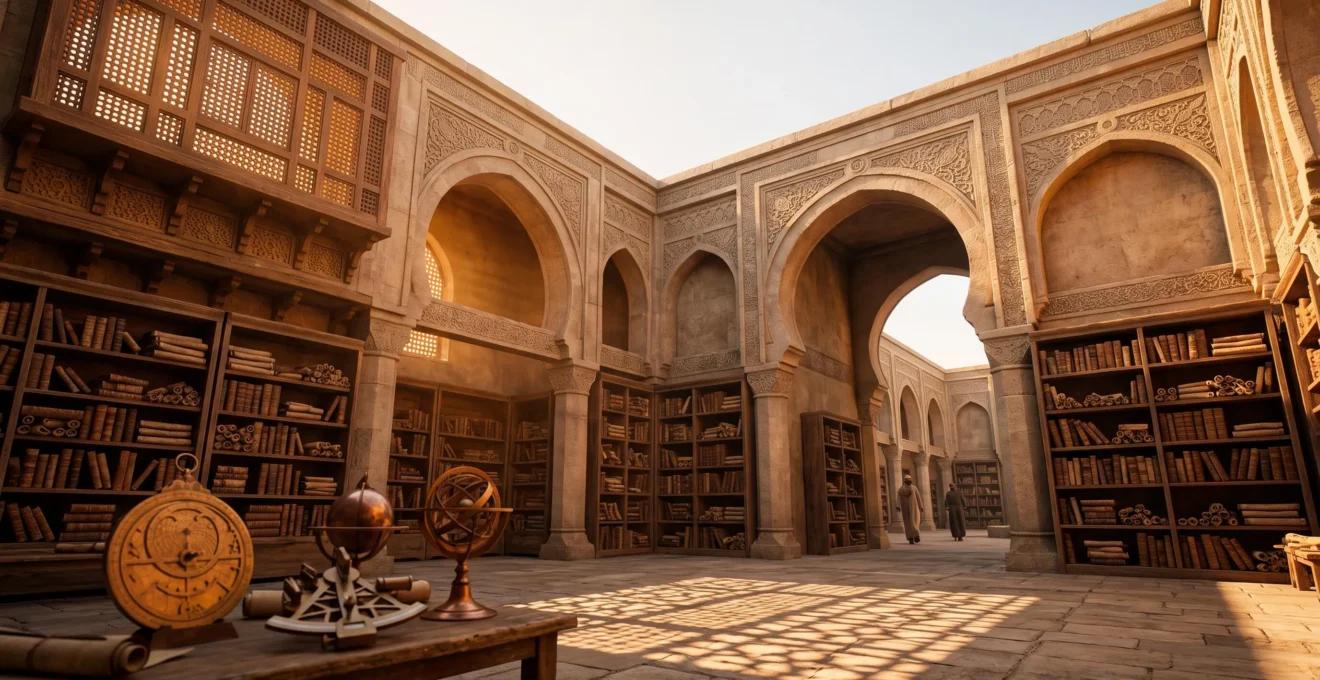
The Islamic Golden Age was not a spontaneous miracle but a deliberately engineered system where strategic state investment in knowledge infrastructure created a self-sustaining ecosystem for innovation.
- State funding was treated as geopolitical R&D, not just cultural patronage, to out-compete rivals.
- Investing in physical infrastructure like industrial paper mills dramatically lowered the cost of knowledge, accelerating its spread and development.
Recommendation: Modern innovation strategists should look beyond funding individual projects and focus on building the complete ‘intellectual supply chain’—from education and tools to distribution and application.
For centuries, policy makers and strategists have sought the formula for creating innovation hubs like Silicon Valley, often attributing their success to a hard-to-define cultural spark. This modern quest often overlooks the most successful and sustained example in history: the Islamic Golden Age. For 500 years, a vast region stretching from Spain to Persia became the world’s undisputed center for science, mathematics, and philosophy. The common narrative often portrays this era as a passive ‘preservation’ of Greek knowledge or a happy accident of history.
This simplistic view misses the crucial lesson. The Golden Age wasn’t an accident; it was the result of a deliberate and replicable system. The immense scientific output was a direct consequence of specific political conditions and strategic state investments. This was not merely about building libraries, but about constructing a complete knowledge infrastructure, from industrial-scale paper mills to state-funded translation departments that functioned like a national R&D program. It was a system that treated knowledge as a strategic asset for economic power, geopolitical influence, and administrative efficiency.
But what if the key was not just investment, but the very structure of that investment? This analysis will deconstruct the political and economic machinery that powered this five-century surge. We will explore the specific signals that preceded the boom, the mechanisms of state funding, the role of intellectual competition, and the systemic fragilities that eventually led to its decline. By understanding the Golden Age as an engineered system, we can extract a timeless blueprint for fostering sustained innovation.
This article examines the structural enablers and systemic conditions that created, sustained, and eventually ended this unprecedented period of intellectual flourishing. The following sections will guide you through the core components of this historical innovation engine.
Summary: The Political and Economic Systems That Engineered the Islamic Golden Age
- What 3 Signals Appeared 50 Years Before the Golden Age’s Scientific Explosion?
- Why Did Scientific Output Increase 600% in Just Three Generations?
- How Did Caliphs Allocate 15% of State Revenue to Scientific Research?
- Why Did Caliphs Spend 20% of Treasury Revenue on Poetry and Astronomy?
- Why Did Europe’s Brightest Minds Travel 2,000 Miles to Study in Cordoba?
- Islamic Golden Age vs. Italian Renaissance: Which Model Produced More Breakthrough Discoveries?
- The Dynasty Change That Ended 200 Years of Scientific Funding Overnight
- Which Arab Mathematical Innovations Still Power Modern Computing and Engineering?
What 3 Signals Appeared 50 Years Before the Golden Age’s Scientific Explosion?
Innovation surges are never spontaneous; they are preceded by foundational shifts in infrastructure, strategy, and culture. The Islamic Golden Age was no exception. Decades before its peak, at least three critical signals emerged, indicating that the political and economic systems were being primed for an intellectual explosion. These were not minor events but deliberate, large-scale investments that laid the groundwork for centuries of discovery. They demonstrate a conscious effort to build an innovation ecosystem from the ground up.
The first and most physical signal was a strategic act of urban planning. In 762, the Abbasid Caliph al-Mansur didn’t just choose a new capital; he designed one. The decision to found Baghdad as a purpose-built circular city was a clear statement of intent. It was conceived from the outset as a global hub, positioned at the crossroads of trade routes, and designed to house the academic institutions that would become the empire’s intellectual heart, most notably the House of Wisdom. This was a physical, top-down investment in creating a center of gravity for talent and knowledge.
The second signal was the importation and industrialization of a disruptive technology: paper. While popular tradition sometimes attributes the translation movement to a dream Caliph al-Mamun had of Aristotle, the material conditions were far more decisive. Chinese prisoners of war introduced papermaking technology after the Battle of Talas, and historians trace the technology’s arrival to around c. 751 AD. This wasn’t a niche craft; it was a revolution in knowledge infrastructure. It replaced expensive parchment and papyrus, drastically lowering the cost of recording, copying, and transmitting information across the vast empire.
The third signal was the formalization of a state-sponsored translation movement. This initiative wasn’t just about collecting old books; it was a geopolitical strategy to absorb and surpass the knowledge of rival empires, particularly the Greeks and Persians. This effort began systematically under the Abbasids, creating what can be understood as an “intellectual supply chain” to import raw knowledge for processing, synthesis, and ultimately, new creation. These three signals—a central hub, a cheap medium, and a strategic acquisition process—were the essential preconditions for the scientific super-bloom that followed.
Why Did Scientific Output Increase 600% in Just Three Generations?
An exponential rise in scientific output is not born from genius alone; it requires a radical change in the underlying knowledge infrastructure. The explosion of scholarship during the early Abbasid period was directly fueled by the industrial-scale adoption of paper. This new, cheap medium transformed knowledge from a scarce, guarded commodity into an accessible, shareable resource, fundamentally altering the economics of intellectual production.
This paragraph introduces the concept of the paper revolution. To properly visualize its impact, consider the material change itself. The image below represents the shift from rare manuscripts to a reproducible medium.
As the illustration suggests, the very texture of intellectual life changed. The case of Baghdad is illustrative. By the late 8th century, papermaking technology had not just arrived; it had been industrialized. The city operated large, powered paper mills as early as 794, even establishing a dedicated paper market, the *Suq al-Warraqin*. This wasn’t a cottage industry; it was a strategic sector. The ability to mass-produce a cheap medium for storing and transmitting information was the disruptive technology that enabled the exponential growth in scholarly manuscripts, correspondence, and administrative records.
The result was a quantifiable explosion in recorded knowledge. While precise figures are impossible, the scale of the output is staggering. The library of the House of Wisdom, for example, became a repository of unprecedented size. While some accounts are mythologized, sober historians estimate that at its peak, the collection contained hundreds of thousands of manuscripts. This massive accumulation of knowledge wasn’t just a passive collection; it was a working library, a data bank that scholars used to cross-reference, critique, and build upon existing work. The combination of a state-funded institution and an industrialized knowledge medium created a virtuous cycle, where more knowledge could be produced, stored, and accessed, leading to even more rapid innovation.
How Did Caliphs Allocate 15% of State Revenue to Scientific Research?
The idea of a state dedicating a significant portion of its budget to science may seem modern, but the Abbasid Caliphate provides a powerful historical precedent. The allocation of vast sums was not an act of whimsical patronage; it was a calculated policy of geopolitical R&D. This spending was driven by two primary systemic goals: asserting cultural and intellectual superiority over rivals like the Byzantine Empire, and inheriting the administrative and scientific mantle of the prestigious Persian Sassanian Empire.
This perspective is powerfully articulated by the historian Dimitri Gutas, who argues that from their very inception, “the Abbasid caliphs sought to assert their superiority over Byzantium and to draw upon the heritage of Iranian kings.” This framing shifts our understanding from patronage to statecraft. Investment in astronomy, medicine, and mathematics provided practical benefits for administration, military logistics, and public health, but its primary function was to project power. A caliphate that could produce the world’s best doctors, most accurate star charts, and most brilliant mathematicians was demonstrating its fitness to rule on a global stage.
The structure of this funding was as important as its scale. Caliph al-Ma’mun, for example, didn’t just throw money at the House of Wisdom; he organized it. He “extended and expanded the House of Wisdom and designated a gallery (Riwaq) for each branch of science.” This act of creating dedicated departments for different scientific disciplines reveals a sophisticated, systemic approach. It functioned less like a single grant and more like a modern diversified R&D portfolio, ensuring that multiple fields of inquiry were pursued simultaneously. This structure created resilience and fostered interdisciplinary collaboration within the broader institution.
Action Plan: Auditing a Modern Innovation Ecosystem with Lessons from the Golden Age
- Patronage vs. Policy: Distinguish between ad-hoc grants (patronage) and strategic, long-term funding tied to national goals (policy). Is your funding reactive or proactive?
- Knowledge Infrastructure Inventory: List all tools and platforms that lower the cost of creating and sharing knowledge (e.g., open-source software, data repositories, collaboration platforms). Where are the bottlenecks?
- Talent Pipeline Analysis: Map the journey of an expert from education to employment. Is the system attracting and retaining talent, or is it a “brain drain” for other ecosystems?
- Prestige & Soft Power Metrics: Identify how intellectual output is used to build national or corporate prestige. Does your ecosystem’s “brand” attract international partners and talent?
- Systemic Fragility Assessment: Identify single points of failure. What happens if a key funding source disappears or a core technology platform becomes obsolete? Develop contingency plans.
Why Did Caliphs Spend 20% of Treasury Revenue on Poetry and Astronomy?
While the 20% figure is likely an exaggeration, the underlying question reveals a core truth of the Golden Age’s political system: poetry and astronomy were not seen as separate domains of “arts” and “sciences.” They were intertwined components of a single, unified project of cultivating state prestige and demonstrating intellectual supremacy. For the rulers of Baghdad and Cordoba, funding a brilliant poet was as strategically important as funding a brilliant astronomer. Both served to legitimize their rule and elevate their court above all rivals.
This system valued the “complete intellectual,” an individual whose accomplishments spanned multiple disciplines. The career of Lubna of Cordoba in the 10th century perfectly embodies this archetype. As a scholar and secretary in the Caliph’s court, she was a master of “Arabic poetry, grammar, Arabic calligraphy art, and mathematics.” Her example shows that literary and mathematical prowess were not siloed skills but mutually reinforcing markers of intellectual and social status. A ruler who could attract and retain such multifaceted talent was demonstrating the superiority of his entire cultural and political project.
Therefore, spending on the arts and sciences was not a zero-sum game but a synergistic investment. Astronomy had practical applications in navigation, timekeeping, and religious observance, which directly benefited the state’s administration and military. Poetry, on the other hand, was the primary medium for political communication, historical record, and the construction of a ruler’s public image. A powerful poem celebrating a military victory or the founding of a new library was a tool of soft power, shaping public opinion and securing a ruler’s legacy. In this context, funding both was a rational and highly effective form of systemic investment in state power.
Ultimately, the caliphs understood that a thriving intellectual ecosystem was their greatest asset. It attracted the best minds, produced practical innovations, and created a cultural gravity that pulled the known world into their orbit. The lavish spending on both poets and astronomers was a testament to this understanding: that true power lies not just in armies, but in the ability to define and dominate the entire field of human knowledge.
Why Did Europe’s Brightest Minds Travel 2,000 Miles to Study in Cordoba?
While Baghdad was the eastern anchor of the Islamic intellectual world, the Caliphate of Cordoba in Al-Andalus emerged as a vibrant, independent western hub. For a continent mired in the so-called “Dark Ages,” Cordoba was a beacon of light. It was a city of paved streets, public baths, and streetlights, but its true draw was its unparalleled intellectual infrastructure. For scholars in Christian Europe, traveling thousands of miles to Cordoba was a rational choice; it was, simply put, where the knowledge was.
The sheer scale of Cordoba’s intellectual life dwarfed that of any other European city. Historical records indicate that for about a century, beginning in 900 CE, Al-Andalus was the most intellectually advanced and quite possibly most populous region in Europe. The city’s libraries were legendary, with the Caliph’s personal library alone said to contain over 400,000 volumes—a number greater than all the books in the rest of Europe combined. This created an irresistible center of gravity for anyone seeking knowledge.
This environment of scholarship is evoked by the serene, contemplative spaces of Andalusian architecture, designed for study and reflection.
Cordoba’s role, however, went beyond being a mere repository. It was an active site of the intellectual supply chain, where Greek and Arab works were studied, commented upon, and synthesized. The philosopher Ibn Rushd, known in Latin as Averroes, is the ultimate example of this. A Cordoban jurist, physician, and philosopher, his detailed commentaries on the works of Aristotle became the primary vehicle through which the Greek philosopher’s thought was reintroduced to medieval Europe. His influence was so profound that Thomas Aquinas, a foundational figure of Christian scholasticism, referred to him simply as “The Commentator.” This demonstrates that Cordoba was not just a destination for study; it was the critical bridge connecting the classical world, the Islamic Golden Age, and the future European Renaissance.
Islamic Golden Age vs. Italian Renaissance: Which Model Produced More Breakthrough Discoveries?
Comparing the scientific output of the Islamic Golden Age and the Italian Renaissance is a complex task, but it forces a critical re-evaluation of the “Renaissance” narrative itself. The term, meaning “rebirth,” implies a sudden rupture from a “dark age” and a direct reconnection with classical antiquity. However, a systemic analysis reveals that the Renaissance was not so much a rebirth as it was the direct inheritor of a long and continuous intellectual supply chain that ran directly through the Islamic world.
The defining characteristic of the Golden Age was not simply the passive preservation of Greek texts. As the scholar A. I. Sabra noted, “the acquired knowledge was not simply reproduced, but creatively reworked and adapted.” Scholars in Baghdad and Cordoba engaged in a dynamic process of critique, synthesis, and original contribution. They corrected errors in Ptolemy’s astronomy, expanded on Euclid’s geometry, and created entirely new fields like algebra. This active, creative engagement is a hallmark of a robust innovation ecosystem, not a passive library.
The proof of this continuous chain lies in the translation movement that preceded the Renaissance. Just as Baghdad had translated Greek into Arabic centuries earlier, cities in Islamic Spain became centers for translating Arabic into Latin. Supported by Christian rulers, groups of Jewish, Christian, and Muslim scholars collaborated, and during the 12th and 13th centuries, these Latin translations of Arab science and philosophy began to transform European universities. The works of Averroes, Avicenna, and al-Khwarizmi became standard university texts, laying the intellectual groundwork for figures like Aquinas, Copernicus, and da Vinci.
From this perspective, the Italian Renaissance appears less like a sudden “discovery” of classical knowledge and more like the moment when Europe’s own knowledge infrastructure finally became capable of fully exploiting the vast intellectual capital that had been developed and curated by the Islamic world for 500 years. The Golden Age was the engine of discovery and synthesis; the Renaissance was the beneficiary that took the finished product and launched the next phase of development.
Key Takeaways
- Innovation is not a miracle; it is the output of a deliberately constructed system of political stability, strategic funding, and knowledge infrastructure.
- True intellectual progress comes not from mere preservation, but from an active process of translation, critique, synthesis, and original creation—an “intellectual supply chain.”
- The decline of an innovation ecosystem is rarely a single event, but a slow erosion of its interdependent systemic enablers, demonstrating a profound “systemic fragility.”
The Dynasty Change That Ended 200 Years of Scientific Funding Overnight
The title of this section is deliberately provocative and reflects a common platitude: that a single event, like a change in leadership or an invasion, can instantly extinguish a golden age. The reality is far more complex and speaks to a core concept for any strategist: systemic fragility. The decline of the Abbasid Caliphate’s scientific dominance was not an overnight event but a slow-motion collapse, where the erosion of political stability gradually starved the innovation ecosystem of its essential resources long before the final, dramatic blow.
The infamous Mongol siege of Baghdad in 1258 is often cited as the definitive end. While catastrophic, it was merely the coup de grâce to a system that was already in terminal decline. The political unity that enabled large-scale state funding had been fracturing for centuries. The historical record shows a decades-long sequence of power shifts, where the Caliph’s authority became increasingly nominal. The Caliphate fell under the control of the Persian Buyids in 945, then the Seljuk Turks in 1055, long before the Mongols appeared. Each shift chipped away at the central government’s ability to direct revenue towards the kind of long-term, prestige-driven scientific projects that defined the early Abbasid era.
The scholars within the system were acutely aware of this growing fragility. The actions of the great Persian astronomer Nasir al-Din al-Tusi are a poignant case study. Foreseeing the impending Mongol invasion, al-Tusi undertook a massive project to rescue thousands of manuscripts from Baghdad’s libraries, moving them to the safety of the Maragheh Observatory, which he convinced the Mongol ruler Hulagu to build. This act of intellectual triage shows that the system’s own experts anticipated its collapse. The “death” of the Golden Age was not a sudden murder, but a long illness whose symptoms were visible for generations.
This historical lesson is critical for modern strategists. An innovation ecosystem is only as strong as its weakest interdependent link. The gradual decay of political stability, the redirection of state funds towards short-term military needs, and the loss of central authority created a system too weak to withstand a major external shock. The Golden Age did not end because the funding stopped overnight; it ended because the political system that guaranteed that funding slowly disintegrated over two hundred years.
Which Arab Mathematical Innovations Still Power Modern Computing and Engineering?
The legacy of a great innovation ecosystem is measured by the endurance of its ideas. While the political structures of the Golden Age have vanished, its intellectual output remains deeply embedded in the foundations of modern science and technology. Nowhere is this more evident than in mathematics, where innovations from 9th-century Baghdad form the bedrock of the digital world. The most profound and enduring of these is the very concept of the algorithm, a cornerstone of all modern computing.
The term “algorithm” itself is a Latinization of the name of the Persian mathematician Muhammad ibn Musa al-Khwarizmi, who worked at the House of Wisdom in Baghdad. His seminal text, “The Compendious Book on Calculation by Completion and Balancing,” introduced a systematic, step-by-step method for solving linear and quadratic equations. This was a revolutionary departure from the more abstract, geometric methods of the Greeks. Al-Khwarizmi’s focus on a repeatable, procedural process—what we now call an algorithm—is the fundamental logic that underpins all computer programming.
The connection is not merely etymological; it is foundational. Donald Knuth, a titan of modern computer science, described al-Khwarizmi’s work as “an indispensable foundation in the world of computing.” This is because every time a computer executes a task, from sorting a spreadsheet to running a complex simulation, it is following an algorithm—a precise sequence of logical steps derived directly from the intellectual tradition established by al-Khwarizmi.
This lineage continues into the most advanced fields of the 21st century. A recent academic study highlights the profound connection between Al-Khwarizmi’s methodologies and modern AI applications, such as machine learning and neural networks, which rely on systematic, iterative algorithms to learn from data. This demonstrates the incredible longevity of a truly breakthrough idea. The systematic approach to problem-solving, born in a specific political and intellectual context, has outlived its parent empire by a millennium and now powers the next technological revolution. It is the ultimate testament to the power of a well-engineered innovation ecosystem.
By studying the rise and fall of the Islamic Golden Age not as a historical fable but as a case study in systemic design, modern leaders can gain invaluable insights. The lesson is clear: sustained, world-changing innovation requires more than brilliant minds; it requires a stable, supportive political system that deliberately builds and maintains the infrastructure for knowledge to flourish. Applying these historical blueprints is the logical next step for any organization serious about fostering its own golden age.