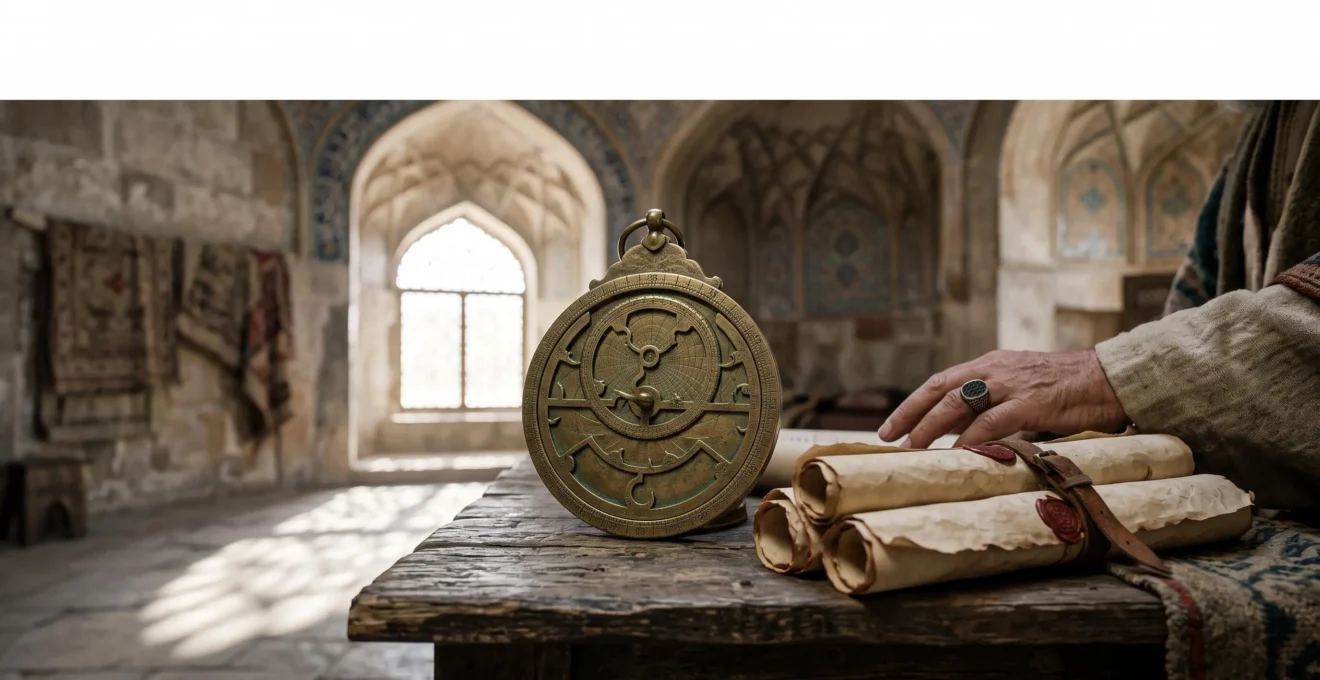
Caliphal patronage was a strategic state investment, not philanthropy, directly tying scientific and cultural funding to political goals.
- Funding surged to legitimize power and project cultural superiority over rivals, particularly the Byzantine Empire.
- A central bureaucracy and targeted talent-scouting of elite scholars maximized the return on investment, creating a self-sustaining knowledge economy.
Recommendation: Modern grant-makers should analyze funding not merely as an expense, but as a long-term tool for building strategic cultural and scientific assets.
For any arts administrator or grant maker, the central question is perennial: how does a nation decide what knowledge is worth funding? In an environment of limited resources, we debate the ROI of arts programs, the strategic value of pure research, and the difficult balance between preserving heritage and fostering new creation. We look for models of success, often focusing on the Italian Renaissance or the post-war scientific boom, assuming these represent the pinnacle of cultural investment.
But what if the most effective, durable, and transformative funding model in history came centuries earlier? The patronage of the Abbasid Caliphs during the Islamic Golden Age is often romanticized as a simple love of learning. The reality, as we will explore, is far more sophisticated. This was not charity; it was a calculated, state-driven investment in political legitimacy, soft power, and economic dominance. The Caliphs understood that controlling knowledge was as critical as controlling territory.
This analysis will deconstruct the Caliphal model, moving beyond vague praise to examine the specific mechanisms that made it work. We will investigate the political triggers that unlocked vast sums of state revenue, the rigorous criteria used to select scholars, the crucial role of state-built infrastructure, and finally, the institutional fragilities that led to its eventual, sudden collapse. The lessons for today’s cultural policy experts are both powerful and cautionary.
To understand this complex system, this article examines the specific levers and mechanisms that defined this era of unprecedented innovation. We will explore the motivations, selection processes, and political conditions that created and ultimately dismantled this historical funding model.
Summary: The Caliph’s Playbook: Unpacking the Mechanisms of a Historical Innovation Engine
- Why Did Caliphs Spend 20% of Treasury Revenue on Poetry and Astronomy?
- What Political Conditions Created the Islamic Golden Age’s 500-Year Innovation Surge?
- How Did Caliphs Choose Which 500 Scholars to Fund From 10,000 Applicants?
- State Patronage or Private Sponsorship: Which Funded More Lasting Masterpieces?
- Why Did Caliph Patronage Encourage Testing Hypotheses Rather Than Debating?
- How Did Caliphs Allocate 15% of State Revenue to Scientific Research?
- When Did Caliphs Double Arts Funding: The 5 Political Moments That Triggered Investment
- The Budget Cut That Destroyed 200 Years of Scientific Institutions Overnight
Why Did Caliphs Spend 20% of Treasury Revenue on Poetry and Astronomy?
The immense state expenditure on intellectual and cultural pursuits under the Abbasid Caliphate was not an act of arbitrary generosity but a calculated geopolitical strategy. The motive was twofold: to establish overwhelming cultural superiority over rivals, chief among them the Byzantine Empire, and to construct a new, cohesive “Islamicate” civilization that unified a vast and diverse territory. This spending was a direct investment in soft power and imperial legitimacy. As one analysis notes, the translation project had specific political and ideological motives, with Abbasid caliphs seeking to absorb the heritage of ancient Persian and Greek knowledge to bolster their own imperial claims.
This created a powerful feedback loop. The prestige of the Caliph’s court attracted the world’s greatest minds, and their work, in turn, enhanced the Caliph’s prestige. This was not merely about collecting books; it was about building a knowledge economy. The state actively created the infrastructure for this economy. For instance, the establishment of the first paper mills in Baghdad by 800 CE, a technology acquired from Chinese prisoners of war, dramatically lowered the cost of reproducing and disseminating knowledge. This industrial policy was as crucial as the funding of scholars, turning Baghdad into the world’s information-processing supercomputer.
The House of Wisdom (Bayt al-Hikmah) was the crown jewel of this strategy. More than a library, it was a state-funded institute for research, translation, and scholarship that acted as an economic multiplier. By providing generous stipends, resources, and a collaborative environment, the Caliphate cornered the market on intellectual talent, making Baghdad the undisputed center of global science and philosophy for centuries.
This strategic expenditure demonstrates that the Caliphs viewed knowledge not as a luxury but as a fundamental pillar of state power, on par with the military and the treasury.
What Political Conditions Created the Islamic Golden Age’s 500-Year Innovation Surge?
The 500-year surge in innovation was not an accident of history but the direct result of a set of deliberate and sustained political conditions. The foundational act was the establishment of a new, stable, and centralized political entity. In 762 CE, the Abbasid Caliphate moved its capital from the periphery to a purpose-built city: Baghdad, the “Round City.” This was a statement of intent. The city was designed from the ground up to be a global hub for commerce, governance, and, most importantly, intellect.
This political stability, combined with a strategic location at the crossroads of major trade routes, created immense wealth. The Caliphate controlled a vast, unified economic zone stretching from Spain to India, allowing for the free movement of goods, people, and ideas. This created a cosmopolitan environment where scholars from different cultures and faiths—Christians, Jews, and Muslims—could congregate and collaborate under the protection and patronage of the state. This intellectual pluralism, underpinned by a common scholarly language (Arabic), was a direct result of a political decision to prioritize talent over origin.
Furthermore, the early Abbasid caliphs established a political culture where patronage of the arts and sciences was a key marker of a successful reign. Rulers like Harun al-Rashid and his son al-Ma’mun engaged in a form of competitive legacy-building, each seeking to outdo his predecessor in the splendor of his court and the brilliance of the scholars he sponsored. This made intellectual patronage a core function of political leadership, hardwiring it into the state’s operational DNA for generations and creating the stable, long-term conditions necessary for a true golden age.
Without this unique confluence of stability, wealth, and a politically motivated commitment to knowledge, the institutional frameworks for innovation would never have taken root.
How Did Caliphs Choose Which 500 Scholars to Fund From 10,000 Applicants?
The Caliphate’s selection process was not an open-ended grant program but a highly targeted talent acquisition strategy. While the numbers were vast, the approach was far from a random distribution of funds. The primary criterion was not just potential, but demonstrated excellence and relevance to the state’s strategic objectives. Caliphs and their advisors acted more like modern venture capitalists or elite recruiters, actively headhunting the best minds rather than passively reviewing applications. Under the patronage of Caliph Al-Ma’mun, this was a global effort, attracting scholars to “share knowledge across science, philosophy, astronomy, medicine and art.”
The key was identifying individuals who could not only preserve existing knowledge but build upon it. Patronage was extended to figures like Muhammad ibn Musa al-Khwarizmi, whose work on algebra and algorithms had immediate practical applications in taxation, inheritance law, and engineering. Similarly, Al-Kindi was sponsored for his ability to synthesize Greek philosophy with Islamic theology, a crucial task for building the ideological foundations of the empire. A deep analysis of the Translation Movement reveals a clear pattern: the state was not just collecting texts, but investing in individuals capable of creating new intellectual property that served the empire’s needs.
This process was facilitated by the very institutions the Caliphs had built. The House of Wisdom and other academies served as hubs where talent could be identified, vetted, and nurtured. A scholar’s reputation within these circles, demonstrated through debate and the quality of his work, was the most valuable currency. In essence, the Caliphate outsourced the initial vetting to a peer-review system it had itself created, allowing the final funding decisions to be focused on a pre-qualified pool of elite talent.
Action Plan: Auditing Your Patronage Strategy
- Points of Contact: List all channels where funding is announced and talent is scouted. Are you relying on passive applications or actively headhunting?
- Collecte: Inventory your current portfolio of funded projects. Categorize them by goal: preservation, new creation, or strategic capability-building (e.g., developing a new artistic medium).
- Cohérence: Confront your portfolio with your organization’s core values. Does your funding reflect your stated mission, or has it drifted?
- Mémorabilité/Émotion: Identify the 1-2 “legacy” projects in your portfolio—the ones that are truly unique vs. generically competent. What made them successful?
- Plan d’intégration: Identify gaps. Do you need more “Al-Khwarizmis” (practical problem-solvers) or “Al-Kindis” (foundational thinkers)? Prioritize your next funding cycle to fill these holes.
This strategic approach ensured that the state’s immense resources were concentrated on individuals and projects with the highest potential for generating significant intellectual and political returns.
State Patronage or Private Sponsorship: Which Funded More Lasting Masterpieces?
While both state and private patronage coexisted during the Islamic Golden Age, it was state patronage that served as the foundational engine, creating the ecosystem in which private sponsorship could later flourish. The most lasting and transformative “masterpieces”—whether the development of algebra, the establishment of the scientific method, or the great works of philosophy—were almost exclusively products of large-scale, long-term state investment. Private patrons, while important, typically operated on a smaller scale and with a shorter time horizon.
The state’s role was to undertake the “megaprojects” that no single individual could afford. The collection and translation of the entire corpus of Greek, Persian, and Indian knowledge was a multi-generational state-driven effort, initiated by Caliph Al-Mansur and massively expanded by his successors. This vast undertaking created the critical mass of knowledge that formed the bedrock of the Golden Age. Only after the state had built this infrastructure did wealthy merchants, viziers, and officials begin to emulate the Caliphs, establishing their own private libraries and sponsoring individual scholars. The state created the market and set the standard for what was culturally valuable.
This dynamic is perfectly captured in the illustration below, where the state’s investment represents the heavy, foundational mass upon which private contributions could build. The state provided the scrolls of established knowledge, while private patrons could then fund the ornate inkwells for new scholarship to be written.
The evidence suggests a clear sequence: the state acted as the primary venture capitalist, taking on the high-risk, high-cost, long-term investments in intellectual infrastructure. Private patrons then entered the field, acting more like angel investors, sponsoring specific scholars or projects that aligned with their personal interests within the framework the state had already built. While private sponsorship created many valuable works, the foundational masterpieces that defined the era were overwhelmingly the result of strategic state funding.
Therefore, state and private funding were not competitors but partners in a clear hierarchy, with the state providing the essential foundation for innovation.
Why Did Caliph Patronage Encourage Testing Hypotheses Rather Than Debating?
The patronage model of the Caliphate was fundamentally results-oriented. While theological and philosophical debate had its place, the state’s strategic interests lay in funding knowledge that was practical, verifiable, and could generate tangible advantages—be it in medicine, engineering, cartography, or warfare. This created a powerful incentive structure that favored an empirical framework and the scientific method over purely scholastic disputation. A superior astronomical model meant better navigation and more accurate prayer times; a more effective medical procedure meant a healthier army and populace. These were measurable outcomes.
The archetypal figure of this movement is Hasan Ibn al-Haytham, often called the “father of modern optics.” His work was a direct challenge to the ancient Greek method of relying on abstract reasoning alone. Instead, Ibn al-Haytham conducted meticulous experiments with light, shadow, and perception. He built early versions of the camera obscura and systematically tested his hypotheses, a process he documented in his monumental *Book of Optics*. It is a landmark of scientific history that Ibn al-Haytham used the scientific method to obtain his results, a process that requires observation, hypothesis, experimentation, and verification.
This focus on empiricism is visually represented in the tools of the era, such as the alchemical vessel depicted below. These were not instruments for debate, but for testing, measuring, and transforming physical matter. The patronage system rewarded scholars who could demonstrate their theories through repeatable experiments, not just defend them with rhetorical skill. This practical, evidence-based approach is what allowed scholars of the Golden Age to correct the errors of ancient authorities like Ptolemy and Galen and lay the groundwork for the European Scientific Revolution centuries later.
By funding laboratories, observatories, and hospitals, the Caliphs were investing in the very infrastructure of empirical testing. They were not paying for talk; they were paying for discovery.
This pragmatic focus ensured that the intellectual output of the era was not just profound but also profoundly useful, driving innovation across a wide range of fields.
How Did Caliphs Allocate 15% of State Revenue to Scientific Research?
Allocating such a significant portion of state revenue to scientific and cultural endeavors required a sophisticated bureaucratic apparatus, not just a benevolent ruler’s whim. The Abbasid Caliphate developed a remarkably modern system of public finance that enabled this level of sustained investment. The key institution was the Diwan al-Kharaj, effectively the state’s finance and tax department. This body was responsible for much more than simply collecting taxes; it was a data-driven organization.
The Diwan conducted land surveys, kept detailed records of agricultural output, and monitored trade revenues across the empire. This provided the Caliph with a clear and relatively accurate picture of the state’s total income, allowing for systematic budgeting. As one historical analysis of the period’s tax systems highlights, the Diwan was established specifically to record taxes and other revenues to the state treasury and also collected various statistical data. This centralized fiscal control was the mechanism that made large-scale, multi-year funding commitments possible.
The allocation to the House of Wisdom and other scholarly initiatives was therefore not an ad-hoc payment but a formal line item in the state budget. Funds were drawn from the central treasury (the Bayt al-Mal) and disbursed to support specific projects, pay scholar salaries, and finance translation efforts—sometimes paying for books by their weight in gold. This formal, bureaucratic process ensured a level of predictability and stability in funding that was unprecedented. It transformed patronage from a personal gift into a professionalized, state-managed enterprise. The ability to track, measure, and allocate revenue was the quiet, administrative bedrock upon which the entire intellectual edifice of the Golden Age was built.
It was this mastery of finance and administration, as much as a love of learning, that enabled the Caliphate to fund its ambitious intellectual agenda on an industrial scale.
When Did Caliphs Double Arts Funding: The 5 Political Moments That Triggered Investment
Surges in funding for arts and sciences were rarely arbitrary; they were almost always tied to specific, pivotal political moments that created a pressing need for the Caliph to assert or re-assert his legitimacy and power. These were not acts of peacetime largesse but strategic moves in a high-stakes political game. An analysis of the era reveals several key patterns for when a ruler would “double down” on intellectual patronage.
One primary trigger was the consolidation of power after a civil war or succession crisis. After Caliph Al-Ma’mun defeated his brother Al-Amin in a devastating civil war that ravaged Baghdad, he initiated one of the most significant expansions of funding for the House of Wisdom. This massive investment was a political masterstroke: it reframed his rule not as one of conquest but as one of enlightenment, repositioning Baghdad as a center of intellectual rebirth and earning him the posthumous title of “Master of Arabic Civilisation.” The funding was a tool to heal political wounds and build a new, unifying narrative.
Another key moment was the need to project superiority over a rival power. The ongoing ideological and military competition with the Byzantine Empire fueled the translation movement. Every ancient Greek text translated into Arabic was a symbolic victory, appropriating the heritage of a rival and demonstrating that the Caliphate was the true heir to classical wisdom. Funding was also increased during periods of great territorial expansion to help create a new, shared “Islamicate” civilization, a concept that could unify a diverse empire of Arabs, Persians, Turks, and others under a single cultural and intellectual banner. Finally, a new dynasty seeking to legitimize its rule, like the Abbasids overthrowing the Umayyads, would use massive cultural projects to demonstrate its fitness to govern and erase the memory of its predecessors.
In each case, a surge in funding was a direct response to a political imperative, demonstrating that for the Caliphs, culture and science were indispensable instruments of power.
Key Takeaways
- Caliphal patronage was a strategic state investment in soft power and legitimacy, not mere philanthropy.
- The system relied on sophisticated bureaucratic mechanisms (like the Diwan al-Kharaj) for budgeting and targeted talent-scouting for selection.
- The model’s greatest strength—centralized state funding—was also its greatest weakness, making it vulnerable to shifts in political and ideological priorities.
The Budget Cut That Destroyed 200 Years of Scientific Institutions Overnight
The decline of the Islamic Golden Age is often attributed solely to the Mongol sack of Baghdad in 1258. While catastrophic, this event was the final blow to a system that had already been hollowed out from within by a devastating “budget cut” of a different kind: the withdrawal of ideological and political support. The system’s greatest strength—its reliance on a centralized, all-powerful patron—had become its fatal flaw. This demonstrates the profound institutional fragility of a system dependent on the whims of a single funding source.
The turning point occurred much earlier, in the late 9th century. Caliph Al-Ma’mun had championed a rationalist school of theology known as Mu’tazilism, which was highly compatible with Greek philosophy and scientific inquiry. However, his successors reversed this policy, embracing a more conservative, traditionalist orthodoxy. This ideological shift had immediate and disastrous consequences for state funding. As historian Hillel Ofek notes, the backlash was so severe that by 885, it had become a crime to copy books of philosophy. This was not a gradual decline; it was a switch being flipped. The very activities the state had once promoted were now suppressed.
This withdrawal of state support dismantled the institutional ecosystem over decades. Observatories lost funding, scholars were marginalized, and the spirit of critical inquiry was replaced by an emphasis on dogma. The abandoned observatory in the image below serves as a powerful symbol of this process: the structure remains, but its purpose and lifeblood are gone. When the Mongols arrived in 1258, they were not destroying a thriving intellectual center but delivering the coup de grâce to an institution already in a state of managed decline, its scholars killed or scattered.
The lesson for modern policy experts is stark: without institutional resilience and diverse funding streams, even the most brilliant cultural and scientific edifice can be dismantled almost overnight by a shift in political winds.
For today’s arts administrators and policy experts, the ultimate challenge is therefore not just to build centers of excellence, but to build resilient institutions that are structured to outlast the political cycles and ideological shifts that are an inevitable part of history.