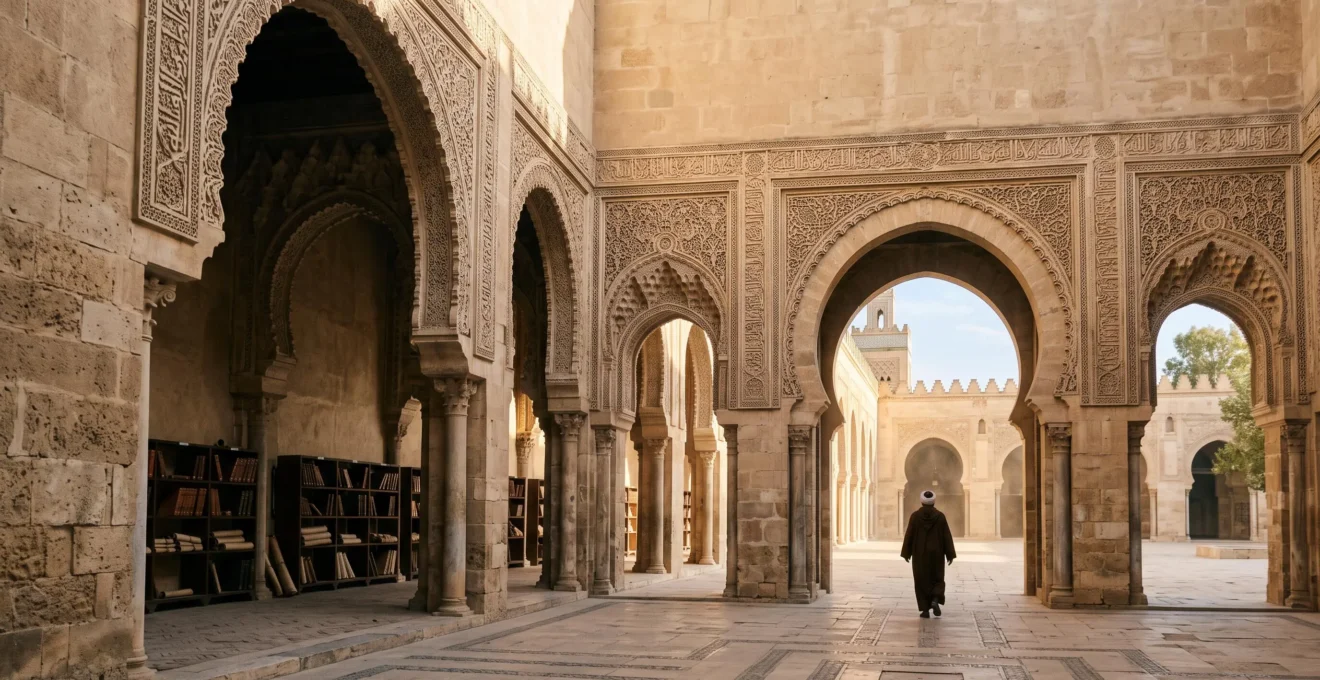
The Islamic Golden Age’s intellectual dominance was not an accident; it was the result of a deliberate, well-funded institutional strategy that created the medieval world’s first true research universities.
- Open, pluralistic academies actively generated new knowledge, vastly out-innovating the closed, preservationist model of contemporary European monasteries.
- Sustained state patronage and private endowments created a stable “knowledge economy” that incentivized discovery and attracted the world’s top minds.
Recommendation: Understanding this history reveals that sustainable innovation depends less on individual genius and more on creating resilient, open, and well-supported institutional frameworks.
When we picture the great leaps of human understanding, we often imagine solitary geniuses—an Archimedes in his bath or a Newton under his apple tree. The story of the Islamic Golden Age is frequently told this way, as a collection of brilliant individual achievements in mathematics, medicine, and philosophy. This narrative, while inspiring, misses the most revolutionary innovation of all: the creation of the institutions themselves. While Europe’s intellectual life was largely confined to the cloistered preservation of doctrine, a network of vibrant centers across the Arab world was actively forging a new model for human knowledge.
The common understanding is that these centers “saved” Greek knowledge by translating it. This is true, but it is only a fraction of the story. It doesn’t explain the magnetic pull that made a German nun declare Córdoba “the ornament of the world,” nor the economic and political systems that funded this massive intellectual enterprise. The real question is not *what* they knew, but *how* their institutions were structured to create, debate, and disseminate knowledge on an unprecedented scale. What if the true genius of the era was not just in its discoveries, but in building the very systems that made discovery possible?
This analysis will deconstruct the institutional architecture of these medieval powerhouses. We will examine the open-access model of Baghdad’s academies, explore the funding mechanisms that fueled a 500-year innovation surge, and analyze the systemic vulnerabilities that led to their eventual decline. By looking beyond the individual achievements, we uncover a blueprint for a functioning knowledge economy—a lesson in institutional design that remains profoundly relevant today.
This article explores the specific systems, funding models, and cultural conditions that allowed these centers to function as the research universities of their age. The following sections break down this institutional framework, from its rise to its lasting legacy.
Summary: The Institutional Blueprint of the Golden Age
- Why Did Europe’s Brightest Minds Travel 2,000 Miles to Study in Cordoba?
- How Did the House of Wisdom Save 70% of Greek Philosophy From Extinction?
- Baghdad’s Open Academies vs. Europe’s Closed Monasteries: Which Produced More Innovation?
- The Leadership Mistake That Let 400,000 Manuscripts Burn in 1258
- What Conditions Allowed Al-Qarawiyyin to Survive 1,200 Years While Others Vanished?
- How Did Caliphs Allocate 15% of State Revenue to Scientific Research?
- How Did Universities Revise Curriculum After Accessing Arab Medical Texts?
- What Political Conditions Created the Islamic Golden Age’s 500-Year Innovation Surge?
Why Did Europe’s Brightest Minds Travel 2,000 Miles to Study in Cordoba?
Long before the first European universities were established, the intellectual gravity of the Arab world was undeniable. In the 10th century, a German nun and poet named Hroswitha of Gandersheim, who had never seen the city, was so captivated by its reputation that she described Córdoba as “the ornament of the world.” This was not mere hyperbole; it reflected a consensus. The city was a beacon of learning, public works, and cultural sophistication that drew scholars, merchants, and diplomats from across the known world. The allure was a combination of accessible knowledge and a vibrant, pluralistic society where Christian, Jewish, and Muslim thinkers interacted.
This intellectual magnetism is perfectly personified by the journey of Gerbert of Aurillac. As a young Christian monk from France, he traveled to the borderlands of Islamic Spain not as a missionary, but as a student. There, he absorbed the advanced mathematical and astronomical knowledge circulating from centers like Córdoba. This was not a casual pursuit; he used this knowledge to reintroduce the abacus to Europe and champion the use of Arabic numerals, a system far superior to the cumbersome Roman one. Gerbert’s career arc demonstrates the power of Córdoba’s intellectual ecosystem: this provincial monk, educated by Arab-derived science, eventually ascended to become Pope Sylvester II, the head of the Western Church. His story illustrates that the knowledge flowing from Al-Andalus was not seen as a threat, but as a vital resource for even the highest echelons of European society.
How Did the House of Wisdom Save 70% of Greek Philosophy From Extinction?
The preservation of classical Greek knowledge was not a passive act of collecting dusty scrolls. It was an active, state-funded, and systematic project of intellectual rescue and integration. The legendary House of Wisdom (Bayt al-Hikma) in Baghdad was the epicenter of this effort, functioning less like a library and more like a modern research institute. Its mission was not merely to store texts, but to acquire, translate, and ultimately build upon them. This process was described by the historian A.I. Sabra as the “appropriation and naturalisation of Greek science by Islamic civilisation,” a deliberate effort to make foreign knowledge a native tool for innovation.
This “appropriation” was a monumental undertaking, driven by a multilingual and multi-faith cast of scholars. The scale of the work is staggering. For instance, the Nestorian Christian translator Hunayn ibn Ishaq personally rendered or supervised over 100 works of key figures like Plato, Aristotle, and the physician Galen into Arabic. This was not a simple word-for-word translation. Hunayn and his team would collate multiple Greek and Syriac manuscripts of the same text, compare them for accuracy, and produce a definitive critical edition in Arabic. This rigorous, scholarly method ensured that the knowledge being preserved was not corrupted, but clarified and enhanced. It was this process of active curation, not passive storage, that truly saved these foundational texts from being lost to history.
Appropriation and naturalisation of Greek science by Islamic civilisation.
– A.I. Sabra, The influence of the Academy of Gondishapur on the formation of the House of Wisdom
This systematic approach turned Baghdad into the intellectual clearinghouse of the world, where ancient wisdom was not just remembered but revitalized. By translating these works into Arabic, the scientific lingua franca of the time, they made them accessible to a new generation of thinkers from Spain to Persia, fueling centuries of commentary, critique, and new discovery.
Baghdad’s Open Academies vs. Europe’s Closed Monasteries: Which Produced More Innovation?
The stark difference in intellectual output between the Arab world and early medieval Europe was not due to a difference in intelligence, but in institutional mission. While European monasteries were primarily centers of contemplation and preservation, Baghdad’s academies were engines of discovery and debate. The core purpose of a monastery was to safeguard existing Christian doctrine and copy manuscripts for liturgical use. Innovation was not the goal; fidelity to established dogma was. Access was highly restricted, and the language of scholarship, Latin, was largely a clerical and administrative tongue.
In contrast, Baghdad’s institutions, epitomized by the House of Wisdom, were fundamentally open and pluralistic. Their mission was to actively expand the frontiers of knowledge. Scholars were not just monks copying texts; they were salaried researchers, translators, and debaters from diverse backgrounds—Christians, Jews, Muslims, and others—working together. This diversity was a strategic asset. As one analysis notes, the primary working languages were not just Arabic, but also Greek, Syriac, and Persian, creating a rich environment for cross-pollination of ideas. This institutional design fostered a culture of critical inquiry rather than rote learning. The result was a system geared for generating new discoveries, not just preserving old ones.
This table, based on modern historical analysis, starkly contrasts the divergent goals and structures of these two contemporary models of learning.
| Criterion | Baghdad’s Open Academies | Europe’s Closed Monasteries |
|---|---|---|
| Core Mission | Generate new discoveries, translate and expand knowledge | Preserve existing doctrine and manuscripts |
| Access | Open to multi-faith scholars, public debate | Restricted mainly to clergy, contemplative and liturgical use |
| Dominant Language Role | Arabic as a shared scientific lingua franca across regions | Latin primarily liturgical and administrative |
| Contemporary Classification | Considered by some medieval historians as outside the strictly ‘university’ Christian-European model | Seen by some medieval historians as the specifically Christian, European origin of the university |
Ultimately, the question of which produced more innovation is answered by their institutional mandate. European monasteries succeeded perfectly in their goal of preservation, forming a crucial bedrock for later developments. However, Baghdad’s open academies, with their focus on translation, synthesis, and public debate, created an ecosystem that was structurally designed for intellectual and scientific breakthroughs. They were, in function if not in name, the true research universities of their time.
The Leadership Mistake That Let 400,000 Manuscripts Burn in 1258
The siege of Baghdad in 1258 by Mongol forces under Hulagu Khan is an event of cataclysmic proportions in world history. The popular narrative is one of pure, barbaric destruction. Eyewitness accounts, passed down through generations, paint a horrifying picture: “Survivors said so many books were thrown into the river that the waters of the Tigris ran black with ink; others said the waters were red from blood.” This powerful imagery captures the profound sense of loss—the destruction of not just a city, but of a repository of human knowledge, with estimates of hundreds of thousands of manuscripts from various libraries, including the House of Wisdom, being lost forever.
However, to view this tragedy solely as an external act of destruction is to miss the critical leadership lesson. The Abbasid Caliphate’s great strength—its centralization of knowledge in the magnificent capital of Baghdad—had become its greatest systemic vulnerability. For centuries, the city had acted as an intellectual magnet, drawing in scholars and texts. But this concentration meant that a single military defeat could have a disproportionately devastating impact on the intellectual heritage of an entire civilization. The mistake was not in building the libraries, but in creating a system where a single “black swan” event could wipe out the master copies of centuries of work. There was no distributed backup, no off-site server. The fall of Baghdad was a catastrophic single-point-of-failure.
More recent scholarship, however, adds a crucial layer of nuance to this story of absolute decline. While the physical destruction was immense, the intellectual network was more resilient than previously thought. As a recent volume of studies notes:
The contributions to this volume challenge the long-standing narrative of Baghdad’s cultural and intellectual decline following the Mongol conquest of 1258.
– Editors, Medieval Worlds 22, The Mongols’ Baghdad: Knowledge Transmission through Manuscript Cultures Before and After the Conquest
Scholars fled, carrying knowledge with them to other centers in Egypt, Syria, and Persia. The Mongol rulers themselves, in a surprising turn, became patrons of science in later generations. The tragedy of 1258 is therefore not just a story of destruction, but a harsh lesson in the dangers of over-centralization and the remarkable resilience of a distributed intellectual culture.
What Conditions Allowed Al-Qarawiyyin to Survive 1,200 Years While Others Vanished?
While the great centralized library of Baghdad proved tragically vulnerable, a different institutional model in Fez, Morocco, was built for longevity. The University of al-Qarawiyyin stands as a testament to a different kind of resilience. Founded in 859 CE, it is recognized by UNESCO and the Guinness World Records as the world’s oldest continuously functioning degree-granting institution. Its survival for over a millennium, through countless dynastic changes, wars, and famines, was not an accident. It was the direct result of its foundational structure.
The key to its endurance lies in its origin story. The institution was not founded by a caliph or a sultan, but by a woman, Fatima al-Fihri. The case study of its founding reveals a critical strategic difference from state-sponsored institutions:
Fatima al-Fihri’s Endowment-Funded Foundation Model
Fatima al-Fihri, the daughter of a wealthy merchant, used her substantial inheritance to establish the al-Qarawiyyin mosque and its associated madrasa (school) in the 9th century. By embedding the institution’s survival in a private philanthropic endowment (a *waqf*), she made it financially independent from the whims of any single ruler or dynasty. This model, where the institution was funded by the proceeds of donated assets rather than direct state budgets, allowed it to outlast numerous political upheavals in Morocco over the following 1,200 years. Its allegiance was to its mission, not to a political patron.
This *waqf* system created a form of institutional resilience that the great, state-dependent libraries of Baghdad and Córdoba lacked. While state patronage could create spectacular results in the short term, it also tied the fate of the institution to the political and military fortunes of its sponsor. Al-Qarawiyyin, by contrast, was built on a foundation of community investment and legal independence. This decentralized, endowment-based model proved to be the more robust strategy for long-term survival, allowing it to weather the storms that leveled other, more famous centers of learning.
How Did Caliphs Allocate 15% of State Revenue to Scientific Research?
The notion of a caliph dedicating a significant portion of the state budget to scientific research might seem fantastical, but it reflects a core principle of the Abbasid era: knowledge was a form of power and prestige. While a precise figure like “15%” is difficult to substantiate across the entire period, the scale of investment was undeniably massive and systemic. This was not about a few rulers with a hobby; it was a state-level policy. Early sponsorship, for instance by powerful families like the Barmakids, involved commissioning numerous translations from Greek, laying the groundwork for a true “knowledge economy.”
This state investment needed ideological justification to be sustained. It couldn’t be seen as a mere luxury. A key mechanism for this was framing scientific inquiry as an act of piety and a fulfillment of the ruler’s duty. The case of Caliph al-Ma’mun provides a perfect example of how this was achieved.
Al-Ma’mun’s Dream: Legitimizing State Science Funding
One of the most powerful legitimizing narratives for the massive investment in the House of Wisdom revolves around Caliph al-Ma’mun. It is said that the Greek philosopher Aristotle appeared to him in a dream, urging him to seek out and translate the works of the ancients. Whether the dream was a genuine experience or a brilliant piece of political communication is irrelevant. By framing his patronage of science and philosophy as a divinely-inspired mission endorsed by the greatest of the ancient sages, al-Ma’mun elevated the translation movement from a personal project to a matter of caliphal prestige and religious virtue. This ideological framing provided the social and political cover to justify spending vast sums on libraries, observatories, and the salaries of scholars, both Muslim and non-Muslim.
This strategic use of narrative transformed state patronage from simple altruism into a tool of “soft power.” A caliph’s legitimacy was measured not only by his military victories but also by the brilliance of the scholars at his court. Funding science became a competitive enterprise, with rulers and governors vying to attract the best minds. This created a virtuous cycle: state investment produced impressive scientific results, which in turn enhanced the prestige of the state, justifying further investment. It was this self-reinforcing loop that fueled the Golden Age’s remarkable and sustained intellectual output.
How Did Universities Revise Curriculum After Accessing Arab Medical Texts?
The intellectual output of the Islamic Golden Age did not remain confined to its borders. As political tides shifted, this vast body of knowledge began to flow back into Europe, primarily through Spain and Sicily, forcing a radical revision of European education, particularly in medicine. For centuries, European medical practice had been based on a fragmented and often superstitious understanding of the classical traditions of Galen and Hippocrates. The arrival of Arabic texts changed everything.
European scholars like Gerard of Cremona and Constantine the African dedicated their lives to translating these works from Arabic into Latin. They were not just recovering lost Greek texts; they were discovering centuries of new research, commentary, and clinical practice. Key texts like Ibn Sina’s (Avicenna’s) *The Canon of Medicine* were not mere summaries but comprehensive encyclopedias that systematized all known medical knowledge, from pharmacology to surgery. They introduced concepts entirely new to Europe. Indeed, among the era’s intellectual achievements in medicine that reshaped later scholarship were the first accurate description of pulmonary circulation by Ibn al-Nafis, significant advances in ophthalmology and cataract surgery by Ammar ibn Ali al-Mawsili, and the introduction of a more rigorous, evidence-based approach to clinical practice.
The impact on the nascent universities of Bologna, Padua, and Paris was revolutionary. The *Canon of Medicine* became a standard medical textbook in Europe for over 600 years, well into the 17th century. The curriculum had to be rebuilt around this new, more sophisticated body of knowledge. It forced a shift away from purely theoretical or faith-based healing toward a more empirical and systematic study of the human body. The introduction of these texts did not just add new facts to the curriculum; it imported a more advanced methodology of inquiry, laying the groundwork for the European scientific revolution that would follow centuries later.
Key Takeaways
- Institutional Design Matters: The success or failure of intellectual movements depends heavily on the structure of their institutions—open and generative versus closed and preservationist.
- Pluralism as an Engine: The most innovative centers were those that embraced intellectual and cultural pluralism, understanding that diversity of thought is a catalyst for discovery.
- The Peril of Centralization: Concentrating all intellectual capital in a single location creates a critical vulnerability, whereas decentralized, endowment-based models can prove more resilient over centuries.
What Political Conditions Created the Islamic Golden Age’s 500-Year Innovation Surge?
The remarkable intellectual flourishing that we call the Islamic Golden Age was not a historical accident. It was the product of a specific and potent set of political and social conditions that created a fertile ground for innovation. This period, lasting roughly from the 8th to the 14th century, was defined by a period of cultural flourishing lasting roughly six centuries across a vast connected territory, from Al-Andalus in the west to Central Asia in the east. This vast, unified trade zone, secured by a common language of commerce and scholarship (Arabic), allowed not just goods, but ideas, texts, and scholars to move with relative ease. A discovery made in Baghdad could be debated in Córdoba within a generation.
Furthermore, the rise of the Abbasid Caliphate in 750 marked a crucial political shift. The Abbasids moved the capital to Baghdad and consciously built their legitimacy not just on military might or religious lineage, but on their patronage of arts and sciences. They inherited and absorbed the administrative and intellectual traditions of the older empires they conquered, particularly the Persian Sassanian tradition of state-sponsored wisdom. As the historian Dimitri Gutas argues, this was a calculated political strategy.
The translation project had quite specific political and ideological motives.
– Dimitri Gutas, The influence of the Academy of Gondishapur on the formation of the House of Wisdom
By sponsoring the translation of Greek, Persian, and Indian texts, the Abbasid rulers were positioning themselves as the rightful inheritors of all previous human knowledge, presenting Islam not as a rejection of the past, but as its culmination. This created a political environment where intellectual curiosity was not just tolerated but actively encouraged and lavishly funded as a tool of statecraft. This combination of a vast, interconnected territory, a common scholarly language, and a political elite that saw science as a source of prestige created the unique conditions for a 500-year surge in innovation.
Action Plan: Fostering a Modern “Golden Age” in Your Institution
- Points of contact: Identify and map all channels of knowledge intake, including formal partnerships, academic journals, conference attendance, and informal expert networks.
- Collecte: Conduct a thorough inventory of existing intellectual assets—patents, publications, internal expertise, and proprietary data—to understand your current knowledge base.
- Cohérence: Confront these assets with your institution’s core mission. Is your research and development aligned with strategic goals, or has it become fragmented and unfocused?
- Mémorabilité/émotion: Critically assess your level of “intellectual pluralism.” Are diverse, even conflicting, viewpoints and methodologies actively encouraged to challenge orthodoxy, or are they suppressed?
- Plan d’intégration: Develop a strategic plan for both funding high-risk, “blue-sky” research (the modern equivalent of state patronage) and for protecting and distributing critical intellectual property to avoid a single point of failure.
By studying these historical models, modern leaders, educators, and innovators can draw vital lessons about fostering intellectual growth, building resilient institutions, and guarding against the enduring fragility of human knowledge.