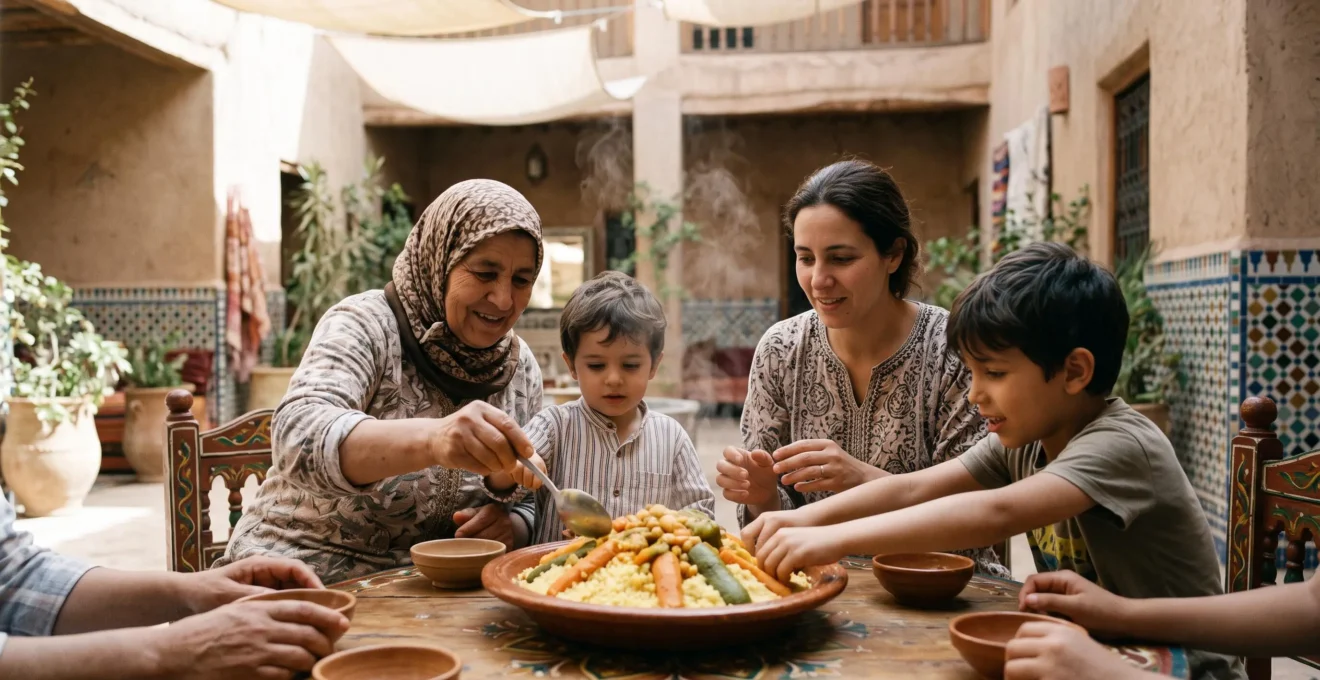
The true power of the weekly couscous ritual lies not in the final shared platter, but in the highly structured, laborious preparation process itself, which functions as a social technology for generational bonding.
- The deliberate “inefficiency” of hand-rolling and multi-stage steaming creates crucial time for informal knowledge transfer and social interaction.
- Serving high-value items like spiced lamb reinforces deep-seated cultural codes of honour and generosity, functioning as a form of social insurance.
Recommendation: Researchers studying family cohesion should analyse the preparatory labour behind communal meals, not just the act of consumption, to understand the core mechanisms of social bonding.
For any researcher in London observing the domestic traditions of the Maghrebi diaspora, the Friday couscous meal stands out as a powerful, unifying ritual. It is easy to see it simply as a culinary tradition—a delicious and generous meal shared with family after Jumu’ah prayers. Most analyses stop there, noting its role as a symbol of hospitality and togetherness. This surface-level view acknowledges the “what” and the “when” but misses the profound “how.” It fails to dissect the intricate social mechanics at play that transform a simple dish of semolina into the very fabric of family life.
The common understanding focuses on the final act of consumption. But what if the true bonding mechanism is not the shared platter, but the shared labour that precedes it? This perspective reframes the entire event. The hours spent hand-rolling the grains, the patient multi-stage steaming, the slow simmering of the broth—these are not mere chores. They are a form of ritualised inefficiency, a social technology perfected over generations to create the time and space necessary for the transmission of cultural knowledge, the reinforcement of social roles, and the deepening of emotional ties. It is in the process, not just the product, where the magic lies.
This article will deconstruct the couscous ritual through an anthropological lens. We will explore how the specific techniques of its preparation serve a social function, why the choice of ingredients carries such symbolic weight, and how the very structure of the meal—from preparation to consumption—is engineered to forge and maintain the extended family unit. We will move beyond the plate to understand the invisible labour that holds it all together.
To understand this intricate social phenomenon, this article breaks down the key components of the couscous ritual. The following sections will explore the meaning embedded in each step, from the choice of grain to the final act of sharing, revealing how this dish became a cornerstone of family cohesion.
Summary: The Making of a Ritual: Deconstructing the Social Power of Couscous
- Why Does Hand-Rolled Couscous Carry More Weight Than Factory-Made?
- How Do Families Steam Couscous Over Broth Without Making It Mushy?
- Couscous or Rice: Which Staple Creates Stronger Family Rituals?
- The Steam Timing Mistake That Turns Couscous Into Heavy Paste
- When Should Families Begin Couscous Preparation Before Guests Arrive?
- Why Does Serving Spiced Lamb Signal Greater Generosity Than Other Dishes?
- Why Does Eating From Shared Platters Create Stronger Bonds Than Individual Plates?
- Why Did Spiced Lamb Become the Symbol of Arab Generosity At Communal Gatherings?
Why Does Hand-Rolled Couscous Carry More Weight Than Factory-Made?
In an age of convenience, the persistence of hand-rolled couscous is not merely about superior taste or texture; it is an act of profound social significance. Factory-made couscous, which can be prepared in minutes, serves a purely nutritional purpose. Hand-rolled couscous, however, is a vehicle for generational transmission. The process itself—the rhythmic motion of fingers rolling semolina with water and flour—is a form of embodied knowledge. This practice has been recognized by UNESCO as intangible cultural heritage, a knowledge system transmitted informally from mother to daughter through observation and imitation.
This shared labour creates a unique sensory landscape of home. As Israeli food historian Pascale Perez-Rubin recalls in Moment Magazine, the sound is as important as the taste:
The soothing sound of gold bangles on your mother’s hand banging again and again against the aluminum tray is the sound of home
– Pascale Perez-Rubin, Moment Magazine, “The Power of Couscous”
This “sensory scaffolding” embeds the memory of family and belonging deep within the individual. The value of hand-rolling, therefore, is not in the grain itself, but in the time, skill, and intimacy woven into it. This tradition is so vital that it sustains entire female-led economies.
The Kabyle Women’s Cottage Industry of Hand-Rolled Couscous
In the Kabyle region of Algeria, where traditions remain strong, a thriving micro-economy of cottage industries is run by women. This includes La Maison Lahlou, which employs 300 women to roll couscous that is then sold commercially. This case shows how the hand-rolling tradition, far from being obsolete, still sustains an entire female-led economy built on inherited manual skill. It demonstrates that the labour is a valued craft, carrying economic as well as cultural weight.
Choosing to hand-roll couscous is a conscious decision to invest time in the family unit, transforming a simple meal into a repository of memory, skill, and connection. The weight it carries is the weight of culture itself.
How Do Families Steam Couscous Over Broth Without Making It Mushy?
Achieving the perfect, fluffy texture in couscous—where each grain is separate, light, and absorbent—is a technical skill that embodies the ritual’s core tenets of patience and attention. The process is a multi-stage art, a deliberate “ritualised inefficiency” designed to prevent the grains from becoming a dense, heavy paste. The secret lies in a series of steaming and fluffing cycles performed in a special pot called a couscoussier, which allows the grains to cook in the aromatic steam of the simmering broth below without ever touching the liquid.
This method is not about speed; it’s about control and care. Each steaming phase swells the grains, and each fluffing phase separates them, allowing them to cool slightly and absorb moisture evenly. This repeated, hands-on intervention is a critical juncture for social interaction and teaching. It is during these moments of “active waiting” that conversations flow and techniques are corrected by elder hands guiding younger ones. The physical act of fluffing the hot grains with oiled hands is a tactile skill passed down through generations.
The mastery of this process is a point of pride and a key marker of a successful host. It ensures the couscous can properly receive the rich broth and toppings, making the final dish a delight rather than a disappointment. The method itself is a testament to the idea that the best things require time and cannot be rushed.
Action Plan: The Traditional Multi-Stage Steaming Method
- Initial Steam: Bring four to five inches of water to a boil in the base of a couscoussier. Add the semolina to the top steamer basket and steam uncovered for 10 minutes, mixing every 30 seconds to prevent clumping.
- Second Steam: Cover the pot and continue steaming for another 30 minutes, ensuring you stir the grains thoroughly approximately every 10 minutes to maintain separation.
- First Fluff & Season: Transfer the steamed grains to a large, shallow bowl (a *gasaa*). Sprinkle with salt, drizzle with oil, and use a fork or your hands to gently break up any lumps and separate the grains.
- Broth Infusion: Before serving, return the couscous to the steamer basket for a final steaming over the boiling meat and vegetable broth for 15 to 20 minutes. This infuses the grains with flavour.
- Final Fluff: Transfer the couscous back to the bowl. Fluff it one last time, adding a little broth or melted butter (*smen*) so it is moist but never wet, ready to be served.
Couscous or Rice: Which Staple Creates Stronger Family Rituals?
While both couscous and rice can serve as staple carbohydrates, they function very differently as social technologies. Rice is often a food of convenience—quickly boiled in a single pot, easily portioned, and suited for individual consumption. Couscous, in its traditional form, is the opposite; it is a food of deliberate connection. Its preparation is a labour-intensive, collaborative act, and its consumption is almost always a communal affair. This fundamental difference is why couscous fosters stronger, more resilient family rituals.
The distinction is not just in the cooking, but in the entire social framework surrounding the meal. As Abduljelil Ben Rabeh of the Tunisian mission in Washington D.C. noted for Forbes, its ritualistic nature is consistent: “To this day, many households still prepare it once a week.” This regular, predictable gathering is a cornerstone of family life. Even in diaspora communities where daily meals may shift towards convenience, the couscous ritual is often intentionally preserved as a link to heritage and a tool for building community, as one case study highlights. In these contexts, the same platter becomes a bridge to home, a way to share Moroccan hospitality with friends from different backgrounds.
The following table, based on field accounts of traditional Maghrebi dining, breaks down the core differences in how these two staples function socially.
| Dimension | Traditional Couscous | Rice |
|---|---|---|
| Preparation labor | Multi-stage, collaborative, often a full morning of hand-rolling and steaming | Single-pot boiling, typically an individual task |
| Serving vessel | Large communal gsaa platter eaten by hand | Usually portioned into individual bowls |
| Social function | Forces gathering, conversation, and generational presence | Enables solitary or fast, individual eating |
| Cultural placement | Reserved for Fridays and celebrations | Everyday convenience staple |
Ultimately, rice is a food that can be adapted to a fast-paced, individualistic lifestyle. Traditional couscous actively resists it, demanding time, collaboration, and gathering. It is this inherent friction with modern efficiency that makes it such a powerful tool for creating and sustaining family bonds.
The Steam Timing Mistake That Turns Couscous Into Heavy Paste
The transformation of light, airy couscous grains into a dense, unappealing paste is the most feared outcome for any host. This failure is almost always the result of one critical error: rushing the process. Specifically, it stems from either insufficient steaming time, which leaves the grains hard and raw in the center, or, more commonly, over-saturating the grains with liquid too early. This mistake violates the central principle of the ritual: patience. The preparation of couscous is, as UNESCO’s official file notes, a ceremonial process involving several different operations, each of which must be respected.
When the steaming and fluffing cycles are hurried, the grain’s delicate structure does not have time to set properly. The outer layer becomes gelatinous while the core remains undercooked. If liquid is added at this stage, the grains cannot absorb it. Instead, they collapse, melding together into a solid mass. The multi-stage steaming process is designed specifically to build the grain’s integrity, allowing it to swell and then separate, creating a structure that is both tender and robust enough to handle the final addition of broth.
This technical detail has a powerful social parallel. Rushing the process is a failure to be present. It is an attempt to achieve the result without engaging in the shared time and labour that give the meal its meaning. As one chef specializing in this traditional craft explains, the authentic method stands in stark contrast to the five-minute instant version. It “requires a lot of patience, practice and time-consuming labor.” This statement serves as a reminder that the value is created through the slow, deliberate work. The risk of creating a heavy paste is the physical manifestation of a social shortcut; it is the consequence of prioritising efficiency over connection.
Therefore, avoiding the pasty texture is more than a culinary goal. It is a commitment to the ritual itself. It requires the cook to be attentive, to be patient, and to respect the rhythm passed down through generations. It is an understanding that the time spent is not a cost but the primary ingredient.
When Should Families Begin Couscous Preparation Before Guests Arrive?
In the context of the Friday couscous ritual, the gathering does not begin when guests walk through the door. It begins in the quiet hours of the early morning, with the first steps of preparation. The entire process is a slow-burn event where the sensory experience—the sounds and smells of cooking—functions as the opening act, building a palpable sense of anticipation that permeates the home and even the neighbourhood. As one observer beautifully described it, long before the meal is served, “the aroma of slowly simmering spices filled the narrow streets of the medina.”
The timeline for preparation is dictated by the labour-intensive nature of the traditional method. If the couscous is being hand-rolled from scratch, the process must begin shortly after dawn. This involves hours of rolling, drying, and the initial steaming cycles. The broth, with its tough cuts of meat and root vegetables, also requires a long, slow simmer to develop its rich flavour and tenderise the ingredients. This early start transforms the entire morning into part of the social event, even if it only involves the women of the household. It is a period of quiet industry and intimate conversation before the larger group convenes.
This rhythm is a cultural constant across the Maghreb, turning Friday into a day structured around the meal.
The Rhythm of a Moroccan Friday Morning
An account of daily life in Morocco illustrates a familiar national rhythm. On Fridays, the markets are busy in the morning as households procure the freshest ingredients. Mosques fill for the midday *Jumu’ah* prayer. Immediately after, kitchens come alive as steam from couscous pots perfumes the house. By early afternoon, a large, fragrant platter anchors the family table. This established timeline shows that the preparation is not a stressful rush before a deadline; it is the fundamental, grounding activity that structures the most important social day of the week.
Therefore, the question of when to begin is answered not by a clock, but by a commitment to the ritual’s integrity. Preparation starts early enough to ensure the process is slow, deliberate, and unhurried, allowing the home to gradually fill with the promise of the feast to come.
Why Does Serving Spiced Lamb Signal Greater Generosity Than Other Dishes?
In Arab culture, and particularly in its Bedouin roots, generosity (*karam*) is not just a virtue; it is a pillar of the honour code. Within this framework, serving meat—and specifically lamb—is the ultimate expression of hospitality and respect for a guest. This is not arbitrary. Lamb has historically been the most valuable livestock, a walking repository of a family’s wealth. To slaughter a lamb for a guest is therefore a significant economic sacrifice, a tangible demonstration of the host’s high regard for their visitor.
This principle is deeply embedded in the cultural psyche. An ancient Bedouin definition of manhood, as cited in an analysis on TheTorah.com, is one who “strikes with a sword and feeds a guest meat.” This powerful phrase links martial prowess and honour directly to the act of providing meat. It frames hospitality not as a soft social grace but as a duty tied to a man’s strength and standing in the community. The act of sacrificing a prized animal is a public performance of one’s ability and willingness to provide, reinforcing social status.
The scale of this gesture can be staggering, illustrating its importance in communal events. For example, at large traditional feasts such as the mansaf, as many as 250 sheep might be slaughtered to honour the guests. While a weekly family meal is on a much smaller scale, the underlying symbolism remains potent. Choosing lamb over chicken or a purely vegetarian stew is a deliberate signal. It elevates the meal from a simple family gathering to a celebration, an act of abundance and open-heartedness.
The heavy spicing of the lamb with expensive aromatics like saffron, cumin, and *ras el hanout* further amplifies this signal of generosity. It shows that no expense has been spared in creating a rich and memorable experience for the family and any guests present. Thus, spiced lamb is not just food; it is a complex social signal of honour, sacrifice, and abundance.
Why Does Eating From Shared Platters Create Stronger Bonds Than Individual Plates?
The use of a large, communal platter—the *gasaa*—is one of the most powerful social technologies embedded in the couscous ritual. Unlike individual plates, which create physical and psychological boundaries between diners, the shared platter dissolves them. It forces participants into a shared space, creating a dynamic of interdependence and cooperation. This mode of eating is a physical enactment of community, reinforcing the idea that the family is a single, unified entity, not a collection of individuals.
As lifestyle writer Sally Kirby observes, the tradition is deeply symbolic, “Symbolising connection, community and sharing, as families gather to eat from one large plate.” The physical act of reaching into the same dish requires a heightened awareness of others. Diners must negotiate space, pace themselves with the group, and be mindful not to overstep their portion of the platter. This creates a non-verbal dialogue and a synchronised rhythm of eating that is absent from individual dining. It is a learned etiquette that promotes self-restraint and group consciousness.
This practice is a cornerstone of traditional Arab hospitality. In this format, traditionally, meat, rice, spices and bread are placed in a single large bowl, and guests sit around it and eat communally. Often, the host will use their hands to place the best pieces of meat in front of the guests as a sign of honour. This act of service, performed within the shared space of the platter, further deepens the bond between host and guest. The platter becomes a stage for performing acts of generosity and respect.
Moreover, eating by hand from a shared dish is an act of trust and intimacy. It breaks down formal barriers, creating a relaxed and familial atmosphere. It connects generations, as the hands of a child, a parent, and a grandparent all meet at the same source of sustenance. The shared platter is therefore not just a serving vessel; it is a tool for engineering physical proximity and social cohesion.
Key Takeaways
- The primary bonding function of the couscous ritual is the shared, multi-stage labour of its preparation, which acts as a “social technology.”
- The deliberate “inefficiency” of traditional methods like hand-rolling creates essential time and space for intergenerational knowledge transfer.
- Serving high-value meat like spiced lamb is rooted in historical codes of honour, functioning as a performance of generosity and a form of social insurance.
Why Did Spiced Lamb Become the Symbol of Arab Generosity At Communal Gatherings?
The elevation of spiced lamb to the pinnacle of culinary generosity in Arab culture is not merely a matter of taste; it is a deeply rational social contract rooted in the harsh realities of desert survival. While today it signifies abundance and honour, its origins lie in a powerful system of mutual obligation. To understand its symbolic weight, one must look to its function within Bedouin society, the cultural bedrock of many Arab traditions. Offering lamb was never just about being kind; it was a strategic act of community-building.
A woman raised in an Israeli-Moroccan family vividly recalls how the scent of a neighbour’s cooking would trigger powerful childhood memories, carrying “cumin and turmeric, allspice and ras el hanout, simmering lamb, carrots and chickpeas all carried in the steam of the couscous.” This sensory memory connects the aroma of spiced lamb directly with the feeling of community and home. Yet, behind this warmth lies a pragmatic history.
Bedouin Hospitality as a Survival-Rational Insurance System
In the precarious environment of the desert, where resources were scarce, extreme hospitality was not an optional virtue but a critical survival mechanism. As an analysis of the culture explains, Bedouin hospitality functioned as a collective insurance system, enforced by honour rather than law. By offering your most valuable asset—a lamb—to a traveller or guest, you were making a deposit into a social bank. You were creating an obligation, reinforced by a strict honour code, that you would be treated with the same generosity should you find yourself in need. This reframes the act from pure altruism to a rational, reciprocal system of risk management.
This historical framework explains why lamb carries far more symbolic weight than other foods. It represents the highest possible sacrifice and, therefore, the highest honour bestowed upon a guest. It is a public declaration that the host is fulfilling their social duty to the utmost, reinforcing their status and reliability within the tribe. When a family serves spiced lamb at a communal gathering today, they are tapping into this deep cultural wellspring. They are performing an act that simultaneously says, “You are honoured in our home,” and, “We are an honourable family.”
By deconstructing the couscous ritual, we see that its power to bind families is not accidental. It is a highly sophisticated social technology where every detail—from the labour-intensive preparation to the communal serving style—is optimised to foster connection, transmit values, and reinforce the family unit. For researchers studying social bonds, it offers a compelling model of how culture can be intentionally embedded in a culinary practice. The next step is to apply these observational insights to other domestic rituals, seeking out the hidden mechanics of togetherness.