For anyone engaging with Arab cultures, the offering of tea or coffee is a familiar, seemingly straightforward gesture of welcome. It’s often viewed through a simple lens of tradition and generosity. This surface-level understanding, however, misses the profound social architecture at play. The preparation and service of these beverages are not merely about hospitality; they are a sophisticated form of ritualised communication, a non-verbal language that establishes hierarchy, demonstrates respect, and solidifies social bonds. To observe the ceremony is to witness a social contract being drafted in real time, with every movement and ingredient carrying specific contractual weight.
While Western hospitality might focus on efficiency and individual preference, many Arab traditions prioritise a shared, performative experience. The rustle of mint leaves, the rhythmic pounding of coffee beans, the visual spectacle of a high pour—these are not incidental details. They are the clauses and sub-clauses of an unspoken agreement between host and guest. Understanding this framework moves beyond simple cultural appreciation; it offers a key to decoding the very grammar of social interaction. This article deconstructs this grammar, analysing how specific actions within tea and coffee rituals function as deliberate acts of social negotiation, defining relationships and status long before any formal conversation begins.
This analysis will dissect the key performative elements of these rituals. We will examine how physical actions signal respect, how ingredients build social bonds, and how the timing and sequence of service dictate the flow of social dynamics. By the end, the simple act of drinking tea will be revealed as a complex and meaningful social performance.
Summary: Decoding the Unspoken Language of Arab Hospitality Rituals
- Why Does Pouring Tea From Height Signal Deep Respect?
- How Do Hosts Control Foam Density to Indicate Guest Rank?
- Green Tea or Mint Tea: Which Offers Stronger Social Bonds?
- The Temperature Mistake That Scalds Guests and Ruins Hospitality?
- When Should Tea Be Served: Immediately After Arrival or After Meal?
- Why Does Freshly Roasted Coffee Change Social Dynamics More Than Instant?
- Why Does Eating From Shared Platters Create Stronger Bonds Than Individual Plates?
- How Did Aromatic Coffee Become the Centrepiece of Arab Hospitality Rituals?
Why Does Pouring Tea From Height Signal Deep Respect?
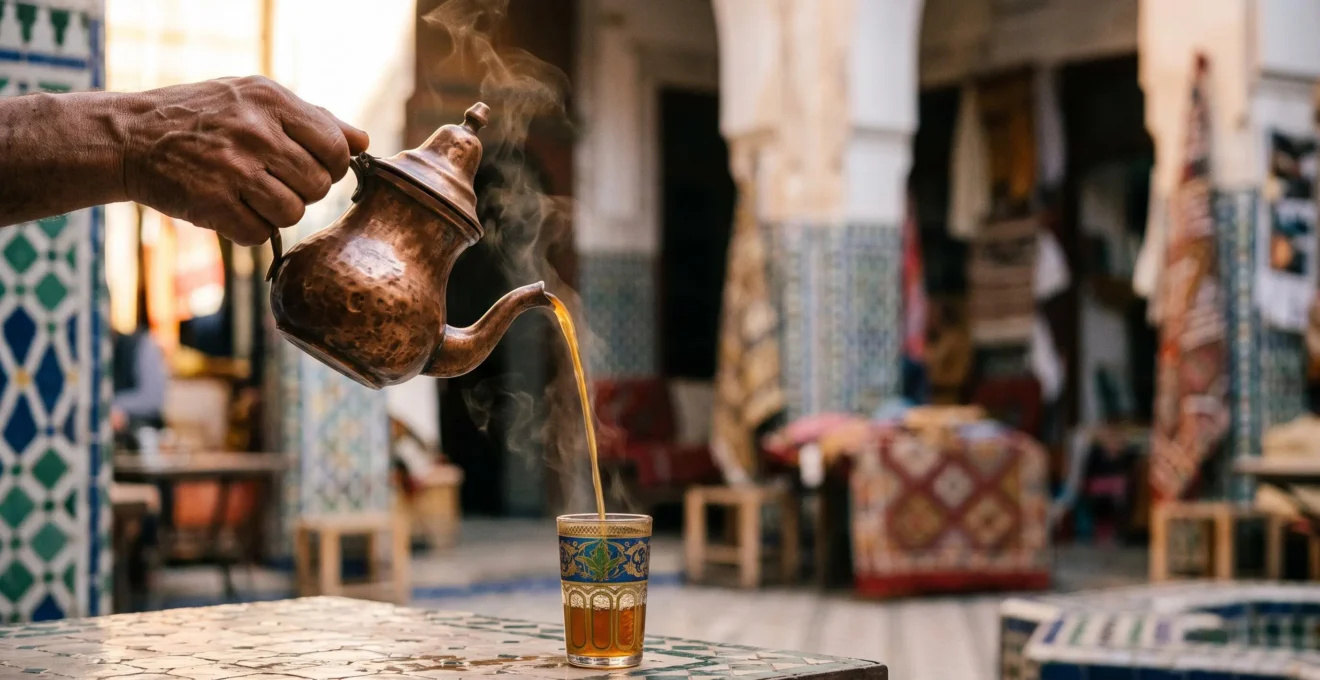
The iconic image of Moroccan mint tea being poured from a great height is far more than theatrical flair; it is a fundamental act in the grammar of hospitality. The primary physical purpose is to aerate the tea, cooling it slightly while creating a desirable frothy head. However, its social function is infinitely more significant. The act of raising the silver teapot, or *berrad*, and casting a long, precise arc of tea into a small glass is a demonstration of skill, effort, and focused attention. It is a piece of performance art dedicated entirely to the guest.
From an anthropological perspective, this is an act of ‘performative hospitality’. The host is not just making tea; they are visibly investing time and expertise into the guest’s experience. A low, quick pour might be efficient, but it signals a lack of care or importance. The high pour, with its risk of splashing and its requirement of a steady hand, is a non-verbal declaration: “Your presence is important enough for me to perform this ritual with precision and dedication.” The distance of the pour translates directly into the depth of the welcome.
This gesture elevates the drink from a simple beverage to a gift. The host has imbued the tea with their personal effort, transforming it into a carrier of social meaning. As the team at Slow Morocco aptly puts it, the process itself is the message:
The high pour aerates the tea and produces the foam that means it was made with care. The distance is the hospitality.
– Slow Morocco, Slow Morocco – Why Moroccans Pour Tea from a Height
This physical act sets the stage, establishing a baseline of respect upon which the rest of the social interaction will be built. It is the opening statement in a conversation conducted not with words, but with gestures.
How Do Hosts Control Foam Density to Indicate Guest Rank?
If the high pour is the opening statement, the resulting foam—known in Morocco as *rghwa* or *rezza* (the turban)—is the punctuation. The quality, density, and persistence of this foam are not accidental; they are a crucial indicator of the tea’s quality and, by extension, the host’s esteem for their guest. A tea served with a thick, stable crown of foam is a sign of a masterfully prepared beverage, an exhibition of the host’s symbolic capital. It signals that the tea was brewed with expertise and care, using high-quality green tea and a proficient technique.
The Moroccan tea ceremony, or *atay*, provides a perfect case study. The process involves pouring tea back and forth between the pot and a glass to mix the ingredients and build the foam before the final serve. The first glasses, which are often the frothiest, are typically reserved for the most honoured guests. As Roaming Camels Morocco notes, this foam is considered a mark of skill and quality. Serving a guest a glass with little to no foam can be interpreted as a slight, suggesting either a lack of skill or a lack of effort on the host’s part.
The *rghwa* is therefore a visual cue that communicates rank and respect within the gathering. A host can subtly manage the social dynamics by controlling who receives the glass with the most impressive ‘turban’ of foam. This foam is not merely a byproduct; it is a key element in the social theatre of the tea ceremony, a visible testament to the host’s commitment to honouring their guests.
Your Audit Checklist: Decoding the Signals in Your Tea Ceremony
- Ritual Elements: List all the distinct actions in your tea service (e.g., presenting the leaves, the high pour, the first taste). What does each action communicate?
- Sensory Investment: Inventory the sensory experiences you are creating. Are the sounds (clinking glasses), sights (foam), and smells (mint, steam) being actively managed or left to chance?
- Hierarchy of Service: Map out your serving order. Does it consciously reflect guest status, or is it random? The first glass served holds the most symbolic weight.
- Foam Quality: Objectively assess the *rghwa*. Is it dense and lasting, or thin and fleeting? This is a direct, visible metric of the perceived quality of your hospitality.
- Guest Feedback Loop: How do you handle a guest’s refusal of a second or third glass? Is it acknowledged as a social cue, or ignored? This interaction tests the strength of the social contract.
Green Tea or Mint Tea: Which Offers Stronger Social Bonds?
While Moroccan mint tea is famous, the choice between a sweeter, mint-infused tea and a more austere, pure green tea can signal different social intentions. Mint tea, with its accessible sweetness and refreshing aroma, is often associated with immediate, welcoming hospitality. The pure green tea ritual, however, particularly as practiced by Sahrawi people in the desert, is built around a more profound, extended form of social bonding that prioritizes the collective over the individual.
The Sahrawi green tea ritual, known as ‘djimaat talat’ (the three djims), is a structured tradition centred on community. The first ‘djim’ represents the *djemaa* (the group or community), underscoring that the entire purpose of the ritual is the shared experience. As documented by Morocco World News, this ceremony is not a quick refreshment but a lengthy afternoon gathering, demonstrating how the ritual itself is designed to facilitate prolonged social connection. The focus is on the time spent together, with the tea acting as the anchor for conversation and community building.
This ritual also famously involves serving three successive rounds of tea from the same leaves, each with a distinct character. This progression is captured in a well-known proverb:
The first glass is as gentle as life, the second as strong as love, the third as bitter as death.
– Traditional Moroccan/Saharan saying, Marrakeche.com
To partake in all three glasses is to share a complete, multi-faceted experience with the host and other guests. It is a commitment of time and presence. Therefore, while mint tea may create an immediate and pleasant bond, the structured, multi-stage green tea ritual is designed to forge deeper, more enduring social connections through a shared, time-intensive journey.
The Temperature Mistake That Scalds Guests and Ruins Hospitality?
In the intricate ballet of the tea ceremony, temperature control is a subtle but critical element of the host’s performance. While boiling water is used to properly steep the tea and extract flavour from the leaves, serving a guest a beverage that is too hot to drink is a significant failure in the social contract. It forces the guest into an awkward position: either they risk burning themselves, or they must wait, creating a pause in the fluid exchange of hospitality. A skilled host understands how to manage this variable.
This is another area where the high pour reveals its genius. As noted in a piece by The Manual, the act of pouring from a distance is not just for aeration; it is a practical technique for temperature modulation. The long journey from the spout of the *berrad* to the glass allows the tea to cool just enough to be at a perfect, immediately drinkable temperature upon arrival. It is an act of foresight and empathy, anticipating the guest’s comfort and ensuring the social flow is not interrupted.
Serving tea that is “scalding hot” can be interpreted as a sign of an amateur or, worse, an indifferent host. It suggests the mechanics of the process were followed without consideration for the end user—the guest. The perfect serving temperature, therefore, is a demonstration of mastery. It communicates that the host is not just a provider but a caretaker, one who has considered every aspect of the guest’s experience, down to the final degree. This anticipation of the guest’s needs is a core tenet of performative hospitality, transforming a simple cup of tea into a gesture of genuine care.
When Should Tea Be Served: Immediately After Arrival or After Meal?
In the social grammar of Arab hospitality, the timing of the tea service is as meaningful as the tea itself. While tea may be served at various points during a visit, the offer made immediately upon a guest’s arrival holds a unique and powerful significance. Serving tea at the threshold, as a guest crosses from the outside world into the private space of the home, is the ultimate gesture of welcome. It is the formal opening of the social contract for the visit.
This initial offering is not about quenching thirst; it is a symbolic act that says, “You are welcome here, and I am now responsible for your comfort.” It establishes the roles of host and guest immediately and unequivocally. To delay this offer can create a subtle feeling of ambiguity or distance. The tea served after a meal is also important—it aids digestion and provides a relaxed setting for conversation—but it serves a different function. The post-meal tea is about closure and contentment, while the arrival tea is about initiation and acceptance.
Because this initial offer is so heavily weighted with social meaning, refusing it is a delicate matter. As Marrakeche.com highlights, refusing the first offer of tea can be seen as impolite because it symbolically rejects the host’s opening gesture of hospitality. It is akin to refusing a handshake. Even if a guest is not thirsty, the socially correct action is to accept the small glass, as accepting the tea means accepting the host’s welcome and formally entering into the guest-host relationship.
Why Does Freshly Roasted Coffee Change Social Dynamics More Than Instant?
The transition from tea to coffee in our analysis reveals a similar, if not deeper, commitment to performative hospitality. The difference between serving instant coffee and serving coffee roasted and ground in front of the guests is the difference between a transaction and a ritual. Instant coffee is about efficiency; the Arabic coffee ceremony, or *gahwa*, is about a shared, multi-sensory experience that fundamentally alters the social dynamics of the gathering.
The traditional preparation of *gahwa* is a public performance. As described in UNESCO’s inscription of the ritual as Intangible Cultural Heritage, the process begins with the host lightly roasting the coffee beans in a pan over a fire, right in front of the guests. The beans are then pounded in a copper mortar, creating a distinct rhythm that announces the coffee is being prepared. This process is not hidden away in a kitchen; it is a central part of the social event. It fills the air with a rich aroma and builds a sense of anticipation that a kettle of instant coffee could never achieve.
This visible and audible investment of effort transforms the coffee from a simple commodity into a bespoke creation made specifically for those present. It communicates a profound level of respect and dedication. The host is not just serving a drink; they are sharing a process and an experience. This ritual has evolved from a simple welcome to a powerful diplomatic tool. As The National notes, this ceremony, which began as a humble gesture, is now central to diplomatic visits and cultural showcases. The choice to engage in this full, fresh ritual over a quicker alternative is a deliberate choice to elevate the social importance of the occasion and the status of the guests.
Why Does Eating From Shared Platters Create Stronger Bonds Than Individual Plates?
The principle of shared experience extends from beverages to food, most notably in the practice of eating from a communal platter. While individual plates create personal space and autonomy, the shared platter dissolves these boundaries, forcing a different kind of social engagement. This practice is not merely about tradition; it is a powerful tool for fostering cooperation and building subconscious bonds, a phenomenon now being validated by social science.
Eating from a single dish requires a level of coordination and non-verbal communication that individual plates do not. Diners must be aware of each other’s movements, pace, and needs. This creates a subtle, shared rhythm and a sense of collective ownership over the meal. Research from Cornell and the University of Chicago Booth School of Business has found that this dynamic has a measurable effect on social interaction. Their studies showed that people who ate from a shared plate, whether friends or strangers, were more likely to cooperate and be less competitive in subsequent tasks.
This practice stands in stark contrast to modern trends in many Western societies. The 2024 World Happiness Report notes the rise of “eating alone,” finding that roughly one in four Americans now eat all their meals alone. The shared platter, by its very design, is an antidote to this isolation. It physically and psychologically pulls people together, transforming the act of eating from an individual act of consumption into a collective act of communion. It reinforces the ‘we’ of the group over the ‘I’ of the individual, creating a powerful foundation for social cohesion.
Key Takeaways
- Hospitality as Performance: Arab tea and coffee rituals are a form of ‘performative hospitality’ where gestures like the high pour and fresh roasting are a visible investment of skill and effort for the guest.
- A Language of Objects: The tools of the ceremony—the quality of the foam (rghwa), the type of cup, and the shared platter—are not passive props but active carriers of social information about status and respect.
- The Contract of Timing: The timing of an offer, especially tea or coffee upon arrival, functions as a formal opening to a social contract, making its acceptance or refusal a socially significant act.
How Did Aromatic Coffee Become the Centrepiece of Arab Hospitality Rituals?
Arabic coffee, or *gahwa*, represents the formalisation of all the hospitality principles we have discussed. It is a highly structured ritual where every detail is codified to communicate respect and social hierarchy. While tea can often be a more informal, fluid affair, the *gahwa* ceremony is a precise and symbolic system that has become the ultimate expression of honour in many parts of the Arab world, particularly the Gulf. Its importance is underscored by UNESCO’s recognition of the traditions of Saudi Khawlani coffee knowledge and practices in 2022.
The ritual is governed by a strict social grammar. The host, or *dallal*, serves the coffee in small, handleless cups (*finjan*). The order of service is paramount. According to the official UNESCO decision on the ritual, the most important or oldest guest is served first. This is a clear and unambiguous acknowledgement of status. The cup is only ever filled about a quarter full, a sign of generosity that implies the host is ready and willing to refill it as many times as the guest desires. To fill the cup to the brim would be an insult, suggesting the host wants the guest to drink up and leave.
The guest’s role is also codified. Accepting one, two, or three cups is customary. To signal that one has had enough, the guest gently shakes the empty cup from side to side before handing it back. This non-verbal cue is universally understood and respected, closing the loop of the coffee service for that individual. Through this intricate system of service order, pour level, and responsive gestures, *gahwa* becomes more than a drink. It is a sophisticated, living tradition—a formalised system for negotiating and affirming social order, making it the undeniable centrepiece of Arab hospitality rituals.
Now that you can read the subtle language of these rituals, the next step is to observe them not as static traditions, but as a dynamic and living form of communication that enriches every social encounter.