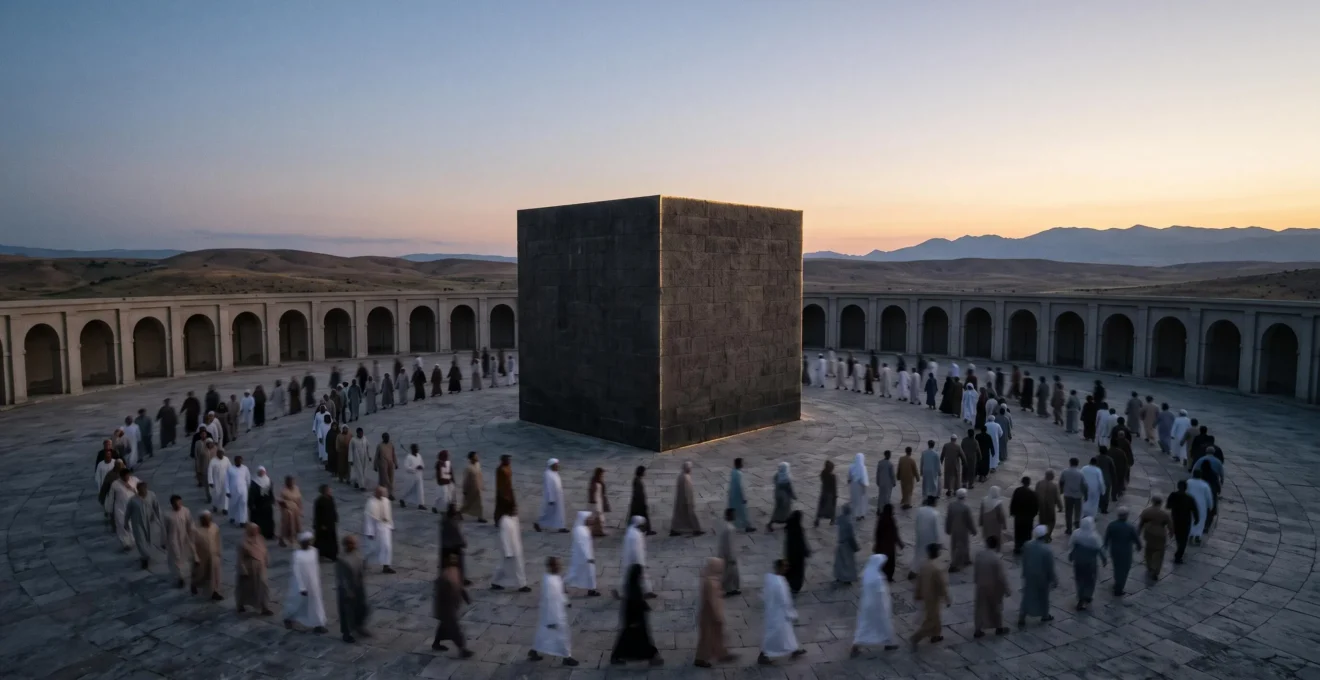
The Kaaba’s 1,400-year reign as a spiritual center is rooted not just in faith, but in its strategic function as a self-reinforcing “sanctuary ecosystem.”
- It began as a pre-Islamic hub where the promise of safe commerce (the haram) drew tribes from across Arabia, establishing its economic indispensability.
- Its history is a cycle of destruction and politically charged reconstruction, where each rebuild served to reinforce its symbolic power and the authority of its custodians.
Recommendation: To understand any sacred site, one must analyze the crucial interplay of its spiritual narrative, economic function, and political symbolism.
For over fourteen centuries, the Kaaba has remained the unmoving spiritual axis for billions of people. Each year, millions of pilgrims converge on Mecca, their movements creating a living vortex of devotion around the simple, black-draped cube. The familiar narrative attributes its origin to Abraham and Ishmael, establishing its sanctity from a primordial moment. While this tradition is the bedrock of its spiritual significance, it doesn’t fully explain how this specific structure, in this specific desert valley, has maintained such profound and uninterrupted gravitational pull through empires, wars, and sweeping cultural shifts. The story is far more complex than just a building; it is the story of a dynamic “sanctuary ecosystem.”
To truly understand the Kaaba’s endurance, we must look beyond its four walls. Its power was forged in the pre-Islamic world, where it served not only as a pan-tribal shrine but, more critically, as a guarantor of economic security in a lawless land. This foundation was then built upon by Islam, which repurposed and amplified its symbolic power. But its status was never static. It was contested in civil wars, destroyed by catapults, and rebuilt by rival caliphs, with each act of destruction and rebirth layering new meaning onto its stone foundations. This article will explore the mechanisms—economic, political, cultural, and architectural—that transformed a simple stone structure into the enduring spiritual center of the Islamic world, a process of continuous, and often violent, reinforcement of its sacred role.
To navigate this rich history, this article examines the key functions and pivotal moments that defined the Kaaba’s journey. We will explore its pre-Islamic origins, its monumental transformations, its role in culture and politics, and the universal principles of sacred architecture it embodies.
Summary: The Kaaba’s Rise as a Global Sacred Center
- Why Did Pre-Islamic Arabs Journey 1,000 Miles to Visit a Simple Stone Structure?
- How Did the Kaaba Transform From a Simple Shrine to a Monumental Complex?
- Kaaba, Jerusalem, or Rome: Which Sacred Site Attracted More Pilgrims in 1000 CE?
- The Siege That Nearly Demolished Islam’s Holiest Site in 683 CE
- When Did Pilgrims Traditionally Journey to Mecca: The 4 Optimal Departure Periods?
- Why Were the Mu’allaqat Considered the Greatest Poetry Ever Written in Arabic?
- Why Do Spiritual Sanctuaries Place Water Before Prayer Rather Than After?
- How Did Spiritual Sanctuaries Combine Architecture, Water, and Light To Induce Contemplation?
Why Did Pre-Islamic Arabs Journey 1,000 Miles to Visit a Simple Stone Structure?
Long before the advent of Islam, the Kaaba was already the most significant pilgrimage destination in the Arabian Peninsula. Its centrality was not based on architectural grandeur—it was a simple, unadorned cuboid structure. Its power stemmed from its unique function as a sanctuary in both a spiritual and, crucially, an economic sense. In a fragmented landscape of rival tribes and shifting allegiances, Mecca offered something invaluable: the concept of the ḥaram, a sacred and inviolable zone where violence was forbidden and commerce could flourish under divine protection.
During the designated “sacred months,” truces were declared across the region, allowing caravans to travel to Mecca without fear of being raided. This transformed the city into a bustling hub of trade and cultural exchange. As research from the International Journal of Middle East Studies highlights, the concept of the ḥaram, centered on the Kaaba, made Mecca the object of pilgrimage, enabling merchants to travel with “security of life and property.” The presence of the Zamzam well further enhanced its status as a vital oasis. The Kaaba, therefore, acted as a spiritual anchor for a sophisticated economic system, guaranteeing the stability necessary for long-distance trade.
While the spiritual pull of its many idols was real, it was this pragmatic guarantee of safety that made the arduous journey worthwhile. The pilgrimage was as much a commercial expedition as a religious one. However, this traditional view of Mecca as a dominant trade nexus is not without its academic challengers. The late historian Patricia Crone, for instance, offered a significant counter-argument:
In Meccan Trade and the Rise of Islam (1987), Crone argued that the importance of the pre-Islamic Meccan trade had been grossly exaggerated.
– Patricia Crone (paraphrased via Wikipedia), Meccan Trade and the Rise of Islam
This debate underscores the complexity of the Kaaba’s pre-Islamic role. Whether a major commercial hub or a more modest regional center, its function as a neutral ground for arbitration, poetry, and commerce, all under the protection of the sacred, was the true source of its magnetic power. It was a sanctuary ecosystem that served the intertwined spiritual and material needs of the entire peninsula.
How Did the Kaaba Transform From a Simple Shrine to a Monumental Complex?
The Kaaba itself remains a structure of profound simplicity, but the complex surrounding it, the Masjid al-Haram (the Grand Mosque), has undergone one of the most extensive and continuous architectural expansions in human history. This transformation from a simple open courtyard to a monumental complex capable of holding millions is a direct reflection of its evolving role as the heart of a global faith. The process was not a single project but a series of accretions over 1,400 years, with each dynasty—from the Umayyads and Abbasids to the Ottomans and modern Saudis—leaving its mark.
The initial expansions were modest, adding colonnades to provide shade for worshippers. Over centuries, these were replaced with grander arcades, soaring minarets, and expansive marble courtyards. The goal was always twofold: to accommodate the ever-increasing number of pilgrims and to project the power and piety of the ruling sovereign. The modern era has seen this process accelerate dramatically, turning the Grand Mosque into a megastructure of unprecedented scale.
Today’s complex is a marvel of engineering, a “sanctuary ecosystem” made manifest in steel and stone. Official Saudi data provides a glimpse of this scale: the Mataf, the open area around the Kaaba for circumambulation, can accommodate 107,000 people per hour, and the Grand Mosque’s total capacity exceeds 2,000,000 individuals. This physical infrastructure is supported by an equally vast service infrastructure. During the 2022 Hajj, for example, medical services attended to over 22,000 pilgrims, while local telecom providers handled up to 3,000,000 SIM card subscriptions daily. The simple shrine is now the core of a temporary city, complete with its own logistics, healthcare, and communication networks.
This immense growth illustrates a core principle: as the community of believers expanded globally, the sanctuary had to expand with it. The transformation from a humble stone cube in an open space to the heart of a technologically advanced megastructure is the physical embodiment of Islam’s growth from a regional movement to a global faith. Inside, the Kaaba remains an empty room, its power lying not in what it contains but in the unified direction it provides. Outside, the monumental complex serves as the worldly vessel required to host that global devotion.
Kaaba, Jerusalem, or Rome: Which Sacred Site Attracted More Pilgrims in 1000 CE?
Directly comparing pilgrim numbers for Mecca, Jerusalem, and Rome around the year 1000 CE is a task fraught with historical uncertainty. Precise record-keeping was non-existent, and journeying to any of these sites was a perilous, often once-in-a-lifetime undertaking. However, by analyzing the nature and scope of each pilgrimage, we can develop a comparative understanding of their respective spheres of influence. Each city functioned as a spiritual epicenter for one of the three major Abrahamic faiths, but the obligations and incentives for pilgrimage differed significantly.
For Christians, pilgrimage to Rome (to the tombs of Peter and Paul) or Jerusalem (to the sites of Christ’s life and crucifixion) was an act of profound piety, but it was not a compulsory religious duty. Journeys were often undertaken by individuals or small groups—monks, nobles, and penitents—seeking relics, miracles, or forgiveness. The geographic reach was vast, spanning from the British Isles to the Byzantine Empire, but the flow of pilgrims was likely diffuse and irregular, heavily dependent on the relative stability of travel routes.
For Jews, Jerusalem remained the spiritual center and the focus of prayer, but the possibility of pilgrimage was severely limited. Following the destruction of the Second Temple in 70 CE, the city was under non-Jewish rule. While Jewish communities existed and some scholars and devout individuals made the journey, large-scale, organized pilgrimage was not a feature of the era. The focus was on diaspora communities and the preservation of faith in the absence of a central temple.
In contrast, the Hajj to Mecca was a communal and obligatory ritual for all Muslims who were physically and financially able. This doctrinal requirement created a more structured and predictable flow of pilgrims. Large, organized caravans departed annually from major centers of the Islamic world, such as Cairo, Damascus, and Baghdad, traveling for months across vast distances. While the total number of participants in any given year is impossible to state with certainty, the institutional nature of the Hajj suggests it was arguably the most organized and large-scale of the three pilgrimages. It drew people from a geographically contiguous and expanding empire, from Spain and North Africa to Persia and Central Asia, reinforcing a sense of a unified global community (Ummah) in a way that the more individualistic Christian pilgrimages did not.
The Siege That Nearly Demolished Islam’s Holiest Site in 683 CE
The sanctity of the Kaaba did not always render it immune from the political turmoil of the human world. The most dramatic example of this was the siege of Mecca in 683 CE, a pivotal event in the Second Islamic Civil War (Second Fitna). The conflict pitted the Damascus-based Umayyad Caliphate against Abdallah ibn al-Zubayr, who had declared his own caliphate from the holy city of Mecca. When the Umayyad caliph Yazid I sent an army to subdue the rebellion, Mecca found itself under attack, and its sacred center became a battlefield.
During the month-long siege, the Umayyad army set up catapults on the surrounding hills and bombarded the city. Historical accounts confirm that the Kaaba itself was damaged by fire, either from a stray projectile or an accidental blaze in the camp of Ibn al-Zubayr’s followers. The sight of Islam’s holiest sanctuary burning sent shockwaves through the Muslim world. The siege only ended with the sudden death of Caliph Yazid, which forced the Umayyad army to withdraw and left Ibn al-Zubayr in control. This event demonstrated a stark reality: even the Kaaba’s inviolability was secondary to the struggle for political power.
What followed is a powerful example of “architectural legitimacy.” Ibn al-Zubayr immediately began to rebuild the Kaaba, but not to its previous plan. He claimed to be restoring it to what he believed were its true Abrahamic foundations, a larger rectangular shape that Prophet Muhammad himself had reportedly wished to build. This reconstruction was a profound political statement: an attempt to legitimize his caliphate by physically reshaping Islam’s central monument. This legitimacy was short-lived. Less than a decade later, in 692 CE, the Umayyads returned under Abd al-Malik, besieged Mecca again, killed Ibn al-Zubayr, and promptly demolished his version of the Kaaba, rebuilding it according to the dimensions it had during the Prophet’s time. This act was a deliberate erasure of their rival’s legacy and a reassertion of Umayyad religious authority.
This cycle of destruction and politically motivated reconstruction reveals that control over the Kaaba—its narrative, its form, and its custody—was a key instrument of power. The table below outlines the competing visions of these two rival reconstructions.
| Reconstruction | Builder / Date | Political Message | Structural Outcome |
|---|---|---|---|
| First rebuild | Abdallah ibn al-Zubayr, c. 684 CE | Legitimized his caliphate by claiming to restore Abraham’s true foundations | Ibn al-Zubayr’s reconstruction changed the original plan, incorporating modifications that Muhammad himself is reported to have intended |
| Second rebuild | Umayyads under Abd al-Malik / al-Hajjaj, 692 CE | Erased the Zubayrid legacy and reasserted Umayyad religious authority | The Ka’ba, which had been damaged by the bombardment, was rebuilt according to its original plan from the time of the Islamic prophet Muhammad |
When Did Pilgrims Traditionally Journey to Mecca: The 4 Optimal Departure Periods?
The timing of the pilgrimage to Mecca has always been a carefully regulated affair, dictated by a blend of sacred tradition, regional politics, and climatic reality. In both the pre-Islamic and Islamic eras, the journey was not undertaken haphazardly but was concentrated within specific periods that maximized safety and practicality. These periods were determined by the Arabian calendar and the unique status of Mecca as a sanctuary.
In the pre-Islamic period, the key to safe travel was the Ashhur al-Hurum, or the “Sacred Months.” These were four months in the lunar calendar (the first, seventh, eleventh, and twelfth) during which a general truce was observed among the otherwise warring tribes of Arabia. Fighting was forbidden, and blood feuds were put on hold. This truce created protected travel corridors across the peninsula, allowing merchant and pilgrim caravans to journey to Mecca with a guarantee of safe passage. The main pilgrimage, or a precursor to the Hajj, took place in the twelfth month, Dhu al-Hijjah, but the other sacred months also saw an influx of visitors who came for trade, poetry festivals, and to pay homage to their tribal deities housed within the Kaaba.
With the advent of Islam, the practice was both codified and reformed. The Quran affirmed the sanctity of the four months but refocused the primary pilgrimage exclusively on the Hajj. The Hajj rituals are strictly timed to occur between the 8th and 13th days of Dhu al-Hijjah, the final month of the Islamic lunar calendar. This created a single, intense period of pilgrimage that drew Muslims from all corners of the expanding empire. While the pre-Islamic truce system faded with the political unification under Islam, the tradition of large, protected caravans continued, now often state-sponsored by the caliphate.
Therefore, one can identify four key periods in the calendar that shaped the flow of pilgrims. The three pre-Islamic sacred months outside the Hajj period (Rajab, Dhu al-Qa’dah, Muharram) were optimal times for trade-focused visits, while the month of Dhu al-Hijjah was, and remains, the sole window for the Hajj proper. The timing was a brilliant fusion of spiritual ordinance and practical logistics, a system that allowed the sanctuary ecosystem of Mecca to function effectively for centuries.
Why Were the Mu’allaqat Considered the Greatest Poetry Ever Written in Arabic?
In the cultural landscape of pre-Islamic Arabia, a poet was a figure of immense prestige—a historian, propagandist, and entertainer rolled into one. And the ultimate stage for showcasing poetic genius was the market and festival of Ukaz, near Mecca, where tribes gathered during the sacred months. Here, the best poets would compete, and the greatest works were said to receive the highest honor imaginable: to be transcribed in golden letters and physically hung upon the walls of the Kaaba itself. These were the Mu’allaqat, the “Suspended Odes.”
This tradition, whether literal or allegorical, is the source of their immense prestige. The Mu’allaqat are a collection of seven (or sometimes ten) long odes, or qasidas, each a masterpiece of the classical Arabic poetic form. Their name, “The Hanging Poems,” directly anchors their cultural value to the Kaaba’s central role. As reference works describe, the Mu’allaqat is a compilation of seven long pre-Islamic Arabic poems named ‘The Suspended Odes’ because they were said to have been hung in the Kaaba. This act transformed them from mere entertainment into cultural monuments, part of the sacred patrimony of all Arabs.
The poems themselves are complex and rich, typically following a tripartite structure: a nostalgic opening lamenting a lost love, a description of a difficult journey through the desert on a camel or horse, and a final section of praise for the poet’s tribe, a patron, or the poet himself. They are a vivid repository of Bedouin life, values, and language. Their linguistic richness and metrical perfection became the benchmark against which all subsequent Arabic poetry was measured. Their status was so foundational that early Islamic scholars studied them intensely to better understand the language of the Quran.
“the qasida form dominated Arabic poetry right up to the twentieth century”
– Robert Irwin, cited in Literature and History podcast
The Mu’allaqat demonstrate the Kaaba’s “cultural gravity.” It was not just a house of gods or a center for trade; it was the ultimate repository of Arab identity and memory. By serving as the exhibition hall for the era’s greatest literary achievements, the sanctuary cemented its role as the cultural, as well as spiritual and economic, heart of Arabia. The poems’ association with the Kaaba gave them a sacred aura, ensuring their preservation and their enduring influence on literature for well over a millennium.
Why Do Spiritual Sanctuaries Place Water Before Prayer Rather Than After?
Across nearly every spiritual tradition, water holds a profound dual significance: it is both a practical necessity for life and a powerful symbol of purification. In the context of a spiritual sanctuary, its placement and use are rarely accidental. The practice of using water *before* prayer or entering a sacred space, rather than after, is rooted in the universal concept of ritual purity—the idea that one must be in a state of physical and spiritual cleanliness to approach the divine.
This principle is a foundational element in Islam, known as tahara (purification). Before performing the formal prayer (salah), a Muslim must perform ablution, or wudu, a ritual washing of the hands, face, arms, and feet. This act is more than simple hygiene; it is a symbolic transition. The worshipper washes away the impurities of the profane, everyday world to prepare their body and mind for a sacred encounter with God. Water acts as the transformative agent, marking the boundary between the mundane and the holy. Placing this ritual before prayer establishes a clear spiritual sequence: purification is a prerequisite for communion.
This logic is not unique to Islam. Similar practices are found in many other faiths. In Judaism, ritual hand washing (netilat yadayim) is performed before meals and prayers. In Hinduism, pilgrims bathe in sacred rivers like the Ganges before entering a temple. Even in Christianity, the holy water stoup at the entrance of a church allows the faithful to make the sign of the cross, a small act of purification and remembrance of baptism, upon entering the sacred space. At the Kaaba, this principle is embodied by the well of Zamzam. Its miraculous origin story and its physical proximity to the shrine have made its water particularly blessed, the ultimate medium for achieving the purity required for pilgrimage rituals like the tawaf (circumambulation).
Ultimately, placing water before prayer is a form of spiritual stage-setting. It creates a deliberate pause, a moment of conscious preparation that elevates the subsequent act of worship. It signals that entering a sanctuary or addressing the divine is not a casual act, but a transition into a different state of being, one that requires a cleansing of both body and soul.
Key Takeaways
- Economic Foundation: The Kaaba’s initial power came from its function as a haram, a neutral zone that guaranteed safe commerce and made it an indispensable economic hub in pre-Islamic Arabia.
- Political Legitimacy: Control and reconstruction of the Kaaba were used as powerful political tools by rulers to assert their authority and legitimize their reign, as seen in the aftermath of the 683 CE siege.
- Cultural Gravity: The sanctuary served as a cultural anchor, most famously as the repository for the Mu’allaqat poems, cementing its role as the heart of Arab identity beyond its purely religious function.
How Did Spiritual Sanctuaries Combine Architecture, Water, and Light To Induce Contemplation?
Spiritual sanctuaries, from the Grand Mosque in Mecca to the cathedrals of Europe and the temples of Kyoto, are more than just places of worship; they are meticulously designed environments intended to guide the human psyche toward contemplation. They achieve this by masterfully manipulating three fundamental elements: architecture, water, and light. The interplay between these elements creates a sensory experience that quiets the external world and encourages internal reflection.
Architecture forms the primary vessel. Grand scale, soaring ceilings, and vast open spaces can evoke a sense of awe and humility, reminding the individual of their smallness in the face of the divine or the cosmos. Conversely, small, enclosed chapels or intimate prayer niches create a sense of introspection and personal connection. Repetitive geometric patterns, as seen in Islamic tilework or Gothic tracery, have a mesmerizing effect, drawing the eye and mind away from distracting thoughts and into a meditative state. The very act of moving through a prescribed architectural path—a cloister, a series of courtyards, or the circumambulation around the Kaaba—is a physical form of meditation.
Water is then introduced as an element of life and purification. Its sound—the gentle trickle of a fountain or the rush of a sacred river—is inherently soothing, masking worldly noise and creating a tranquil soundscape. Its reflective surface can be used to mirror the sky or the surrounding architecture, creating an illusion of depth and a connection between the earthly and the celestial. As discussed, it is also the primary agent of ritual cleansing, a physical act that prepares the mind for a spiritual state.
Finally, light is used as a dramatic and symbolic tool. The dim, filtered light of a cathedral’s stained-glass windows or a mosque’s carved mashrabiya screens creates an otherworldly atmosphere, separating the sacred interior from the harsh brightness of the outside world. Shafts of light are often directed to highlight specific points of focus—an altar, a mihrab, or a statue—guiding the worshipper’s attention. The slow movement of light across a room throughout the day serves as a natural clock, marking the passage of time and encouraging a state of patient observation. Together, these three elements construct a complete sensory experience that facilitates the transition from a state of distraction to one of contemplation and reverence.
Action Plan: How to Analyze a Sacred Space
- Map the Path: Trace the prescribed journey for a visitor from the entrance to the focal point. Note how architecture (gateways, corridors, open courts) directs movement and controls views.
- Inventory Water’s Role: Locate all sources of water. Is it for cleansing (ablution fountains), aesthetics (reflecting pools), or sound (fountains)? How does its presence change the atmosphere?
- Observe the Light: Visit at different times of day. How is natural light filtered, blocked, or directed? Identify how artificial light is used to create focus or mood after dark.
- Analyze Material and Sound: Note the materials used (stone, wood, marble). How do they affect the soundscape? Is the space designed for echoing chants or for silent, absorbed prayer?
- Identify the Focal Point: Determine the ultimate destination of the architectural journey. How do light, space, and orientation combine to give this single point its overwhelming significance?
By applying this analytical framework, whether to the Kaaba or any other holy site, we move beyond simply seeing a building and begin to understand it as a sophisticated instrument designed to shape human experience. The next step for any student of sacred architecture is to visit such a place not as a tourist, but as an observer, and consciously decode the techniques used to inspire awe and introspection.