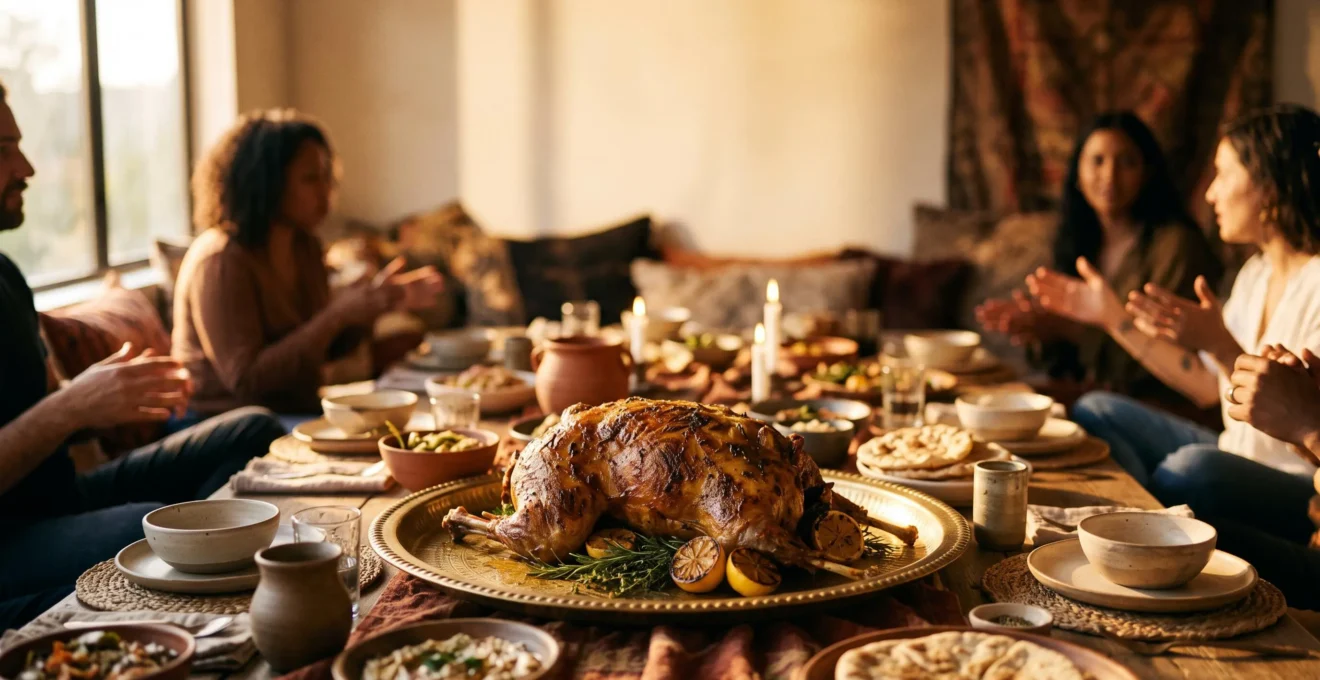
Spiced lamb symbolises Arab generosity not merely because of its cost, but because it functions as a ‘total social fact’—a profound investment of time, skill, and honour that binds guest and host.
- The specific cooking method—slow-roasting versus quick grilling—communicates different, nuanced forms of hospitality and social intimacy.
- Accoutrements like hand-rolled couscous and the use of shared platters are not just traditions; they are crucial technologies for building and reinforcing social cohesion.
Recommendation: When invited to a feast, observe these culinary rituals not just as food, but as a deep language of generosity and community being spoken through flavour and shared experience.
For any Londoner who has had the pleasure of being a guest at an Arab home or a truly authentic Middle Eastern restaurant, the experience can be overwhelming. Platters arrive piled high with fragrant rice, vibrant salads, and at the centre of it all, a magnificent offering of spiced lamb. The instinct is to attribute this incredible display to simple, albeit immense, generosity. We might think, “Lamb is expensive; this is a grand gesture.” While true, this view only scratches the surface of a much deeper cultural performance.
The common understanding stops at the economic value of the dish. But to truly appreciate the significance, we must look beyond the cost. Why this specific animal? And why do the accompanying rituals, from the blend of spices to the way it’s eaten, carry such weight? The answer is not just in the meat itself, but in the complex social language it speaks. The preparation and presentation of spiced lamb are a performance of honour, a transfer of effort, and a reinforcement of community bonds that has been refined over centuries.
This is not just dinner; it is a ‘total social fact’ in action. This article will deconstruct that language. We will explore the historical roots that make lamb a more potent symbol than any other dish, decode the grammar of its spices, and understand why sharing a slow-roasted shoulder creates a different, deeper bond than sharing grilled kebabs. We will see how the very act of hand-rolling couscous or eating from a single platter transforms a meal into a powerful ritual of social cohesion.
This exploration will take us from the ancient Bedouin ethos of hospitality to the modern-day family table. By the end, you will not just see a plate of food, but a rich tapestry of social and cultural meaning, woven with threads of cumin, coriander, and cinnamon.
Summary: Why Spiced Lamb Symbolises Arab Generosity at Feasts
- Why Does Serving Spiced Lamb Signal Greater Generosity Than Other Dishes?
- How Do Cooks Balance Cumin, Coriander, and Cinnamon in Lamb?
- Slow-Roasted Lamb or Grilled Kebabs: Which Defines Hospitality Best?
- The Over-Spicing Mistake That Destroys Lamb’s Natural Flavour
- When Should Hosts Serve Spiced Lamb During a Feast?
- Why Does Hand-Rolled Couscous Carry More Weight Than Factory-Made?
- Why Does Eating From Shared Platters Create Stronger Bonds Than Individual Plates?
- How Did Couscous Become the Weekly Ritual That Binds Extended Families Together?
Why Does Serving Spiced Lamb Signal Greater Generosity Than Other Dishes?
The elevation of lamb to the pinnacle of hospitable offerings is rooted deep in the region’s history, long before the rise of modern economies. It’s not just about expense; it’s about the weight of sacrifice and honour. In the pre-Islamic Bedouin ethos, where survival in a harsh environment depended on strong social alliances, generosity was the ultimate virtue. Historical accounts confirm that a sacrificed yearling lamb was a recurring centrepiece in offerings to guests, a practice that framed generosity as a core tenet of identity. To offer a lamb was to offer a significant part of one’s own livelihood and sustenance, a tangible demonstration of placing the guest’s well-being above one’s own.
This act transcends simple economics and enters the realm of what French sociologist Marcel Mauss called a “total social fact.” As one analysis of his work puts it, the gift is a “total social fact,” imbued with “spiritual mechanisms,” engaging the honor of both giver and receiver. Unlike serving chicken or beef, presenting a whole or significant portion of a lamb involves a distinct sense of sacrifice. It’s an animal that is often raised with care, and its offering is a momentous event. It communicates that the host is not just providing a meal, but is engaging in a ritual exchange of honour. The host gives a valuable asset, and the guest, by accepting, confers honour and respect upon the host, completing a powerful social circuit that strengthens bonds.
In this context, the lamb is more than food. It is a vehicle for social communication. Its presence on the table silently declares the high esteem in which the guest is held, activating an ancient code of hospitality that resonates with deep cultural significance. Choosing a lesser dish would not be an insult, but it would not carry the same powerful message of ultimate respect and unstinting generosity.
How Do Cooks Balance Cumin, Coriander, and Cinnamon in Lamb?
The idea of a single, definitive spice blend for Arab lamb is a Western misconception. The balance of cumin, coriander, and cinnamon is not a fixed recipe but a form of regional dialect, a gastronomic grammar that tells a story about a cook’s origin and heritage. The art lies in mastering a regional blend, known broadly as Baharat, which translates simply to ‘spices’. While certain spices form a common foundation, the specific additions and proportions are a matter of intense regional and even familial pride.
A cook from the Levant, for instance, might lean on a classic ‘7 Spice’ blend where allspice and paprika add warmth and colour. Move to the Arabian Gulf, and the aromatic profile shifts dramatically. Here, the defining notes in a Khaliji Baharat might come from the smoky, citrusy tang of loomi (dried black lime) and the precious threads of saffron, reflecting ancient trade routes. In the Maghreb, the complexity explodes with Ras el Hanout, a blend that can famously contain dozens of ingredients, including floral notes from rose petals and the earthy depth of turmeric. A cook’s ability to balance these elements is a sign of deep culinary knowledge, passed down through generations. It is an intuitive process, often done by sight, smell, and memory rather than measuring spoons.
This table offers a glimpse into the distinct identities of these regional blends, showing how the core trio of cumin, coriander, and cinnamon serves as a canvas for local expression.
| Region | Blend Name | Core Spices | Distinctive Regional Additions |
|---|---|---|---|
| Levant (Syria, Lebanon) | Baharat / “7 Spice” | Black pepper, cumin, coriander, cinnamon, cloves | Paprika, allspice |
| Gulf (Saudi Arabia, Kuwait, UAE) | Khaliji Baharat | Cumin, cinnamon, cardamom, black pepper | Dried black lime (loomi), saffron |
| Maghreb (Morocco, Tunisia) | Ras el Hanout | Cumin, coriander, cinnamon, ginger, turmeric | Rose petals, chili (12+ ingredients) |
| Turkey | Turkish Baharat | Cumin, cinnamon, black pepper | Dried mint |
Ultimately, the perfect balance is one that honours tradition while perfectly complementing the natural flavour of the lamb. It is not about masking the meat, but about creating a fragrant, complex harmony that elevates it. This deftness of hand is a crucial part of the generosity; the host is not just giving food, but a carefully crafted piece of their cultural identity, as shown by a deeper look into Baharat’s varieties.
Slow-Roasted Lamb or Grilled Kebabs: Which Defines Hospitality Best?
While both slow-roasted lamb and grilled kebabs are staples of Arab cuisine, they communicate different forms and contexts of hospitality. The choice between them is not arbitrary; it’s a strategic part of the “ritual choreography” of a gathering. As a general rule, sources note that “formal dinners and celebrations generally involve large quantities of lamb”, but the preparation method speaks volumes. Grilled kebabs, or shish kebab, represent a more immediate, widespread, and celebratory form of hospitality. They are perfect for larger, more informal gatherings, barbecues, and street food culture. The open flame, the sizzle, and the quick cooking time create an atmosphere of energy and abundance that is accessible to many.
Slow-roasting a whole lamb or a large shoulder, however, signifies a deeper, more intimate, and patient form of generosity. This method, often involving a hidden oven like a clay *tannour* or a pit in the ground (*zarb*), is an investment of time—hours, sometimes even a full day. This slow transformation of the meat mirrors the slow building of deep relationships. It is a gesture reserved for honoured guests, close family, and momentous occasions. The meat becomes incredibly tender, falling off the bone, symbolizing the host’s desire to make everything easy and delightful for their guest. There is no struggle, only reward.
The contrast is symbolic: the bright, open flame of the grill is for the vibrant, public celebration, while the deep, hidden glow of the slow-roaster is for the profound, heartfelt welcome reserved for those brought into the inner circle. One is not better than the other, but they are not interchangeable. A host chooses the method based on the message they wish to send. Serving a slow-roasted shoulder is a quiet declaration that “you are family; for you, my time is unlimited.”
The Over-Spicing Mistake That Destroys Lamb’s Natural Flavour
In the intricate dance of Arab hospitality, there is a powerful social pressure to be overwhelmingly generous. This concept, known as *karam*, is a celebrated virtue. However, when this drive for abundance is not tempered by skill and respect for the ingredients, it can lead to a critical error: the over-spicing of the lamb. The mistake stems from a misunderstanding of what constitutes true generosity. A novice host, eager to impress, might believe that more spice equals more flavour, more effort, and therefore more generosity. They pile on the Baharat, thinking they are amplifying the gesture, but instead, they overwhelm the delicate, sweet flavour of the high-quality lamb itself.
This impulse is part of a larger phenomenon. A fascinating qualitative study on plate waste in Arab societies identifies excessive *karam* as a key factor. The desire to display boundless generosity can lead to ostentatious excess, where the sheer quantity and richness of the food become more important than the quality of the experience. Over-spicing is a culinary manifestation of this, where the signal of generosity (the spices) drowns out the very thing it is meant to enhance (the lamb). It is a performance of generosity that has tipped into wastefulness, which ironically runs counter to deep-seated religious and cultural values that admonish waste.
The true art, as any master cook in the Middle East will attest, is in achieving balance. The spices should be a fragrant halo, not a heavy blanket. They are there to complement and elevate, to bring out the inherent qualities of the meat, not to mask them. As experts in spice blending note, the fundamental principle is that the “quality of ingredients determines the quality of the blend”, and the same is true for the final dish. The ultimate generosity is not in the quantity of spice, but in sourcing the best possible lamb and having the skill to let its natural excellence shine through, delicately enhanced by tradition.
When Should Hosts Serve Spiced Lamb During a Feast?
The timing and presentation of the spiced lamb during a feast are governed by a precise, unspoken “ritual choreography.” It is never just another dish in a buffet line; it is the climax of the meal, the definitive statement of hospitality. Researchers have noted that for many, hospitality and generosity toward guests are an integral part of faith in Islam, and this belief shapes the structure of the feast. The meal often begins with an array of mezze—salads, dips, and pastries. These are the opening act, designed to welcome guests, stimulate the appetite, and encourage conversation. They are a sign of welcome, but not the ultimate sign.
The spiced lamb is held back, its arrival marking the transition to the heart of the feast. It is brought to the table with a sense of occasion, often on a vast platter atop a mountain of fragrant rice, and placed in the centre, accessible to all. Its arrival signals that the moment of highest honour has come. This is the host’s ultimate offering, and it is presented when all key guests are present and settled. To serve it too early would be to rush the gesture; to serve it too late might imply it was an afterthought. Its presentation at the peak of the gathering solidifies its role as the undisputed centrepiece.
This presentation is steeped in etiquette. For example, one account of tribal traditions highlights how the ritual is codified. While the host prepares a full feast, there is a specific rule that the guest must not touch or poke the lamb’s eye, as this is reserved for the host or the most honoured elder. Such rules, while seemingly obscure, demonstrate how the animal’s body is a map of social hierarchy and respect. The serving of the lamb is the moment the host’s generosity is made most tangible, and it must be done with reverence for the traditions that give it meaning.
Your checklist for appreciating the feast: A guest’s guide
- Centrepiece Identification: Note what form the lamb takes. Is it a whole slow-roasted shoulder (intimate honour) or grilled kebabs (celebratory welcome)?
- Aromatic Clues: Pay attention to the aroma. Can you detect the smoky citrus of loomi (Gulf), the warm allspice (Levant), or a complex floral note (Maghreb)?
- Cooking Method: Observe the texture of the meat. Is it falling off the bone, indicating a long, slow cooking process and a significant investment of time?
- The Communal Act: Acknowledge the shared platter. Serving yourself from the same dish as others is a key part of the social bonding ritual.
- The Host’s Role: Watch the host. They are the orchestrator, ensuring the most honoured guests receive the best portions and that the platter is always full.
Why Does Hand-Rolled Couscous Carry More Weight Than Factory-Made?
In the culinary landscape of the Maghreb, couscous is more than a staple; it is a cultural institution. While a box of instant couscous can be prepared in five minutes, a knowledgeable guest or family member can immediately discern the superior texture and emotional weight of couscous that has been rolled by hand. The difference in value lies in the profound “transfer of effort” and time that hand-rolling represents. Factory-made couscous is a product of industrial efficiency; hand-rolled couscous is a testament to love, patience, and the transmission of ancestral knowledge.
The process itself is a ritual. It involves skillfully rubbing semolina grains with water and flour, meticulously working them until they form perfect, separate pearls. This is a time-consuming, labour-intensive act that cannot be rushed. As one ethnographic observation from a Moroccan home describes, this is often a multi-generational activity. Grandmothers teach granddaughters the technique, their hands moving in unison, while children help with smaller tasks. The value of the couscous is thus built long before it is steamed, as it becomes a vessel for family bonding and cultural preservation. To serve hand-rolled couscous is to offer a guest not just food, but the hours of dedicated labour and the accumulated wisdom of one’s lineage.
This act of creation is the ultimate rejection of modern convenience in favour of communal tradition. The resulting grains are lighter, more absorbent, and have a distinctly more satisfying texture than their instant counterparts. When a guest is served this couscous, they are tasting the physical embodiment of the host’s time and care. It is a declaration that the guest is worthy not of a shortcut, but of a significant and personal investment. This is why it carries infinitely more weight; it is a generosity measured not in money, but in minutes, effort, and love.
Why Does Eating From Shared Platters Create Stronger Bonds Than Individual Plates?
The Western tradition of the individual plate, each with its own perfectly portioned serving, emphasizes personal space and autonomy. The Arab tradition of the communal platter does the exact opposite: it is a powerful technology for dissolving boundaries and forging collective identity. Eating from a single, large dish—be it a platter of lamb and rice or the traditional clay *gassriya* for couscous—is a deliberate act of community-building that creates a bond far stronger than simply sharing a table.
Firstly, it creates a shared sensory reality. Everyone partakes of the exact same food from the same source, creating a sense of unity and equality. There is no “better” portion or individual customisation. This act is, as one observer notes, profoundly “symbolising connection, community and sharing, as families gather to eat from one large plate.” The physical act of reaching into a shared space requires trust, cooperation, and a non-verbal negotiation with fellow diners. It forces a level of interaction and awareness of others that individual plates completely bypass. You are not just eating; you are participating in a delicate, communal dance.
This is beautifully illustrated by the Friday couscous ritual. Accounts note that families across the Maghreb share the meal from a single large *gassriya*, an act explicitly linked to the reinforcement of kinship bonds and a shared sense of abundance. The platter becomes a vessel of kinship. It transforms the meal from a simple act of sustenance into a reaffirmation of the family or group as a single, cohesive unit. By breaking bread from the same source, participants are non-verbally stating, “We are one.” This creates a powerful feeling of belonging and mutual dependence that individual plates, with their inherent separation, can never replicate.
Key Takeaways
- The offering of spiced lamb is a “total social fact,” where the act of giving and receiving engages the honour of both host and guest, rooted in ancient Bedouin tradition.
- The choice of lamb preparation, slow-roasted versus grilled, is a non-verbal cue that communicates the depth and intimacy of the hospitality being offered.
- Communal dining elements like hand-rolled couscous and shared platters are not just traditions but social technologies that build cohesion by valuing shared effort and dissolving individual boundaries.
How Did Couscous Become the Weekly Ritual That Binds Extended Families Together?
For many across the Maghreb, Friday is synonymous with couscous. This weekly meal has attained a ritualistic status that is the social and cultural anchor of the week. To understand its power, a Londoner might consider its closest equivalent: for many families, the Friday couscous is “similar to the Sunday roast tradition for Christian families in the West.” It is the gravitational centre around which the entire extended family orbits. It’s the one meal that is an unwavering appointment, a time to reconnect, share news, and reinforce family ties after the week’s labours and after midday prayers.
The power of the ritual lies in its consistency and its broad social significance. This is not just a family dinner; it is a societal rhythm. However, its role extends far beyond a simple weekly gathering. Couscous serves as Morocco’s national dish and is the recurring centrepiece for nearly every significant life event. Ethnographic accounts confirm that couscous is served not only on Fridays but also at weddings, family reunions, funerals, and the end of Ramadan. This constant presence makes it a powerful social anchor. It is the food of celebration, of mourning, of reunion, and of weekly continuity.
This repetition through the entire arc of family life imbues the dish with profound emotional and social resonance. The taste and smell of a well-made couscous can evoke memories of every major life passage. It binds generations together, with the recipe and the ritual passed from mother to daughter, creating an unbroken chain of culinary and cultural identity. It became the ultimate binding agent because it is always there, a constant and delicious presence in times of joy, sorrow, and simple weekly togetherness, consistently reaffirming that, above all, the family unit endures.