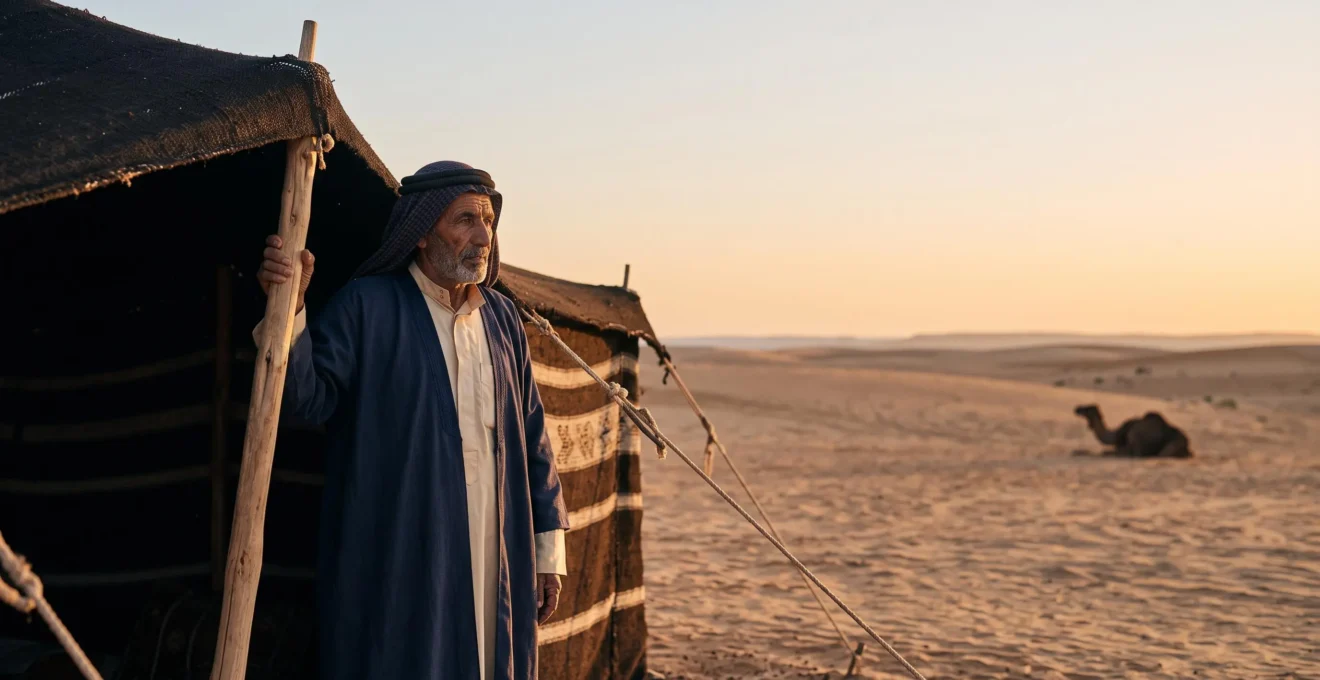
Common wisdom credits Bedouin survival to hardy camels and innate desert knowledge. The reality is far more sophisticated. For 3,000 years, their resilience has stemmed not from individual skills, but from a complex cultural operating system where values like kinship and oral tradition function as advanced social and ecological technologies, designed for distributed risk and sustainable resource management.
For millennia, the vast, arid landscapes of the Arabian Peninsula have posed one of humanity’s greatest survival challenges. Yet, within this seemingly inhospitable environment, the Bedouin people developed a society that not only endured but thrived. It’s easy to fall back on romantic images of resilient nomads, their lives revolving around camels, tents, and a legendary sense of hospitality. While these elements are part of the story, they are merely the surface hardware of a much deeper and more intricate system.
The conventional focus on material culture and individual fortitude misses the crucial point. The true genius of Bedouin resilience lies in a sophisticated cultural software—a set of values and social structures that function as a highly adapted operating system for life in the desert. This system is not a collection of quaint customs; it is a deliberate framework of social technologies engineered to manage risk, preserve critical data, and ensure ecological balance. But what if the key to their 3,000-year success wasn’t just surviving the desert, but programming their culture to master it?
This article deconstructs that cultural operating system. We will explore how kinship solidarity acts as a form of distributed insurance, how oral tradition serves as a dynamic ecological database, and how forced settlement causes this finely tuned system to crash. By examining these components, we can understand Bedouin culture not as a relic of the past, but as a masterclass in systemic resilience.
To fully unpack this sophisticated framework, the following analysis examines the core components of the Bedouin cultural system, from its social foundations to its ecological applications. The table of contents below outlines this structured exploration.
Contents: Unpacking the Bedouin Resilience Framework
- Why Do Bedouin Tribes Show 60% Stronger Kinship Solidarity Than Settled Villages?
- How Did Bedouin Preserve 500 Years of Ecological Knowledge Through Oral Tradition?
- Bedouin or Mongol Nomadism: Which System Better Prevented Overgrazing and Land Degradation?
- The Forced Settlement Program That Destroyed 2,000 Years of Pastoral Balance
- When Did Bedouin Move to Summer Pastures: The 5 Environmental Signals?
- Why Does Multigenerational Living Improve Financial Resilience?
- Why Did Amazigh Language Survive in Mountains While Disappearing in Lowlands?
- Why Has The Extended Family Remained The Cornerstone Of Social Structure Despite Modernisation?
Why Do Bedouin Tribes Show 60% Stronger Kinship Solidarity Than Settled Villages?
In the unforgiving desert, an individual’s survival is inextricably linked to the group. This reality forged a level of kinship solidarity, or Asabiyyah, that is functionally more intense than in settled agricultural communities. This is not simply a matter of affection; it is a social technology for survival. The harsh environment, with its scarce and unpredictable resources, necessitates a powerful collective framework for mutual defence, resource sharing, and risk distribution. In a settled village, a crop failure might be localized, but in the desert, a raid or a dried-up well is an existential threat to all.
This deep-seated solidarity was recognized as the engine of nomadic power by the 14th-century scholar Ibn Khaldun, who saw it as a force born from shared peril. He observed that the constant need for self-reliance and mutual defence in the absence of a formal state creates an unbreakable bond. As he noted in his seminal work, the Muqaddimah:
The affection everyone has for his clients and allies results from the feeling of shame that comes to a person when one of his neighbours, relatives, or a blood relation is in any way humiliated.
– Ibn Khaldun, Al-Muqaddimah (1377)
This sense of collective honour is not merely a feeling but is codified into a functional system. The most potent example of this is the structure of blood-money (diya) payments, which act as a layered insurance mechanism. Rather than an individual being solely responsible for a transgression, the financial burden is distributed across a nested hierarchy of kin, creating a powerful incentive for the entire group to police its members and prevent conflict.
Case Study: Nested Blood-Money Groups as a Layered Insurance System
Anthropological documentation of Bedouin customary law shows that blood-money obligations are organized in nested groups. A case from the Ahaywat of Sinai illustrates this perfectly. In the 1970s, the tribe established a pact to cover large, inter-tribal disputes collectively. However, for smaller, more frequent intra-tribal incidents, distinct and smaller blood-money groups remained responsible. This tiered system of collective responsibility demonstrates a sophisticated strategy of distributing risk, ensuring that catastrophic financial shocks are absorbed by the largest possible group while smaller incidents are managed at a more local level.
Ultimately, the intense solidarity of Bedouin tribes is a direct functional adaptation. It transforms the extended family and clan from a simple lineage into a corporate body with shared liability and collective security, an essential structure for thriving in a world defined by uncertainty.
How Did Bedouin Preserve 500 Years of Ecological Knowledge Through Oral Tradition?
Before satellites and written records, the Bedouin relied on a far more organic and dynamic database: oral tradition. This was not mere storytelling; it was a highly structured system for encoding and transmitting vast amounts of critical data. Poetry (qasidah), proverbs, and genealogies formed an ecological grammar that taught generations how to read the subtle language of the desert, preserving knowledge of well locations, pasture cycles, tribal histories, and survival techniques.
The poetic tradition, in particular, was a sophisticated mnemonic device. Complex rhyme schemes, meters, and rich imagery made long, data-heavy narratives easier to memorize and recall with high fidelity. The power of this system is evident in the fact that some of the most famous pre-Islamic poems, the Mu’allaqat, survived for 150 years through oral transmission alone before they were ever written down. The scholar Suzanne Pinckney Stetkevych noted that the audience for this poetry was highly trained, able to grasp complex, interwoven themes and references, making each performance a dense transfer of cultural and ecological information.
The audience of the oral tradition was educated and cultivated through the intertextuality and interreferentiality of the qasidah so that they intuitively grasped the full subject, despite the seemingly scattered, diverse images.
– Suzanne Pinckney Stetkevych (as discussed in Bedouin Heritage)
This knowledge was not only spoken; it was woven. The traditional craft of Al Sadu, a weaving practice performed by Bedouin women, serves as a tangible, physical archive of cultural data. The intricate geometric patterns are more than decoration; they are a symbolic language that records tribal identity, social history, and the surrounding environment.
The illustration below captures the tactile nature of this living archive, where each thread is a piece of data and the loom is a tool for cultural transmission.
This process of encoding information into artifacts is a powerful form of knowledge preservation. Through these practices, the community ensures that critical data is not lost but is instead embedded into the very fabric of daily life.
Case Study: Al Sadu Weaving as a Data-Rich Cultural Artifact
The value of this practice is recognized in UNESCO’s inscription of Al Sadu as an Intangible Cultural Heritage of Humanity. The documentation highlights how Bedouin women encode tribal identity and heritage into geometric woven patterns using natural fibers from their herds. Master weavers transmit the complex skills and symbolic meanings within the household, effectively turning the simple ground loom into a living archive of tribal history and a medium for passing down generations of knowledge, ensuring its survival and relevance.
Bedouin or Mongol Nomadism: Which System Better Prevented Overgrazing and Land Degradation?
Not all nomadism is created equal. While both Bedouin and Mongol cultures mastered life on the move, their approaches to land management evolved to meet different strategic needs, resulting in vastly different ecological impacts. The central question is not one of superiority, but of objective. Bedouin nomadism was largely a system of sustainable subsistence, while Mongol nomadism, particularly during its imperial phase, was a system of logistical support for a massive, mobile military and political machine.
The Bedouin system is characterized by rotational grazing within a recognized tribal territory, known as a dirah. This practice involves moving herds in a cyclical pattern between different pastures, allowing vegetation time to recover. It is a proactive form of land stewardship, guided by a deep, generational understanding of the local ecosystem’s carrying capacity. Herds were typically smaller, tied to the needs of the extended family, which inherently limited the pressure on any single area. This approach is about long-term equilibrium with a fragile environment.
In contrast, the Mongol system often involved the aggregation of vast numbers of animals to support large, concentrated populations on the move. Their transhumance patterns were more extensive and sometimes linear, driven by conquest and the administration of a sprawling empire. While they possessed their own sophisticated ecological knowledge, the sheer scale of their herds and the logistical demands of their society could place immense, short-term pressure on grasslands, leading to a higher risk of degradation if an area was grazed too intensively.
The following image serves as a metaphor for these two paths: one of careful, repeated passage that preserves the land, and one of overwhelming force that risks depleting it.
The Bedouin model, therefore, proved more effective at preventing long-term land degradation precisely because its primary goal was the perpetual sustainability of the family and clan within a defined territory. It was a system designed for resilience over centuries, not for the rapid projection of power across a continent. This focus on balance is a core feature of their successful adaptation to the desert.
The Forced Settlement Program That Destroyed 2,000 Years of Pastoral Balance
The resilience of the Bedouin cultural system is predicated on one critical, non-negotiable element: mobility. The entire framework of rotational grazing, social organization, and ecological knowledge is designed for a life in motion. When this mobility is forcibly removed through sedentarization programs, the system does not just weaken; it collapses. State-led initiatives to settle nomadic populations, often undertaken in the name of modernization and control, have consistently proven to be ecologically and socially catastrophic.
Forced settlement severs the link between the people and their land management strategies. Confined to a fixed location, their herds inevitably overgraze the surrounding area, leading to desertification and destroying the very resource base they depend on. The pastoral balance, maintained for millennia through careful movement, is shattered in a matter of decades. This creates a vicious cycle of environmental degradation and economic dependence, as formerly self-sufficient pastoralists are forced to rely on wage labor or government aid.
Furthermore, the social fabric unravels. The structures of kinship solidarity and customary law, designed for a dispersed and mobile society, lose their context and authority in the artificial environment of a planned township. This often leads to social dysfunction, unemployment, and a loss of cultural identity, as the core organizing principles of their world become obsolete. The systemic resilience of the nomadic culture is replaced by the systemic fragility of a marginalized, dependent community.
Case Study: The Planned Resettlement of Israel’s Negev Bedouin
A case study of induced sedentarization and urbanization of Negev Bedouin communities offers a stark illustration of this process. The establishment of the planned township of Tel-Sheva, intended as a model for modern settlement, resulted in a community that became socially, economically, and politically dysfunctional. It now ranks among the most disadvantaged settlements in the country. This outcome powerfully demonstrates how forced settlement can dismantle the intricate resilience mechanisms of a previously self-sufficient nomadic system, leading to a profound and lasting state of crisis.
The destruction of this pastoral balance is a clear testament to the interconnectedness of Bedouin culture. Mobility was not just a lifestyle choice; it was the master variable that held the entire ecological and social system together. Its removal is an act that unravels two thousand years of successful adaptation.
When Did Bedouin Move to Summer Pastures: The 5 Environmental Signals?
The seasonal migration of Bedouin tribes was not a random wandering but a precise and calculated response to a complex set of environmental cues. This movement, essential for sustainable grazing, was orchestrated by a deep, collective knowledge of the desert’s rhythms. This “ecological grammar” allowed them to read subtle signals from the sky, land, and living creatures, telling them exactly when to leave winter pastures for the cooler, more durable grazing grounds of summer. This knowledge was a critical technology for resource management.
While the specific signals could vary by region, they generally fell into five interconnected categories:
- Floristic Indicators: The lifecycle of key plant species was a primary signal. The flowering or drying up of certain annual plants that provided rich winter forage indicated that the pasture’s nutritional value was declining and it was time to move on.
- Astronomical Calendars: The rising and setting of specific stars and constellations served as a celestial clock. The appearance of the Pleiades (Al-Thurayya) at a certain point in the dawn or dusk sky, for example, was a widely used marker for seasonal change across the peninsula.
- Climatic Shifts: Changes in prevailing wind patterns and temperature were carefully observed. The shift from cool, moist winter winds to hot, dry summer winds (like the Simoom) was an unmistakable sign that the season was turning.
- Hydrological Signs: The availability of water was paramount. The drying of seasonal pools (ghadir) that form after winter rains was a clear and urgent signal that the herds needed to be moved toward more permanent summer wells.
- Zoological Behavior: The behavior of wildlife, particularly the migratory patterns of birds, provided another layer of confirmation. The arrival or departure of certain bird species was a reliable indicator of the broader ecological shift taking place.
The image below evokes the beginning of such a journey, a small caravan moving across a vast landscape, guided by this invisible map of natural cues.
This multi-faceted approach ensured that the decision to migrate was not based on a single data point, but on a convergence of evidence, making it a robust and reliable system for ecological navigation.
Action Plan: Auditing Environmental Cues Like a Nomad
- Points of Contact: Identify all observable environmental phenomena in your area—dominant plant species, visible constellations, prevailing winds, local water sources, and key animal behaviors.
- Data Collection: Systematically inventory the current state of these phenomena. Is a specific plant flowering or seeding? Where is a key constellation at dusk? Which direction is the wind blowing from?
- Pattern Coherence: Cross-reference these individual signals with historical or traditional knowledge. Does the combination of these signs typically precede a known seasonal shift (e.g., first frost, rainy season)?
- Trigger Identification: Determine the primary “trigger” signal—the one cue that, once observed, confirms the seasonal transition is imminent and action is required.
- Strategic Integration: Based on the convergence of these signals, formulate a concrete plan, whether it’s planting a garden, preparing for a weather change, or, in the Bedouin case, beginning the seasonal migration.
Why Does Multigenerational Living Improve Financial Resilience?
In modern economies, the nuclear family is often the basic economic unit. In traditional Bedouin society, and many other cultures, the multigenerational extended family functions as a more robust and resilient economic entity. This structure acts as a powerful system of distributed financial risk, providing a built-in social safety net that is far more flexible and responsive than formal state welfare or private insurance.
The financial benefits stem from several key mechanisms. The first and most obvious is the pooling of resources. By sharing a single household or a close cluster of dwellings, expenses for housing, utilities, and food are drastically reduced. Income from various members, whether from pastoralism, wage labor, or trade, can be combined to create a more stable and diversified household revenue stream. A sudden job loss or illness affecting one member is buffered by the continued contributions of others.
Second, the multigenerational household is a hub of shared labor. Childcare is often provided by grandparents or other relatives, freeing up parents to work without incurring the high costs of external daycare. Similarly, care for the elderly is integrated into daily life, avoiding the immense financial and emotional costs of institutional care. This internal economy of care and labor represents a massive, non-monetized financial asset.
Finally, this structure facilitates the transfer of skills and capital across generations. Grandparents pass down practical skills, from animal husbandry to traditional crafts, that can have direct economic value. The family unit can also act as an informal bank, pooling savings to fund a new business for a younger member or to purchase a major asset, like a vehicle, that benefits the entire group. This internal system of investment and support enables economic mobility and entrepreneurship without reliance on external financial institutions, which may be inaccessible or exploitative.
This model transforms the family from a collection of individuals into a cooperative economic enterprise, significantly enhancing its ability to withstand financial shocks and build long-term wealth.
Why Did Amazigh Language Survive in Mountains While Disappearing in Lowlands?
The survival of a language against the pressure of a dominant tongue is a testament to cultural resilience. The case of the Amazigh (Berber) languages in North Africa provides a classic example of how geography can function as a cultural firewall. While Amazigh languages largely vanished from the accessible coastal plains and lowlands over centuries of influence from Phoenician, Roman, and Arab civilizations, they have persisted with remarkable vitality in the remote and rugged mountain ranges like the Atlas and Rif.
The primary factor in this linguistic divergence is geographic isolation. Mountainous terrain acts as a natural barrier, limiting contact, trade, and intermarriage with outside groups. The lowlands and plains, by contrast, were the highways of conquest, commerce, and administration. Communities in these areas were constantly exposed to the dominant language of the ruling power—be it Latin, and later, Arabic. For social and economic advancement, adopting the lingua franca was not just advantageous; it was often necessary.
In the mountains, however, communities were more self-sufficient and less integrated into the state’s administrative and economic apparatus. This physical and political distance created a protected space where the Amazigh language could remain the exclusive medium of daily life, religion, commerce, and governance. The language was not merely spoken; it was the operating system of the community, essential for every social transaction. This constant, immersive use reinforced its transmission from one generation to the next.
This isolation also fostered a strong, distinct cultural identity. Shielded from the homogenizing pressures of the lowlands, mountain communities maintained their unique social structures, legal customs, and oral traditions, all of which were encoded in and expressed through their native language. The language and the culture became mutually reinforcing, creating a resilient feedback loop that has allowed them to endure for millennia despite the immense pressures surrounding them.
Key Takeaways
- Bedouin cultural values are not abstract beliefs but functional social technologies designed for risk management and resilience in a harsh environment.
- Kinship solidarity, codified in systems like blood-money payments, acts as a sophisticated, multi-layered insurance policy that distributes risk across the entire group.
- Oral tradition and material crafts like Al Sadu weaving function as complex, data-rich archives for preserving and transmitting critical ecological and social knowledge across generations.
- Nomadic mobility is the master variable of the Bedouin system; its removal through forced settlement leads to a catastrophic collapse of both ecological balance and social structure.
Why Has The Extended Family Remained The Cornerstone Of Social Structure Despite Modernisation?
Despite the profound changes brought by modernization, oil wealth, and state formation, the extended family remains the unshakable cornerstone of many Arab societies, particularly those with Bedouin roots. This enduring relevance is not due to mere tradition or resistance to change. It persists because the extended family continues to perform essential social, economic, and political functions that modern institutions either cannot or do not fulfill with the same level of trust and efficacy.
At its core is the concept of Asabiyyah, or group solidarity. This is the social capital that binds the family and tribe, creating a high-trust network for mutual support. In an environment where formal institutions can be perceived as slow, impersonal, or unreliable, the family network offers a parallel system for everything from securing employment to resolving disputes. It is a time-tested social technology that provides security and opportunity.
Asabiyyah forms the very foundation upon which states and empires are established and sustained, functioning as a form of social capital.
– The Companion (analysis of Ibn Khaldun’s theory)
This is not a theoretical construct; it is a living reality. The family network continues to act as the primary safety net, the first-choice lender, and a crucial arbiter of social conduct. This is powerfully illustrated by the continued use of customary law to resolve conflicts, even in nations with highly developed formal legal systems.
Case Study: The Ja’ha: Tribal Customary Dispute Resolution in Jordan
Contemporary documentation of Jordanian tribal customary law describes the Ja’ha, a mediation body composed of respected elders from the extended family and clan network. This body is convened to resolve serious disputes, negotiate compensation, and restore social harmony, often operating entirely outside the formal state court system. The existence and continued authority of the Ja’ha show the extended family functioning as a parallel, high-trust institution for justice and conflict resolution, demonstrating its undiminished role in maintaining social order.
The extended family, therefore, has not been rendered obsolete by modernization. Instead, it has adapted, continuing to provide a framework of trust, identity, and mutual support that remains indispensable. It is the fundamental social unit upon which all other layers of society are built, a resilient structure that has proven its value across centuries of change.
To fully understand cultural resilience, whether in the desert or in our own communities, the crucial step is to look beyond romantic notions and surface-level artifacts. It requires an analytical shift towards seeing the intricate systems of social technology—the rules, values, and structures—that give a culture its adaptive strength.