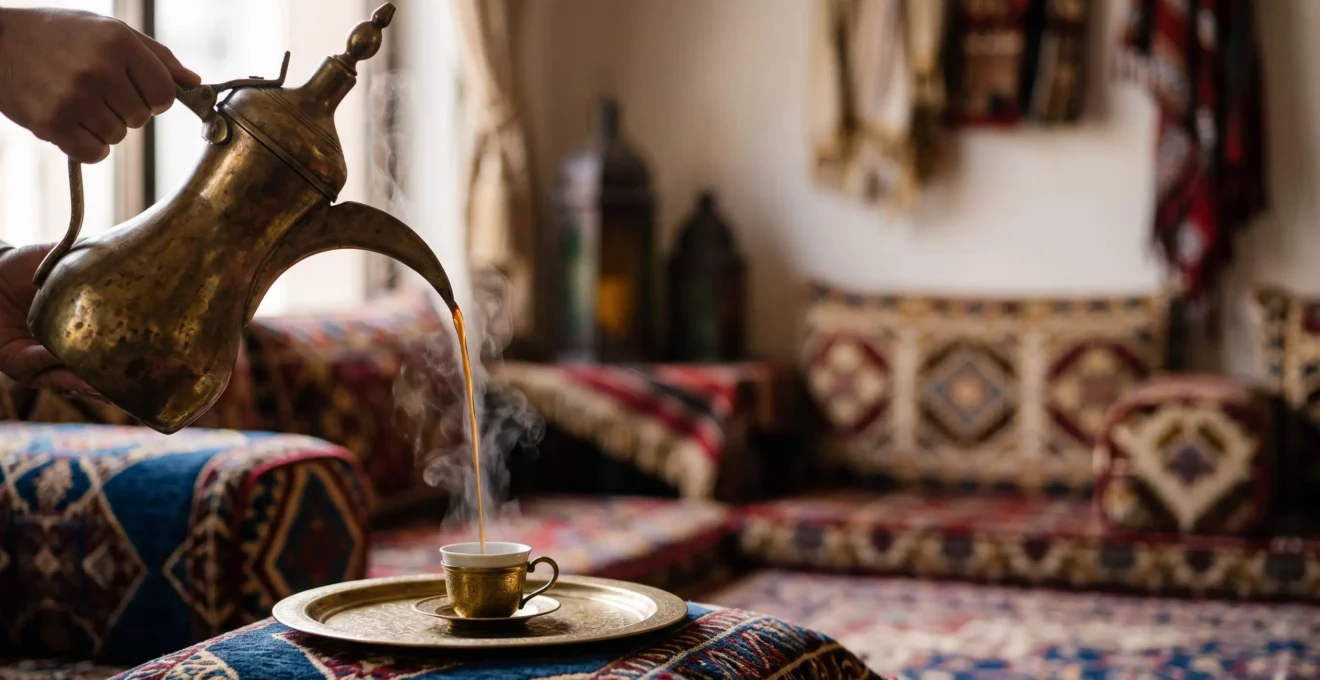
Contrary to the simple notion that Arabic coffee is just a symbol of generosity, it functions as a complex social grammar. This article decodes how every element—from the aroma of the roast to the specific volume poured—is a deliberate signal used to negotiate honour, establish social hierarchy, and manage reputation. Understanding this ritual is to learn a language of respect spoken without words.
To be a guest is a universal human experience, but the codes of hospitality that govern it are deeply cultural. In the Arab world, the offering of coffee, or qahwa, is the quintessential act of welcome. Most observers correctly identify it as a profound gesture of generosity and a cherished tradition. Yet, to stop at this surface-level interpretation is to miss the intricate performance unfolding. It is to hear the words of a language without grasping its syntax or subtext.
The common understanding focuses on the steps: roasting the beans, grinding them with cardamom, and brewing the light, aromatic beverage. But why fresh roasting? Why is the cup only partially filled? These are not arbitrary details. They are carefully calibrated signals in a sophisticated system of non-verbal communication. Reducing this ritual to a mere token of generosity overlooks its function as a dynamic social negotiation, a means of establishing status, and a testament to a host’s character.
This analysis moves beyond the what and into the why. We will explore the Arab coffee and tea rituals not as static traditions, but as a living social grammar. By examining the specific gestures, tools, and sequences, we will decode how honour is performed, how social bonds are forged, and how reputation can be made or broken in the time it takes to brew and serve a single cup. This is not just about coffee; it is about the choreography of honour.
This article examines the core components of this ritualistic language. By understanding the meaning embedded in each action, we can appreciate the depth and complexity of a practice that elevates a simple beverage into a cornerstone of social life.
Summary: Unpacking the Social Grammar of Arab Hospitality
- Why Does Freshly Roasted Coffee Change Social Dynamics More Than Instant?
- How Do Hosts Prepare Coffee to Signal Honour Without Excess?
- Arabic Coffee or Turkish Coffee: Which Hospitality Ritual Creates Stronger Bonds?
- The Over-Brewing Mistake That Turns Coffee Into Bitter Reputation
- When Should Guests Accept Coffee: Before or After the Meal?
- Why Does Pouring Tea From Height Signal Deep Respect?
- Why Does Serving Spiced Lamb Signal Greater Generosity Than Other Dishes?
- Why Is Tea Preparation in Arab Culture More Than a Drink—It Is a Social Contract?
Why Does Freshly Roasted Coffee Change Social Dynamics More Than Instant?
The Arab coffee ritual begins long before the liquid touches the cup. It starts with a sensory announcement. The use of freshly roasted beans over a pre-ground or instant alternative is the first and most crucial statement in this social grammar. The process often involves roasting green beans in a pan (mahmas) over a fire, creating a distinct aroma and a rhythmic sound as they are stirred. As one Bedouin guide, Suleiman, poignantly notes, this is not just a smell or a sound; “It’s the sound of hospitality.”
This sensory broadcast serves a strategic purpose. The aroma travels, alerting guests and even neighbours that a welcome is being prepared. It signals investment of time and effort, a stark contrast to the convenience of instant coffee. This act of fresh preparation communicates that the guest is worthy of a process, not just a product. It transforms the home from a private space into a public stage for a performance of generosity. The sound of the beans being ground in a mortar (mihbaj), often with a specific rhythm, further amplifies this public declaration of welcome.
This performance is so central to cultural identity that in 2015, Arabic coffee was formally recognized by UNESCO as a ceremonial act of generosity. The inscription highlights that the value lies not just in the drink, but in the entire chain of preparation. By choosing to roast fresh, the host is not merely making coffee; they are initiating a dialogue of respect, and the rich aroma is the opening word.
How Do Hosts Prepare Coffee to Signal Honour Without Excess?
Once the coffee is prepared, the “choreography of honour” begins. The host’s every movement is freighted with meaning, designed to show respect without appearing ostentatious or, conversely, stingy. The most senior or honoured guest is always served first. The host, often standing as a sign of respect for the seated guests, holds the coffee pot (dallah) in their left hand and the small, handleless cups (finjan) in their right.
A critical rule in this grammar is the amount of coffee poured. As Emirati culture researcher Ghaia Al Dhaheri explains, “Offering coffee to the guest is an honor for him.” This honour is demonstrated through a highly specific measure: hosts traditionally fill only a quarter of the cup. This gesture may seem counterintuitive to an outsider accustomed to full mugs, but its meaning is precise. A small amount signifies that the guest is so welcome, they are expected to stay for multiple refills. It is an invitation to linger and converse.
Conversely, filling the cup to the brim is a grave insult known as Hishmat al-finjan. It silently communicates, “Drink this one cup and leave.” It is an act of dismissal. Therefore, the small portion is a signal of high esteem and an open-ended welcome. The host must pour with a steady hand, ensuring a smooth flow that demonstrates poise and control. Every element of the service is a carefully managed performance of respect.
As this image illustrates, the physical posture of the host—standing and serving—reinforces the hierarchy of hospitality, where the server elevates the status of the guest. The entire process is a masterclass in calibrated generosity, where honour is communicated not through abundance, but through precision and restraint.
Arabic Coffee or Turkish Coffee: Which Hospitality Ritual Creates Stronger Bonds?
While both Arabic and Turkish coffee are pillars of hospitality in the Middle East, their ritualistic structures create different social dynamics. Turkish coffee is typically prepared and served in individual portions, each in its own cup. The experience, while warm and welcoming, is fundamentally individual. In contrast, the Bedouin tradition of preparing Arabic coffee fosters a deeply communal bond.
The key difference lies in the shared vessel. In a traditional Bedouin setting, a single large pot of coffee is brewed and shared among all present. As an account of a Bedouin coffee gathering details, the ritual unfolds as a shared, unhurried group experience tied to storytelling and community. The host serves each person from the same dallah, creating a tangible link between everyone in the circle. This single source reinforces the idea of a collective experience, where all guests are partaking in the same offering.
This communal structure is highly effective at breaking down social barriers. A visitor recounts sharing coffee with a Bedouin family in Jordan, noting how the group ritual around a single pot fostered an immediate connection with a total stranger despite language barriers. The act of sharing creates a “threshold of trust,” transforming a group of individuals into a temporary community. The focus shifts from the private consumption of a beverage to the public participation in a shared rite.
While Turkish coffee is a gesture of personal welcome, the Arabic coffee ritual, particularly in its nomadic form, is engineered to forge collective bonds. Its grammar is not one-to-one but one-to-many, making it an exceptionally powerful tool for social cohesion.
The Over-Brewing Mistake That Turns Coffee Into Bitter Reputation
In the social grammar of hospitality, the coffee itself is the host’s reputational currency. Its flavour is a direct reflection of their care and competence. A well-brewed coffee—lightly roasted, fragrant with cardamom, and smooth—enhances the host’s standing. A poorly prepared coffee, however, can damage it. The most common mistake is over-brewing, which results in an excessively bitter taste.
Bitterness in coffee can be interpreted as a metaphor for the host’s character or feelings toward the guest. While a certain level of bitterness is expected, an overwhelmingly bitter brew can signal carelessness or even a lack of genuine welcome. It suggests the host was inattentive or unskilled, failing in their primary duty of honouring the guest. This is why the brewing process is so carefully monitored, with the coffee often boiled three times but never for too long.
The ritual, however, provides an elegant mechanism for the guest to manage their intake and avoid any awkwardness. When a guest has had enough, they do not need to say a word. As MOJEH magazine notes, “the shake of the cup alone will spare a visitor an endless run of refills.” By gently jiggling the empty cup from side to side before returning it, the guest politely signals they are finished. This non-verbal cue is universally understood and allows the guest to decline further servings without causing offence, and it saves the host from the social misstep of forcing coffee on an unwilling guest. It is a graceful end to the exchange, preserving the honour of both parties.
When Should Guests Accept Coffee: Before or After the Meal?
A common question for outsiders is about the timing of coffee in the sequence of hospitality. The answer is unequivocal: coffee is not an afterthought or a digestif served after a meal. It is the formal opening of the social encounter. Accepting coffee is the guest’s first act of participation, a signal that they accept the host’s welcome and are willing to enter into a social contract of conversation and mutual respect.
The ritual of coffee and dates is often the very first thing offered to a guest upon arrival. This pairing serves as the primary act of hospitality, a preamble that can last far longer than any meal. A visitor’s account from Saudi Arabia perfectly illustrates this, where an initial invitation for coffee from a stranger unexpectedly led to a two-hour conversation about life and work. The coffee was not a prelude to the “real” interaction; it was the interaction itself. It functioned as the key that unlocked the door to genuine exchange and trust.
Within this contract, there are also rules of engagement for the guest. It is considered polite to accept at least one cup. To refuse the first cup without a valid reason can be seen as a slight, a rejection of the host’s honour. However, consuming too many cups can be seen as greedy. The socially accepted etiquette, as documented in the context of the UNESCO inscription, is to drink at least one cup but not exceed three. The first cup is for hospitality (lil-thayf), the second for mood (lil-kayf), and the third for the sword (lil-sayf), symbolizing a shared bond of protection. By adhering to this rhythm, the guest demonstrates their cultural fluency and respect for the host.
Why Does Pouring Tea From Height Signal Deep Respect?
Just as with coffee, the preparation and serving of tea (shai) in many parts of the Arab world, particularly in the Maghreb, is a performance dense with social meaning. The most visually striking element of the Moroccan tea ceremony is pouring the sweet mint tea from a great height into small, delicate glasses. This is far more than a theatrical flourish to cool the tea or create a frothy head (ragwa).
The height of the pour is a direct, measurable indicator of the level of respect and welcome afforded to the guest. As an Arab America editorial explicitly states, “the higher the tea is poured, the more welcome your guests are.” The act requires skill, a steady hand, and concentration. Pouring from a significant height without spilling is a difficult feat, and the willingness to perform this act of dexterity is a tribute to the guest. It is a physical manifestation of the effort the host is willing to expend to honour their visitor.
This gesture has a standardized dimension; tea is traditionally poured from a height of 20 to 30 centimetres (8 to 12 inches), and sometimes even higher for a particularly esteemed guest. The long, amber stream of tea becomes a visual spectacle, a moment of focused artistry that elevates the simple act of serving a drink into a memorable event. The height of the stream is a visible metric of honour. A low, careless pour for a guest would be a quiet but clear insult, signaling a lack of enthusiasm or respect. Through this dramatic choreography, the host makes their high regard for the guest visible to all.
Why Does Serving Spiced Lamb Signal Greater Generosity Than Other Dishes?
While coffee and tea open the social contract, the offering of a significant meal solidifies it, and no dish makes a more powerful statement of generosity than spiced lamb. In many Levantine cultures, particularly Jordan, serving mansaf—a large platter of rice, flatbread, and lamb cooked in a fermented yoghurt sauce (jameed)—is the ultimate expression of honour. As restaurant co-owner Tamer al-Majali states, “If you want to honour your guest, there’s nothing finer than mansaf.”
Its power as a social signal comes from the significant cost and effort involved. Lamb is a valuable commodity, and preparing a whole lamb for guests is a substantial investment. The dish is traditionally served on a single, large communal platter, reinforcing the collective bond initiated by the coffee. Guests gather around the platter, often eating with their right hand, in a powerful display of community and shared sustenance.
The social grammar of mansaf is so profound that in late 2022, the tradition was inscribed on UNESCO’s list of intangible cultural heritage, which highlights its role in fostering social cohesion. This grammar includes a strict “hospitality protocol.” According to researcher Hassan Mubaideen, the lamb’s head is traditionally placed in front of the most honoured guest as the ultimate mark of respect. This specific, hierarchical gesture elevates the meal from mere sustenance to a formal ceremony of social recognition. Serving a lesser dish might feed the guests, but serving mansaf explicitly and publicly honours them.
Key Takeaways
- Hospitality as Performance: Arab coffee and tea rituals are not just about serving a drink; they are carefully choreographed performances where every gesture communicates respect, honour, and social standing.
- Calibrated Generosity: The rules, such as pouring only a quarter-cup of coffee, are not arbitrary. They are precise signals designed to convey an open-ended welcome and high esteem, where less is more.
- Ritual as Social Contract: Accepting coffee or tea is to enter a social pact. It is the primary vehicle for building trust and initiating genuine conversation, often more significant than the meal that may or may not follow.
Why Is Tea Preparation in Arab Culture More Than a Drink—It Is a Social Contract?
The final layer of meaning in these rituals is the concept of time. The preparation of tea, like coffee, is a process that cannot be rushed. A famous Tuareg proverb captures this beautifully: “It takes three things to make tea: time, embers, and friends.” This sentiment underscores that the ritual’s purpose is not merely to quench thirst but to create a shared space for companionship. The time invested by the host is a gift to the guest.
This idea is most explicitly codified in the Moroccan tradition of serving three successive rounds of tea. As documented by Gastro Obscura, the same fresh mint and green tea leaves are used to brew three sequential glasses for each guest, with the flavour evolving in each round. The first glass is said to be “as bitter as life,” the second “as strong as love,” and the third “as gentle as death.”
Accepting the first glass of tea is an implicit agreement to stay for all three. This is the social contract in its purest form. By accepting the tea, the guest is committing a significant portion of their time to the host. The three rounds create a narrative arc for the social interaction, a shared journey of taste that unfolds slowly. To leave after only one or two glasses would be a breach of this unspoken contract, a clear social faux pas. The ritual therefore transforms the act of drinking tea into a pact of time and presence, binding host and guest together for the duration of the ceremony.
To truly grasp these dynamics, the next step is to observe these rituals not just as a guest, but as a student of cultural communication. Each element, from the clink of the cups to the aroma of cardamom, is a word in a rich and ancient dialogue of human connection.