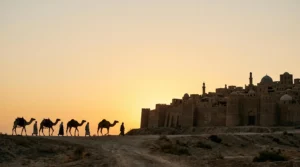
Baghdad’s state-funded “trophy project” model was spectacular but fragile, while Cordoba’s market-driven “knowledge ecosystem” proved more resilient—offering a crucial lesson for modern cities on sustainable innovation.
- Baghdad centralized genius in its magnificent House of Wisdom, making it a brilliant but vulnerable single point of failure.
- Cordoba distributed intellectual production across a city-wide economy of dozens of libraries, scribes, and artisans, creating a robust and adaptable network.
Recommendation: Modern urban planners should study Cordoba’s model to prioritize building decentralized, resilient knowledge ecosystems over singular, high-profile cultural institutions.
In the modern world, we obsess over what makes a city a “knowledge hub.” We analyze Silicon Valley, Boston, or Shenzhen, trying to decode the formula that attracts the brightest minds and sparks innovation. Yet, this competition for human capital is not new. Over a thousand years ago, two rival caliphates—the Abbasids in Baghdad and the Umayyads in Cordoba—were engaged in a fierce contest to become the undisputed intellectual centers of the world. They didn’t just build cities; they engineered magnets for scholars, scientists, and philosophers.
The common narrative credits both with immense libraries and a flurry of translation. While true, this surface-level view misses the crucial strategic differences in their approach. It overlooks the fundamental question that modern urban planners still grapple with: is it better to build a single, monumental “trophy project” to dazzle the world, or to cultivate a decentralized, grassroots “knowledge ecosystem”? Baghdad and Cordoba represent two distinct answers to this question, each with profound consequences for their rise and eventual fall.
This analysis moves beyond a simple inventory of their achievements. We will dissect the contrasting urban, economic, and political models that defined their success and sealed their fate. By comparing Baghdad’s centralized brilliance with Cordoba’s distributed resilience, we uncover timeless principles about how cities can either foster sustainable innovation or create spectacular but fragile centers of learning that can vanish in an instant.
This article dissects the strategic choices that propelled both cities to greatness and ultimately led to their divergent destinies. The following sections explore the specific mechanics of their talent acquisition, urban infrastructure, and the hidden vulnerabilities that brought their golden ages to an end.
Table of Contents: From Regional Powers to Global Magnets: The Urban Genius of Baghdad and Cordoba
- Why Did Baghdad and Cordoba Outcompete 50 Other Wealthy Cities for Scholarly Talent?
- How Did Cordoba Accommodate 60,000 Scholars Without Modern Urban Planning?
- Baghdad or Cordoba: Which City Produced More Mathematical Breakthroughs in 200 Years?
- The Fortification Oversight That Let Invaders Destroy Baghdad in 13 Days
- When Did Cordoba’s Golden Era End: The 4 Indicators Scholars Missed?
- Why Did Europe’s Brightest Minds Travel 2,000 Miles to Study in Cordoba?
- How Did Medinas Accommodate 100,000 People in 1 Square Mile Without Cars?
- What Made Arab Centers of Knowledge the Universities of the Medieval World?
Why Did Baghdad and Cordoba Outcompete 50 Other Wealthy Cities for Scholarly Talent?
In the 9th and 10th centuries, dozens of prosperous cities dotted the Islamic world, from Samarkand to Cairo. Yet, only Baghdad and Cordoba evolved into true “human capital magnets,” drawing scholars like moths to a flame. Their success wasn’t accidental; it was the result of deliberate, state-sponsored strategy. Baghdad set the precedent with a top-down, centralized model. The Abbasid caliphs understood that intellectual prestige was a form of soft power. They didn’t just hope for scholars to arrive; they built the world’s most advanced infrastructure to lure them in.
The legendary House of Wisdom (Bayt al-Hikmah) was the crown jewel of this strategy. It was more than a library; it was a state-funded institute for research, translation, and debate. By providing lavish salaries, resources, and direct access to power, the caliphs turned scholarship into a lucrative and high-status profession. They invested in cutting-edge facilities to signal their commitment. For instance, an account confirms that as early as 829 CE, Caliph al-Ma’mun had already built a dedicated astronomical observatory in Baghdad, a clear statement that the city was the premier destination for scientific inquiry.
Cordoba, the rival Umayyad capital, observed this model and refined it. While also driven by caliphal patronage, its approach became more distributed. Instead of one single institution, Cordoba fostered a city-wide network of intellectual activity. Both cities, however, shared a core strategy: they made knowledge a state priority and invested heavily in the intellectual infrastructure needed to attract and retain the world’s top talent. This intentional investment is what separated them from other wealthy but less ambitious urban centers.
This intense focus on building an attractive environment for scholars established a powerful precedent. As noted by Middle East Eye, the House of Wisdom was designed to “attract scholars from far and wide, and rapidly expanded to include a translation house, an observatory.” This model of attraction, pioneered by Baghdad and perfected by Cordoba, created a virtuous cycle where talent attracted more talent, quickly leaving all other cities behind.
How Did Cordoba Accommodate 60,000 Scholars Without Modern Urban Planning?
Accommodating a massive influx of scholars, scribes, and students requires more than just a welcoming ideology; it demands a robust physical and economic infrastructure. Cordoba’s genius lay in creating a decentralized “knowledge ecosystem” that was woven into the very fabric of the city. Unlike Baghdad’s singular, monumental House of Wisdom, Cordoba’s intellectual life wasn’t confined to one building. It was a thriving, city-wide market economy built on information.
The city boasted over 70 libraries, creating a distributed network of knowledge. This wasn’t just about storing books; it was an engine of employment and enterprise. Historical records show that the royal library alone is reported to have given employment to over 500 people, including scribes, binders, and illustrators. This created a vast support industry—a true intellectual infrastructure—that offered careers and opportunities, drawing in not just elite thinkers but also the skilled artisans needed to support their work. This economic depth provided a level of stability and opportunity that a single, state-run institution could not match.
The image below evokes the intricate craftsmanship that formed the backbone of Cordoba’s knowledge economy, from the binding of manuscripts to the creation of scientific instruments like the astrolabe. It was this ecosystem of supporting trades that allowed the city’s intellectual life to flourish on such a massive scale.
This distributed model created resilience. If one library or workshop faced issues, the city’s intellectual heart would continue to beat. This network of smaller, interconnected nodes made the entire system more adaptable and less vulnerable to a single point of failure. It was this blend of patronage, market forces, and a city-wide distribution of resources that allowed Cordoba to function as a vast, open-air university campus without the formal structure of one.
Action Plan: Auditing a City’s ‘Knowledge Ecosystem’ Potential
- Points of Contact: List all institutions where knowledge is created, shared, or preserved (universities, labs, libraries, incubators, co-working spaces).
- Support Industry Inventory: Catalog the supporting crafts and services. Is there a local industry for data visualization, specialized manufacturing, patent law, or academic publishing?
- Talent Flow Analysis: Map where talent comes from (local universities, international recruitment) and where it goes. Are you retaining the talent you produce?
- Resilience vs. Fragility: Identify dependencies. Is the entire “scene” reliant on one major employer, one funding source, or one physical campus? What would happen if it disappeared?
- Integration Plan: Develop policies that foster connections between these nodes, promoting cross-disciplinary collaboration and creating a true city-wide ecosystem rather than isolated silos.
Baghdad or Cordoba: Which City Produced More Mathematical Breakthroughs in 200 Years?
Directly comparing the “number” of breakthroughs is a complex task, as the nature of their contributions differed strategically. Baghdad was the great originator, while Cordoba became the great synthesizer and refiner. This distinction is key to understanding their roles in the history of science. Baghdad’s primary mission, especially in its early golden age, was a monumental act of cultural rescue and assimilation. As described by World History Edu, the caliphs’ goal was to “translate all this ancient wisdom into Arabic so that it could be studied, debated, and improved.”
This translation movement was an unprecedented undertaking. Scholars in Baghdad’s House of Wisdom systematically translated the works of Greek, Persian, and Indian thinkers, from Euclid and Ptolemy to Aryabhata. This process laid the foundation for the scientific explosion to come. It was in Baghdad that Al-Khwarizmi synthesized Indian and Greek knowledge to pioneer algebra, and the Banu Musa brothers made significant advances in mechanics and geometry. Baghdad’s great contribution was creating the initial, comprehensive library of world knowledge in Arabic, a project that effectively kick-started a new era of scientific inquiry.
Cordoba, emerging slightly later, built upon this foundation. Its scholars had access to the translations and commentaries flowing from the East. They focused less on primary translation from Greek and more on refining, critiquing, and synthesizing the existing body of Arabic knowledge. This is not to say Cordoba lacked originality—the work of figures like Al-Zarqali in astronomy was revolutionary. However, its core strength was in building a more mature and critical scholarly dialogue.
Case Study: Al-Hakam II’s Joint Translation Committee in Cordoba
Under Caliph Al-Hakam II, Cordoba organized a mixed committee of Arab Muslim and Iberian Mozarab Christian scholars dedicated to translating Latin and Greek works into Arabic. This initiative illustrates how the city built on Baghdad’s earlier translation movement by creating a collaborative environment focused on refining and re-circulating knowledge. Rather than just originating translations from scratch, Cordoba was actively engaging with and expanding upon the intellectual currents of its time, demonstrating a more developed phase of the knowledge economy.
Therefore, asking which city produced “more” is like asking whether a foundry or a machine shop is more important. Baghdad was the foundry, forging the raw intellectual material. Cordoba was the sophisticated machine shop, tooling, refining, and assembling that material into new and more complex forms. Both were essential to the overall progress of science.
The Fortification Oversight That Let Invaders Destroy Baghdad in 13 Days
The spectacular collapse of Abbasid Baghdad in 1258 offers a chilling lesson in urban fragility. For all its intellectual brilliance, the city had a critical vulnerability: its knowledge was highly centralized, and its physical defenses had been neglected. The concentration of the caliphate’s intellectual treasures in one location—the House of Wisdom and other grand libraries—made it a catastrophic single point of failure. When the Mongol armies under Hulagu Khan arrived, they didn’t need to conquer a resilient network; they needed to strike one heart.
The consequences were devastating. Historical sources confirm that the siege that ended five centuries of Abbasid rule lasted just thirteen days. This shockingly brief period underscores the city’s lack of military preparedness. The political infighting and complacency of the late Abbasid era had led to a fatal underestimation of external threats. The focus on cultural prestige had come at the expense of pragmatic security. The investment in ideas was not matched by an investment in the walls needed to protect them.
This contrast between immense cultural wealth and physical vulnerability is a stark warning for any civilization. The destruction that followed the siege was absolute, a cultural cataclysm from which the city would not recover for centuries.
The image of the city’s intellectual heritage being physically destroyed became a defining tragedy of the era. The sack of Baghdad was not just a military defeat; it was the targeted destruction of a knowledge hub.
Eyewitnesses described the Tigris River running black with the ink from countless precious books thrown into it by the Mongol hordes.
– Sociology.org, The Mongol Siege of Baghdad in 1258
This horrifying account symbolizes the ultimate price of Baghdad’s centralized model. By placing all its intellectual eggs in one magnificent, but poorly defended, basket, the Abbasid Caliphate ensured that when the fall came, it would be total. The city’s wealth of knowledge, accumulated over 500 years, was annihilated in less than two weeks.
When Did Cordoba’s Golden Era End: The 4 Indicators Scholars Missed?
Unlike Baghdad’s sudden, catastrophic end, the decline of Cordoba was a slow, internal unraveling. The final political collapse of the Caliphate of Cordoba in the early 11th century (the Fitna of al-Andalus) is often cited as the end of its golden age. However, this was merely a lagging indicator—the final symptom of a disease that had been festering for decades. The true decline was not military or political but ideological, and the warning signs were clear long before the walls of power crumbled.
The most potent leading indicator was the rise of ideological intolerance and the suppression of free inquiry. The vibrant, open debate that had characterized Cordoba’s peak began to give way to rigid orthodoxy. This shift was marked by a series of highly symbolic acts of anti-intellectualism: public book burnings. These were not random acts of mob violence but calculated political moves designed to purge “dangerous” philosophical and scientific ideas from public life.
A Pattern of Six Public Book Burnings in al-Andalus
Detailed research on al-Andalus identifies a disturbing pattern: at least six separate, state-sanctioned public book burnings were carried out by five different regimes between the mid-10th and late-12th centuries. This began with the destruction of the philosopher Ibn Masarra’s writings in 961. This evidence demonstrates that ideological purges against philosophy were a recurring and escalating trend, signaling a deep-seated intellectual decay long before Cordoba’s ultimate political fragmentation. Each event chipped away at the city’s reputation as a safe haven for free thought.
These acts created a climate of fear. When books are burned, scholars take notice. The very foundation of Cordoba’s success—its ability to attract and protect diverse thinkers—was being systematically dismantled from within. The powerful vizier Al-Mansur, in a bid to consolidate power in the late 10th century, famously appeased hardline jurists with a grand gesture of anti-intellectualism. According to a report by Raseef22, in his pursuit of popular support, “he resorted to burning the books of al-Ḥakam’s magnificent libraries” that dealt with philosophy and “ancient sciences.”
The four key indicators of decline were therefore not battles, but shifts in the intellectual climate: 1. The Rise of Public Book Burnings: The most visible sign that open inquiry was no longer safe. 2. The Political Censure of Philosophy: When rulers use intellectual suppression to gain political favor. 3. The Flight of Scholars: Figures like Maimonides would later flee Cordoba due to rising intolerance. 4. The Shift from Patronage to Persecution: When the state transitions from protecting scholars to targeting them.
By the time the caliphate fractured politically, its intellectual soul was already deeply wounded. Cordoba’s decentralized knowledge ecosystem was robust enough to withstand economic shocks, but it could not survive the death of its core value: freedom of thought.
Why Did Europe’s Brightest Minds Travel 2,000 Miles to Study in Cordoba?
For a Christian monk in 10th-century France or Germany, the intellectual landscape was bleak. Monastic libraries were small, access to classical texts was scarce, and scientific inquiry was limited. In this context, Cordoba was not just another city; it was a different universe of knowledge. The decision for Europe’s brightest to undertake the arduous and dangerous journey to al-Andalus was driven by one simple fact: an almost unimaginable knowledge gap.
The sheer scale of the resources available in Cordoba was staggering compared to the rest of Europe. While a great European monastery might pride itself on holding a few dozen manuscripts, the libraries of Cordoba operated on an industrial scale. The city was home to a royal library of 400,000 manuscripts, when most European monasteries held fewer than 100. This wasn’t just a quantitative difference; it was a qualitative one. These manuscripts contained the lost works of Greek science and philosophy, advanced mathematics from India, and the latest breakthroughs from Baghdad, all unavailable in Latin Christendom.
To study in Cordoba was to gain access to the cutting edge of global knowledge in medicine, astronomy, mathematics, and engineering. This education was a ticket to power and influence back home, a fact illustrated perfectly by the career of one of the most famous of these intellectual pilgrims.
Case Study: The Career of Gerbert of Aurillac (Pope Sylvester II)
In the late 10th century, the French monk Gerbert of Aurillac traveled to the borderlands of al-Andalus. There, as confirmed by Britannica, he received instruction under Arabian teachers in Cordoba and Seville, focusing on mathematics and natural sciences. He learned about the abacus, the astrolabe, and the Hindu-Arabic numeral system. Upon his return to Europe, this “forbidden” knowledge made him one of the most learned men of his age. His expertise propelled him to the highest echelons of power, serving as an advisor to Holy Roman Emperors and eventually being elected as Pope Sylvester II. His career is a direct testament to how Andalusian training was a gateway to elite European status.
Gerbert’s story was a powerful advertisement. It demonstrated that the knowledge held in Cordoba was not just theoretical; it was a practical tool for advancement. For ambitious European minds, the risks of the journey were far outweighed by the promise of accessing a repository of wisdom that was, at the time, the greatest on Earth.
How Did Medinas Accommodate 100,000 People in 1 Square Mile Without Cars?
The intellectual vibrancy of cities like Cordoba was inseparable from their unique urban form: the medina. This high-density, pedestrian-oriented structure was the “hardware” that enabled the “software” of a bustling knowledge economy to run efficiently. At its peak in the 10th century, Cordoba was not a small town; it was a sprawling metropolis, a city of roughly 500,000 people, the largest in Western Europe. Sustaining such a population without modern transportation required a radically different approach to urban design.
The medina’s design prioritized proximity and walkability above all else. Its labyrinthine network of narrow alleys, shaded courtyards, and mixed-use buildings created an incredibly efficient system for human interaction. A scholar could live, work, shop, and worship all within a short walking distance. This physical layout maximized the potential for spontaneous encounters, intellectual exchange, and collaboration. The “transaction cost” of meeting another person was virtually zero, fostering a dense social and intellectual network that is impossible to replicate in a car-dependent city.
The characteristic high-density, low-rise architecture was key to this model. Homes, workshops, mosques, and markets were tightly interwoven, creating a living, breathing organism rather than a zoned, segregated landscape. The view over a historic medina reveals how this structure works.
As the image shows, the city grows organically, with flat rooftops providing additional living and social space, while narrow streets minimize sun exposure and create a cooler microclimate. This design is not a primitive relic; it is a highly sophisticated solution to the challenges of pre-modern urban living. It allowed for a massive population to live in close quarters, facilitating the constant flow of goods, people, and—most importantly—ideas that fueled the city’s golden age. The medina was, in essence, a perfectly designed incubator for a knowledge-based society.
Key Takeaways
- Strategy Defines Success: Both cities became magnets through deliberate state investment in knowledge, not by accident.
- Centralized vs. Decentralized: Baghdad’s model was a top-down “trophy project” (the House of Wisdom), making it brilliant but fragile. Cordoba’s was a distributed “knowledge economy” with a network of libraries, making it more resilient.
- Two Types of Decline: Baghdad fell to an external shock its fragile structure couldn’t withstand. Cordoba decayed from within due to rising ideological intolerance, proving that even a resilient system can’t survive the loss of its core values.
What Made Arab Centers of Knowledge the Universities of the Medieval World?
To call Baghdad and Cordoba “universities” is not just a metaphor; it reflects their function as the primary global centers for higher learning and research in their time. They possessed all the core components we associate with a modern university system: vast libraries serving as research hubs, a faculty of leading scholars, a diverse student body drawn from across the world, and a culture of debate and knowledge production. However, they were more inclusive and integrated into urban life than their later European counterparts.
One of the most remarkable aspects of this “knowledge ecosystem,” particularly in Cordoba, was the significant role played by women. This was not limited to a few exceptional individuals; it was a structural part of the city’s book economy. While European convents were centers of female literacy, Cordoba had a professional class of female scribes and copyists working within its commercial and intellectual sectors. According to historical sources, Arab chronicles record more than 170 women copying books in a single suburb of Cordoba, often in the highly prized Kufic script. This indicates a level of female economic participation in the intellectual life of the city that was unparalleled at the time.
Beyond the role of scribes, women also reached the highest levels of scholarship. The story of Lubna of Cordoba, a palace secretary and mathematician for Caliph al-Hakam II, is a powerful example. She was not just a manager of the great library but a respected intellectual in her own right. A historical account of her abilities notes that:
her talents were equal to the solution of the most complex geometrical and algebraic problems.
– Historical account of Lubna of Cordoba, The Great Library of Cordoba
It was this combination of state-sponsored infrastructure, a market-driven economy of ideas, a culture of attracting global talent, and a surprisingly broad base of participation that made these cities the true universities of the medieval world. They were not ivory towers but engines of innovation deeply embedded in the economic and social life of the city, offering a powerful model of what a truly “smart city” can be.
By examining the rival strategies of Baghdad and Cordoba, modern city-builders can draw a vital conclusion: creating a spectacular landmark is easy, but fostering a resilient, self-sustaining ecosystem of innovation is the true mark of genius. The lessons from these medieval superpowers are more relevant than ever for those who aspire to build the knowledge hubs of tomorrow.