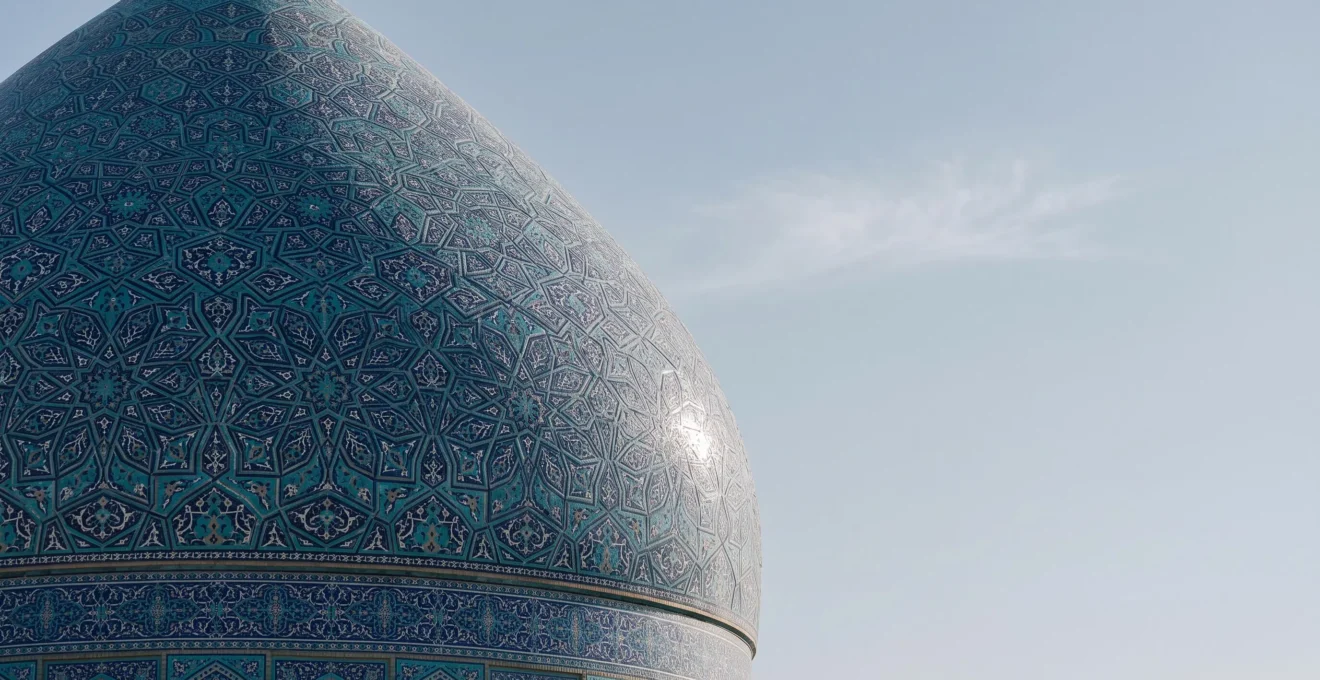
The legendary beauty of Isfahan’s blue tiles is the direct result of artisans mastering a high-stakes chemical process where the primary pigment cost more than silver and a single degree of temperature meant the difference between a masterpiece and ash.
- The cobalt used for the iconic blue was a rare, expensive mineral, making large-scale tilework a statement of immense wealth and power.
- Techniques like haft-rang and the use of lead oxide fluxes were crucial innovations to overcome the extreme challenges of firing at 1,200°C without defects.
Recommendation: To truly appreciate Persian tilework, one must look beyond the colour and see the science, economics, and risk embedded in every square metre.
To stand before the Shah Mosque in Isfahan is to be enveloped by a sea of blue. The sheer scale and vibrancy of its tilework have, for centuries, defined our global image of Persian architectural beauty. The common understanding attributes this aesthetic to the spiritual significance of blue in Islam—a symbol of heaven and divinity—and the mesmerizing complexity of its geometric patterns. While true, these explanations only touch the surface. They miss the far more compelling story happening within the clay and the kiln.
The real narrative of Isfahan’s blue is one of material science, high-stakes economics, and relentless technical innovation. The journey of that specific, luminous cobalt blue from a raw, volatile mineral to a stable, vitrified glaze is a testament to the genius of Safavid artisans. They weren’t just artists; they were chemists and engineers wrestling with materials at the edge of their physical limits. The immense cost of their primary pigment and the constant risk of catastrophic failure in the kiln meant that every square metre of finished tile was not just a decorative surface but a declaration of immense wealth, power, and technical supremacy.
This article moves beyond the symbolic to explore the tangible. We will investigate the chemistry that made the glazes possible, the economic pressures that elevated cobalt to a status rivalling precious metals, and the technological breakthroughs that allowed this art form to flourish on an unprecedented scale. By understanding the profound challenges overcome by its creators, we can appreciate the beauty of Isfahan’s tilework not just as an aesthetic choice, but as a monumental human achievement.
To fully grasp the intricate layers behind this iconic art form, this article explores the crucial questions that reveal its true complexity. The following sections break down the material, economic, and technical dimensions that elevated Isfahan’s tiles to a global symbol of beauty.
Summary: Unpacking the Legend of Isfahan’s Ceramic Art
- Why Did Isfahan’s Blue Tile Work Cost More Per Square Metre Than £5,000 Of Silver?
- How Did Isfahan Artisans Apply Glazes Without Firing Defects at 1,200°C?
- Isfahan Blue Tiles or Moroccan Zellige: Which Ceramic Tradition Has Greater Longevity?
- The Temperature Error That Turns Isfahan Blue Tiles Into Grey Ash
- When Did Isfahan Reach Peak Tile Production During the Safavid Period?
- Why Did Mosaicists Arrange Stones by Colour Rather Than By Figure?
- Ottoman or Persian Masters: Which Tradition Produced More Stylistic Breakthroughs?
- Why Did Intricate Mosaics Require Thousands of Hours for Each Square Metre?
Why Did Isfahan’s Blue Tile Work Cost More Per Square Metre Than £5,000 Of Silver?
The breathtaking expanse of blue on Isfahan’s mosques was not merely an artistic preference; it was a profound statement of economic might. The primary source of this colour was cobalt oxide, a mineral pigment that was, at the time, exceptionally rare and astronomically expensive. Sourced from remote mines, its price on the open market often competed directly with, and sometimes exceeded, that of silver bullion. Therefore, to sheathe a monumental structure like the Shah Mosque in a continuous skin of deep cobalt blue was the 17th-century equivalent of covering it in precious metal. It was a visual language of power understood by every merchant, diplomat, and rival empire.
The economic stability of the Safavid empire provided the foundation for such lavish expenditures. An archaeometric analysis of Safavid-era silver coins reveals that the monarchy maintained a consistently high silver purity in its currency, even during periods of political turmoil. This stable economic footing allowed the court to invest in materials priced against a reliable silver standard. When a patron chose to fund a vast cobalt blue tile project, they were consciously diverting resources that could have otherwise been minted into thousands of pure silver coins. This context transforms the tiles from mere decoration into a quantifiable display of wealth.
This immense cost also elevated the role of the tilework itself. As researcher Farshid Emami notes in a publication for the Metropolitan Museum, the craft evolved beyond simple ornamentation. In his words:
Tilework consequently evolved from a primarily decorative architectural element into a visual medium capable of conveying aspects of courtly culture, gardens, clothing and social life.
– Farshid Emami, Tehran Times
By employing a medium as costly as silver, patrons ensured that the stories and cultural values depicted on the walls were perceived as equally precious. The material and the message were inextricably linked, with the cost of the former guaranteeing the importance of the latter.
How Did Isfahan Artisans Apply Glazes Without Firing Defects at 1,200°C?
Achieving a stable, brilliant glaze at the searing temperature of 1,200°C is a monumental challenge in ceramic science. At this heat, the stonepaste body of the tile and the glassy glaze applied to it expand and contract at different rates. Without perfect chemical harmony, this thermal stress results in catastrophic defects like “crazing” (a network of fine cracks) or the glaze flaking off entirely. Safavid artisans, however, mastered this process through a sophisticated, multi-layered approach and precise chemical engineering.
The secret lay in the composition of the glaze itself and its careful application. As the image below illustrates, the tile was not coated in a single layer of blue. Instead, it was a complex sandwich: a base layer of opaque white tin-glaze was applied first to the stonepaste body, providing a brilliant canvas. Over this, the cobalt oxide pigment was painted, and finally, a transparent overglaze was applied. This final layer was the key. It was a type of ‘fritware’ glaze, where silica and fluxes were pre-melted into a glass, ground into a powder, and then applied.
This frit contained a critical ingredient. As noted by M.S. Tite, a leading scholar on the material, Persian artisans developed a unique formula. The research highlights that, “The ‘frits’ in both cases are unusual in that they contain lead oxide as well as soda; the lead oxide would help reduce the thermal expansion coefficient of the ceramic.” This addition was a stroke of genius, allowing the glaze to ‘fit’ the tile body more snugly during the violent temperature changes of the kiln, dramatically reducing the risk of defects and creating the deep, vitreous matrix that gives Isfahan blue its characteristic luminosity.
Checklist for Analysing Historical Glaze Integrity
- Visual Inspection: Examine the tile surface for signs of crazing, shivering, or crawling, which indicate thermal expansion mismatch.
- Layer Identification: At a chipped edge, identify the distinct layers: the pale stonepaste body, the opaque white underglaze, the pigment layer, and the clear overglaze.
- Colour Consistency: Assess the cobalt blue for uniform saturation, noting any areas of discolouration that might suggest firing inconsistencies.
- Surface Texture: Feel for the glassy smoothness of a well-vitrified glaze versus a rough, under-fired surface.
- Sound Test: Gently tap the tile (if permissible) to listen for a clear ring, indicating a solid bond, versus a dull thud, which could signal hidden delamination.
Isfahan Blue Tiles or Moroccan Zellige: Which Ceramic Tradition Has Greater Longevity?
When comparing the longevity of Isfahan’s *haft-rang* tiles with Moroccan *zellige*, the answer depends entirely on the definition of “longevity.” Is it the physical endurance of a single tile against the elements, or the enduring resilience of the craft itself across generations? Each tradition optimized for a different kind of permanence, reflecting their unique environmental and cultural contexts.
In terms of material longevity, the high-fired, vitrified stonepaste tiles of Isfahan are objectively superior. Their glassy, non-porous surface is highly resistant to water absorption, UV degradation, and erosion. This makes them exceptionally durable in Iran’s dry, continental climate with its extreme temperature swings. Conversely, Moroccan *zellige* is made from terracotta, a more porous material. While beautiful, individual tesserae can absorb moisture and are more susceptible to loosening over time, especially in a humid, maritime climate.
However, when considering methodological longevity, the story reverses. Moroccan *zellige* is a triumph of resilient craft transmission. The technique of hand-cutting geometric shapes from glazed tiles is a living tradition, passed down from master to apprentice within artisan families. It requires immense skill but not complex chemistry, making repair and replication relatively straightforward. The Persian *haft-rang* technique, by contrast, is chemically fragile. Its reliance on complex multi-layer glazes and precise kiln control meant the knowledge was concentrated in specialized workshops and was nearly lost after the Safavid era. Reviving it requires academic research and laboratory-style support to reverse-engineer the original chemistry.
This comparative analysis, drawn from scholarship compiled by sources like the World History Encyclopedia, reveals two different philosophies of permanence. The table below summarizes these key distinctions.
| Dimension | Isfahan Haft-Rang Tiles (Persian) | Moroccan Zellige |
|---|---|---|
| Material Longevity | Superior: high-fired vitrified glaze resists UV fading, erosion, and water absorption | Moderate: porous terracotta base can absorb moisture; individual tesserae may loosen over time |
| Methodological Longevity | Fragile: chemically complex multi-layer technique nearly lost post-Safavid; relies on institutional revival | Robust: geometric cutting method embedded in family craft transmission; easily replicated and repaired |
| Climate Suitability | Optimised for Iran’s dry continental climate: non-porous surface withstands extreme thermal shock | Optimised for maritime Morocco: porous base and thick grout lines accommodate humidity cycling |
| Repairability | Difficult: matching original cobalt chemistry and kiln conditions is technically demanding | High: individual tessera can be hand-cut and replaced without specialist chemical knowledge |
| Knowledge Transmission | Academic and institutional: requires scientific documentation and laboratory support | Living craft: passed master-to-apprentice across generations in artisan families |
| UNESCO Recognition | Naqsh-e Jahan Square (including Shah Mosque tilework) — World Heritage Site since 1979 | Zellige craft represented within Moroccan intangible cultural heritage framework |
The Temperature Error That Turns Isfahan Blue Tiles Into Grey Ash
The kiln was the heart of the Safavid ceramic workshop, but it was also a place of immense risk. The line between a luminous blue masterpiece and a worthless pile of grey ash was perilously thin, determined by just a few degrees of temperature. For the artisans, every firing was a high-stakes gamble. If the kiln temperature rose even slightly above the critical threshold, the delicate chemical balance of the cobalt glaze would be destroyed in a process called destructive devitrification.
Modern materials science provides a clear window into this failure mode. As a 2026 study in *Archaeological and Anthropological Sciences* explains, cobalt silicate acts as a violent flux at extreme temperatures. Instead of remaining a stable pigment suspended in a clear glass matrix, the superheated cobalt begins to aggressively dissolve the silica in the glaze around it. This chemical reaction breaks down the vitreous structure, causing the glaze to crystallize improperly, lose its transparency, and boil away. The result is not a slightly off-colour blue, but a catastrophic failure: a bubbled, burnt surface of a dull, lifeless grey. Every artisan knew that a moment’s inattention while stoking the kiln could destroy weeks of work and a small fortune in cobalt pigment.
The chemical interactions were even more complex when multiple pigments were present. Research from The Royal Society has shown how different metallic oxides could interfere with each other during firing. M.S. Tite’s work notes a specific interaction: “When cobalt and copper were present in the glaze or in the adjacent glazes, they were preferentially absorbed by chromite and replaced magnesium and iron in the chromite lattice.” This illustrates the incredibly complex and often unpredictable dance of elements happening at 1,200°C. Artisans had to develop an almost intuitive understanding of this high-temperature chemistry, passed down through generations, to navigate the risks.
This constant threat of failure is central to the story of Isfahan blue. The beauty we see today is a survivor. For every perfect tile that adorns a mosque, countless others likely succumbed to the fire, turning into grey ash. This fact imbues the surviving works with a sense of preciousness born not just of expensive materials, but of profound, hard-won technical risk. The value lies in the mastery required to consistently avoid this fate, a process illuminated by rigorous analytical studies of the craft.
When Did Isfahan Reach Peak Tile Production During the Safavid Period?
The absolute zenith of Isfahan’s tile production occurred during the reign of Shah Abbas I (1588-1629). His ambitious architectural program, which transformed Isfahan into one of the world’s most magnificent cities, created an unprecedented demand for ceramic decoration. This demand, however, could not have been met using traditional, time-consuming methods. The key to this golden age of production was a pivotal technological innovation: the widespread adoption of the *haft-rang*, or “seven-colored,” tile technique.
Prior to this period, the dominant method was tile mosaic, or *moarraq*. This involved painstakingly cutting individual pieces of monochrome-glazed tile into complex shapes and fitting them together like a jigsaw puzzle. While producing stunning results, it was incredibly slow and laborious. As a scholarly overview from the World History Encyclopedia confirms, the development of *haft-rang* was the game-changer. This technique allowed artisans to paint multiple colors onto a single tile, separated by a greasy, manganese-based substance that prevented the glazes from running together during firing. The entire panel could then be fired in one go.
This innovation dramatically reduced production time, enabling the industrial scale required for projects like the immense Shah Mosque (completed in 1629). This building stands as the ultimate testament to the efficiency and aesthetic potential of the *haft-rang* technique. As noted in a study on Persian tiles, this method was a deliberate choice to accelerate construction.
One such shortcut was to replace the mosaic faience technique with Haft Rang tiles in order to cut down the time spent on decorating the building which contained vast surfaces, making the Abbasi Great mosque one of the fine examples of Haft Rang tile work.
– Editorial research team, Brewminate
While tile mosaics continued to be used for high-status and curvilinear areas, the reign of Shah Abbas I represents the moment when Persian tile production matured into a true industry. The perfection of the *haft-rang* method was the technological catalyst that made the architectural vision of the Safavid golden age physically possible, marking the undisputed peak of both the quantity and quality of Isfahan’s ceramic output.
Why Did Mosaicists Arrange Stones by Colour Rather Than By Figure?
The overwhelming emphasis on geometric and vegetal patterns in Islamic mosaic art, rather than figurative scenes, is a direct expression of a core theological principle: aniconism. This is the avoidance of figural images, particularly in sacred contexts. For the artisans of Isfahan and across the Islamic world, this was not a limitation but a creative directive that pushed them toward a different, more abstract language of divinity. The goal was to create a visual experience that encouraged spiritual contemplation rather than distracting with worldly representations.
By arranging tesserae into fields of pure colour and intricate, repeating patterns, mosaicists created a sense of infinite, ordered beauty. As scholarship from sources like the Museum of Islamic Art in Doha explains, “These ongoing, looping and scrolling shapes reflected God’s infinite creations, and reflected a sense of divine oneness or unity.” The mathematical perfection and endless repetition of the geometric designs were seen as a direct reflection of the perfection and indivisibility of God. It was a visual metaphor for the underlying order of the universe, a spiritual concept made manifest in stone and glaze.
This approach is deeply rooted in Islamic philosophy. As academic research on sacred geometry shows, this design philosophy can be linked to theological schools like Ash’arite atomism. This worldview understands reality as being composed of atom-like units constantly being created and re-created by God. Abstract, non-figurative pattern-making, therefore, becomes the most fitting way to represent this divine, moment-to-moment act of creation. The focus shifts from *what* is depicted to the underlying structure and harmony of the depiction itself.
In this context, colour becomes a primary vehicle for emotion and meaning. Vast fields of cobalt blue were not just backdrops; they were the main event, intended to evoke feelings of transcendence, serenity, and the boundless nature of the divine. The choice to prioritize colour and pattern over figure was a sophisticated artistic and spiritual strategy to guide the viewer’s mind toward contemplation of the infinite.
Ottoman or Persian Masters: Which Tradition Produced More Stylistic Breakthroughs?
Pitting the ceramic traditions of the Ottoman and Persian empires against each other in a quest for “more” breakthroughs is ultimately a false rivalry. The reality is a far more interesting story of centuries-long dialogue, mutual influence, and parallel innovation. Both traditions produced extraordinary stylistic and technical advances, often in response to one another. Their relationship was one of a shared foundation followed by a dynamic divergence, creating two distinct but related lineages of ceramic excellence.
The early Ottoman ceramic tradition was heavily indebted to Persian masters. As researcher Anita Chowdry highlights, there was a direct transfer of knowledge and skill. Before the rise of the famous Iznik workshops, she notes, “Master tile-makers from Tabriz were regularly commissioned to make classic fritware Cuerda Seca tiled installations for early Ottoman mosques and mausoleums.” This establishes a clear baseline of Persian technical and stylistic influence at the foundation of Ottoman architectural ceramics.
However, the Ottoman tradition soon developed its own unique trajectory, particularly in the imperial workshops of Iznik. While both traditions worked with stonepaste (fritware) bodies and brilliant glazes, their styles diverged. Ottoman artists developed a distinct and celebrated floral style—featuring tulips, carnations, and hyacinths—and a specific colour palette, including the famous “tomato red” made from Armenian bole. Persian tilework, especially in the Safavid era, focused more on vast, flowing arabesques, complex geometric compositions, and figural scenes in non-sacred contexts. Comparative materials-science studies confirm this divergence, showing distinct chemical and microstructural differences between Iznik-style production and that of Safavid Iran, even while acknowledging their shared Timurid ancestry.
Ultimately, both traditions were engines of innovation. The Persian masters pioneered the *haft-rang* technique that enabled massive architectural projects. The Ottoman masters at Iznik achieved a level of control over a complex floral vocabulary and a unique colour palette that was unparalleled. To ask which produced more breakthroughs is to miss the point: it was their continuous, competitive, and collaborative dialogue that pushed the art of Islamic ceramics to its greatest heights.
Key Takeaways
- The value of Isfahan blue was tied to the price of cobalt, which rivaled silver, making it a display of economic power.
- Technical innovations in glaze chemistry (haft-rang, lead oxide) were essential to manage the extreme 1,200°C firing process and enable large-scale production.
- The choice of non-figurative, geometric patterns was both a spiritual directive (aniconism) and a strategy to maximize the aesthetic impact of pure, expensive colour.
Why Did Intricate Mosaics Require Thousands of Hours for Each Square Metre?
The assertion that intricate Persian tile mosaics required thousands of hours of skilled labour per square metre is not an exaggeration; it is a direct reflection of the staggering complexity of the *moarraq* technique. This traditional method, which predates the faster *haft-rang* process, was an exercise in precision, patience, and mathematical genius. Every single curve, star point, and floral petal in a design was composed of dozens, sometimes hundreds, of individually hand-cut pieces of tile.
The process began with a master designer creating a full-scale pattern on paper. This pattern was then used as a template to cut pieces from large, monochrome-glazed tiles. Using simple hand tools, artisans would meticulously shape each tiny component, a process that required immense skill to avoid chipping the fragile glaze. These pieces, or tesserae, were then arranged face-down on the template, fitted together like a perfect jigsaw puzzle. Once the entire panel was assembled, plaster was poured over the back to create a single, solid slab that could then be installed on the wall. The sheer number of pieces involved in a complex geometric or arabesque pattern was immense.
Recent scholarship has begun to quantify this labour intensity. A study published on ResearchGate used computational geometry to analyze the tilework of Isfahan’s mosques. By calculating the number, size, and complexity of the geometric forms, the research provides a data-driven basis for estimating the hours required. The conclusion is clear: the more intricate the pattern, the greater the number of individual pieces per square metre, and thus, the exponential increase in labour. This research validates the “thousands of hours” thesis by demonstrating the direct correlation between geometric complexity and labour input.
This painstaking process was a testament to the spiritual and cultural value placed on these buildings. As one analysis of the art form puts it, “Islamic mosaics showcase geometric patterns together with vegetal elements and calligraphic writings to present spiritual concepts through design without representing living forms.” The immense investment of time was seen as a worthy offering, a form of devotion where human effort was transmuted into a beautiful, enduring reflection of divine order.
The next time you stand before a work of Persian ceramic art, look closer. To understand its beauty is to appreciate the centuries of scientific struggle, economic calculation, and human dedication captured within its cool, blue glaze. This is not just decoration; it is history, science, and spirit, fired into permanence.