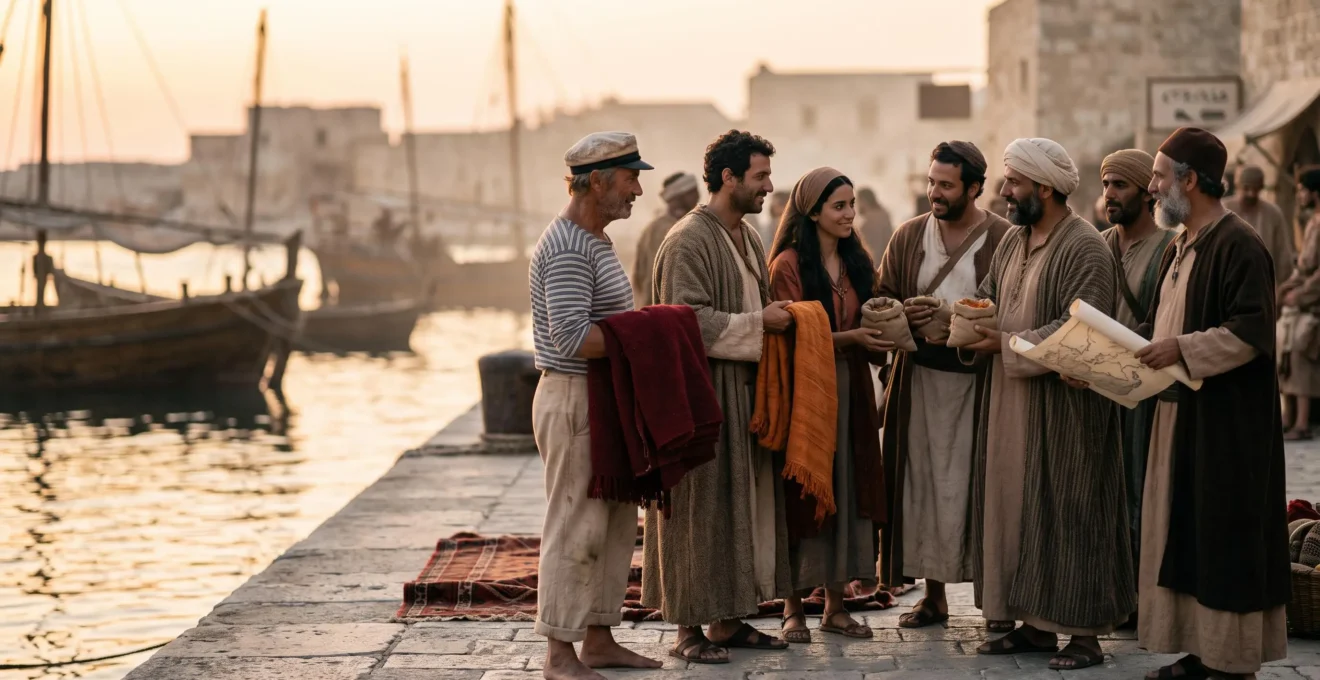
Contrary to the view of the Mediterranean as a mere border between continents, it functioned as a “liquid continent” in its own right. The true engine of cultural fusion was not the grand politics of empires but the pragmatic, day-to-day necessities of maritime life. A shared identity forged in bustling ports among sailors and merchants created a resilient, hybrid culture that often superseded the rigid allegiances of religion and nationality, turning the sea from a barrier into the very heart of exchange.
The conventional map presents the Mediterranean Sea as a vast blue expanse separating Europe from Africa, a natural barrier between continents and civilizations. For centuries, its history has been told through the lens of empires clashing—Rome against Carthage, Crusaders against Saracens, Venice against the Ottomans. This narrative, focused on conflict and division, sees the sea as a frontier, a line to be defended. Another common story focuses on the one-way transmission of knowledge from a supposedly enlightened Arab-Islamic world to a Europe mired in its “Dark Ages,” often centering exclusively on the intellectual splendor of Al-Andalus.
But what if this perspective is fundamentally flawed? What if the sea was not a void between lands, but a place in itself? This article proposes a different view: that of the Mediterranean as a liquid continent. This was a fluid, dynamic world with its own rules, rhythms, and, most importantly, its own culture. The shared experiences of navigating treacherous waters, trading goods, and seeking refuge in foreign ports created a unique ‘port city identity’ that often meant a sailor from Genoa had more in common with a merchant in Tunis than with a farmer in their own respective hinterlands.
This pragmatic synthesis, born from the necessity to communicate and do business, was the true engine of cultural exchange. It was more powerful than the edicts of kings and caliphs. We will explore this by examining the shared language of the ports, the invisible currents that carried music and ideas from Andalusia to Italy, and the layered cultural identity of islands like Sicily. We will even see how a cataclysmic event like the 1492 expulsion did not extinguish this fusion, but instead transplanted it, proving the incredible resilience of a culture born of the sea.
To fully grasp how the sea transformed from a boundary into a nexus of civilization, this article delves into the specific mechanisms of this exchange. The following sections explore the distinct culture of coastal cities, the flow of artistic and scientific knowledge, the lasting legacy on Mediterranean islands, and the overarching frameworks that made this unprecedented integration possible.
Table of Contents: The Mediterranean as a Cultural Nexus
- Why Did Coastal Cities Share More Culture With Foreign Ports Than Inland Neighbors?
- How Did Andalusian Music Transform Italian Renaissance Composition in 50 Years?
- Spain or Sicily: Which Mediterranean Island Retained More North African Cultural Elements?
- The Expulsion Decree That Ended 700 Years of Mediterranean Cultural Fusion
- When Did Experienced Sailors Cross to North Africa: The 4 Seasonal Navigation Windows?
- Medieval Cordoba vs. Modern London: Which Integrated Diversity More Successfully?
- Isfahan Blue Tiles or Moroccan Zellige: Which Ceramic Tradition Has Greater Longevity?
- How Did Arab Civilization Integrate 20 Different Cultural Traditions Into a Cohesive Identity?
Why Did Coastal Cities Share More Culture With Foreign Ports Than Inland Neighbors?
The answer lies in the fundamental distinction between terrestrial and maritime life. Inland societies were often defined by feudal loyalties, agricultural cycles, and relatively static populations. Their identity was tied to the soil. In contrast, coastal cities like Genoa, Venice, Alexandria, and Tunis were nodes in a vast, interconnected web. Their lifeblood was not the land, but the sea—a shared space of opportunity and peril. This gave rise to a unique port city identity, a culture of pragmatism and exchange that transcended religious or imperial allegiance.
The most tangible evidence of this shared world was the Mediterranean Lingua Franca, or Sabir. This was not a formal language but a pidgin, a stripped-down tongue created organically for the purpose of trade and communication between people who spoke mutually unintelligible languages. It was the practical tool of the liquid continent. A linguistic analysis of this trade pidgin shows that its lexicon was a hybrid, primarily based on Italian and Spanish vernaculars but heavily peppered with words from Arabic, Turkish, and Greek. The existence and widespread use of Sabir for centuries proves that on the docks and decks of the Mediterranean, getting the deal done was more important than liturgical correctness.
This shared language facilitated more than just commerce; it was the carrier wave for ideas, technologies, and customs. A sailor from Marseille might learn a new navigational technique from an Egyptian pilot, a Venetian merchant could adopt Arabic accounting methods, and a Tunisian corsair might develop a taste for Sicilian pastries. This constant, low-level exchange created a cultural layer common to all port cities, a familiarity that was absent just a few dozen miles inland, where a foreign traveler was an object of suspicion rather than a business partner.
Ultimately, the sea imposed its own logic. Loyalty was to one’s ship, one’s trading partners, and the unwritten laws of maritime conduct. This created a cosmopolitan environment where a person’s utility and reliability mattered more than their origin, fostering a horizontal culture of the coast distinct from the vertical hierarchies of the interior.
How Did Andalusian Music Transform Italian Renaissance Composition in 50 Years?
While the port cities created the *conditions* for exchange, the courts of Southern Europe provided the patronage that allowed specific cultural forms, like music, to take root and flourish. The transformation of Italian music during the Renaissance was not a sudden event but the culmination of centuries of influence, with the sophisticated musical traditions of Al-Andalus traveling across the Mediterranean sea lanes, primarily through Sicily and Southern Italy.
The influence began with the instruments themselves. The Arabic `oud`, a pear-shaped, fretless string instrument, was introduced to Europe through Moorish Spain. In the hands of European luthiers, it gradually acquired frets and a slightly modified shape, becoming the lute—the quintessential instrument of the Renaissance court. Similarly, the `rabab`, a bowed instrument, is the direct ancestor of the European `rebec`, a key forerunner of the violin family. These instruments didn’t just appear; they were carried by traveling musicians, merchants, and court envoys, their sounds echoing in the hybrid courts of Norman Sicily and Aragonese Naples.
Beyond the hardware, Andalusian music brought a new software: its complex modal and rhythmic systems. The Arabic `maqamat` (melodic modes) and `iqā’āt` (rhythmic patterns) introduced a level of sophistication and emotional depth that was revolutionary. These concepts, along with poetic forms like the `zajal` and `muwashshah`, influenced the development of the first secular song forms in Europe, such as the Italian `ballata` and the French `virelai`. This wasn’t a simple case of copying; European composers adapted these foreign structures, blending them with their own traditions of plainchant and polyphony to create something entirely new.
Within the span of just a few decades in the 15th century, these influences crystallized. The theoretical work of Arab musicians and philosophers, translated in centers like Toledo and Palermo, provided the intellectual framework, while the constant flow of performers provided the practical inspiration. This rapid absorption and adaptation of Andalusian musical DNA was a key catalyst that helped propel Italian music from its medieval forms into the rich expressive language of the Renaissance.
Spain or Sicily: Which Mediterranean Island Retained More North African Cultural Elements?
When comparing the legacy of Arab-Islamic rule in Spain (specifically, the island-like region of Andalusia) and Sicily, the answer depends on the definition of “retained.” While Andalusia’s Al-Andalus is famed for its high culture—philosophy, science, and monumental architecture like the Alhambra—it could be argued that Sicily absorbed North African influence into the very fabric of its everyday life in a more lasting and syncretic way.
The key difference lies in the process of cultural change that followed the end of Muslim rule. In Spain, the Reconquista was a prolonged, centuries-long military and ideological crusade aimed at complete religious and cultural replacement. While it couldn’t erase 700 years of history, its goal was purification, culminating in the 1492 Expulsion. The result was a brilliant but ultimately supplanted layer of civilization.
In Sicily, the story was one of successive conquests rather than a single ideological war. After two centuries of Arab rule, the Normans arrived in the 11th century. But instead of eradicating the existing culture, they adopted and adapted it. The Norman kings, like Roger II, styled themselves as rulers in the Mediterranean tradition, employing Arab administrators, using Arabic on their coinage, and patronizing a unique Arabo-Norman architectural style. The Palatine Chapel in Palermo is a breathtaking example, featuring Byzantine mosaics, a Latin basilica plan, and an Islamic `muqarnas` ceiling. This was not coexistence; it was true synthesis.
This layering of influences—what can be called cultural sediment—meant that North African elements became deeply embedded in Sicilian life. They persist today not as museum pieces, but as living culture. This is evident in the Sicilian dialect, which is rich with Arabic loanwords (e.g., `sciarra` from `šārah`, meaning ‘quarrel’). It’s in the cuisine, with its emphasis on citrus, pistachios, and couscous (`cuscusu`). It’s in the urban layouts of towns like Mazara del Vallo, which still resemble a North African casbah. While Spain’s legacy is a magnificent, well-preserved ruin of a lost golden age, Sicily’s is a living, breathing hybrid, a testament to a more fluid process of cultural amalgamation.
The Expulsion Decree That Ended 700 Years of Mediterranean Cultural Fusion
The Alhambra Decree of 1492, which ordered the expulsion or forced conversion of Spain’s Jews, is often portrayed as the tragic end of the `convivencia` and the final victory of a monolithic Christian identity. It was, without a doubt, a human and cultural catastrophe. Historical records indicate that of the Sephardic Jewish population, over 200,000 converted to Christianity under duress, while estimates of the expelled range from 40,000 to 100,000. This act shattered a community that had been an integral part of the Iberian peninsula’s intellectual and economic life for centuries. Yet, from a Mediterranean perspective, it was not merely an ending but also a violent transplantation.
This expulsion created a forced diaspora as a vector for cultural transmission. The exiles—Jews and, later, Muslims (Moriscos)—did not simply vanish. They carried the unique cultural fusion of Al-Andalus with them across the sea, primarily to North Africa and the welcoming territories of the Ottoman Empire. They brought their language (Ladino, a form of medieval Spanish), their music, their cuisine, and their advanced skills in medicine, trade, and craft. This was not a dilution of culture, but its preservation in a new vessel.
The Ottoman Sultan, Bayezid II, immediately recognized the folly of the Spanish monarchs’ decision. He dispatched his navy to rescue the refugees and welcomed them into his empire, famously remarking on the shortsightedness of King Ferdinand. As he reportedly stated in a letter:
Do they call this Ferdinand a politic prince, who can thus impoverish his own kingdom and enrich ours?
– Sultan Bayezid II of the Ottoman Empire, A 1492 Letter Regarding Jewish Property in Spain
Case Study: The Sephardic Reinvention of Thessaloniki
The Ottoman Empire granted protection to the expelled Jews and encouraged them to settle in key cities. The Greek port of Thessaloniki became a major destination. The Sultan’s invitation was also a shrewd demographic strategy to prevent ethnic Greeks from dominating the city and to boost its commercial vitality. The Sephardic newcomers transformed Thessaloniki into one of the great multicultural metropolises of the Mediterranean for the next 450 years, known as the “Mother of Israel.” This demonstrates how the culture of fusion, expelled from its Andalusian home, was deliberately transplanted and preserved as a strategic asset elsewhere in the Mediterranean’s “liquid continent.”
In this light, the expulsion was not just an act of cultural destruction but also an act of involuntary cultural seeding. It spread the unique genetic code of Andalusian hybridity across the Mediterranean, ensuring its survival and evolution in new lands long after its source had been extinguished.
When Did Experienced Sailors Cross to North Africa: The 4 Seasonal Navigation Windows?
The Mediterranean “highway” was not open 24/7. Its traffic was dictated by a force far greater than any emperor or admiral: the weather. For the sailors of the pre-modern era, who relied on square-rigged ships and rudimentary navigational aids, understanding the sea’s seasonal rhythms was the difference between a profitable voyage and death. The exchange of goods, people, and ideas across the sea was therefore pulsed, occurring within specific seasonal navigation windows.
Spring (Late March to Early June): This was the primary outward-bound window. After the unpredictable and violent storms of winter, the seas calmed, and the winds became more reliable. This was the ideal time for a vessel leaving a European port like Genoa or Marseille to begin a voyage towards the Levant or the coast of North Africa. The weather was generally fair, and the days were lengthening, allowing for more hours of sailing.
Summer (Mid-June to August): Summer was the season of the Etesian winds (or Meltemi) in the Aegean and Eastern Mediterranean. These strong, dry winds blew consistently from the north. While they made sailing from Europe to Egypt very fast and reliable, they made the return journey extremely difficult, often forcing ships to take a much longer, circuitous route. For crossings in the Western Mediterranean, between Spain and the Maghreb, summer offered stable conditions, but the risk of heat and becalmed seas could also be a problem.
Autumn (September to Early November): This was the crucial return window. The Etesian winds subsided, and the prevailing winds shifted, allowing ships that had been in the East or in North Africa to make their way home before the onset of winter. It was a race against time. Merchants and sailors knew that lingering too long could mean being trapped for the entire winter or risking a voyage in treacherous conditions. This period saw a flurry of activity as vessels laden with spices, silks, and grain hurried back to their home ports.
Winter (Mid-November to Mid-March): For the most part, open-sea navigation ceased. The saying `mare clausum` (“the sea is closed”) was a reality. Winter in the Mediterranean brings notoriously unpredictable gales, high seas, and poor visibility. While some coastal trade and short-hop journeys continued, long-distance crossings like those to North Africa were considered foolhardy. Ships were laid up, sailors returned home, and the great highway of cultural exchange fell quiet, waiting for the spring thaw.
Medieval Cordoba vs. Modern London: Which Integrated Diversity More Successfully?
Comparing a 10th-century caliphate capital with a 21st-century global metropolis is a complex task, yet it reveals a crucial difference between deep integration and modern multiculturalism. While modern London is celebrated for its diversity, with communities from across the globe living side-by-side, it often functions as a collection of parallel societies. In contrast, medieval Cordoba, during the height of its `convivencia`, fostered a more profound and fertile form of intellectual and cultural synthesis.
London’s model is one of pluralism and tolerance, where different cultures maintain their distinct identities, languages, and social spheres. You can find a microcosm of Karachi, Warsaw, or Lagos within the city. This enriches the city immensely, but the interactions are often at a surface level—cuisine, music festivals, and commerce. Deep intellectual and philosophical engagement across cultural lines is not the defining characteristic of the system.
The Cordoban model was different. It was an environment where thinkers from the three Abrahamic faiths were not just coexisting but were actively engaged in the same intellectual project, using a shared language—Arabic—as their medium. As a case study on the city’s legacy highlights, this led to an incredible cross-pollination of ideas. The Judaeo-Arab philosophy of Maimonides in his “Guide of the Perplexed” was in direct conversation with the Arab-Islamic rationalism of Averroes in “The Incoherence of the Incoherence.” In turn, a comparative analysis shows both thinkers profoundly influenced the Christian scholasticism of St. Thomas Aquinas in his “Summa Contra Gentiles.” They were all wrestling with the same fundamental questions of faith, reason, and Aristotle’s legacy, creating a single, integrated intellectual ecosystem.
As the historian Christine Mazzoli-Guintard notes, the debate around `convivencia` is complex and often idealized, but its core truth is that it was a period of “constantly renewed questioning” that led to immense creativity. While Cordoba was far from a utopian society and had its own hierarchies and conflicts, its model of success was based on intellectual fusion, not just social juxtaposition. London’s diversity is a magnificent mosaic of separate, brightly colored tiles; Cordoba’s was a crucible where different metals were melted down to forge a new, stronger alloy.
Isfahan Blue Tiles or Moroccan Zellige: Which Ceramic Tradition Has Greater Longevity?
Both the magnificent blue-and-white tile panels of Isfahan’s mosques and the intricate geometric mosaics of Moroccan `zellige` represent peaks of Islamic artistry. However, when assessing for longevity, not just in terms of material survival but of the tradition’s adaptability and continuity, Moroccan `zellige` arguably demonstrates a greater resilience. The reason lies not in its aesthetic complexity, but in the profound simplicity and modularity of its production process.
The tilework of Safavid Isfahan often employed techniques like `cuerda seca` or large-scale mosaic faience, where vast, complex patterns were designed as a whole and executed in large, bespoke panels. This resulted in breathtaking, unified compositions, but the process was complex and tied to the patronage of a powerful court. In contrast, the foundation of `zellige` is humble: a simple, hand-molded clay tile. According to studies of traditional production in Fez, the process starts with basic squares of glazed terracotta, often around 10cm by 10cm.
The genius of `zellige` is what happens next. Master craftsmen, or `ma’alems`, use a sharp hammer (`menqach`) to hand-chisel these simple squares into a vast vocabulary of fundamental geometric shapes—squares, diamonds, stars, polygons. These small, modular pieces, called `furmah`, are then assembled face-down into an intricate pattern, set in plaster, and raised as a single panel. This modular, generative system is the key to its longevity. It is an open-ended “language” of geometry, not a closed statement. It can be adapted to any surface, scale, or architectural context, from a small fountain to the entire wall of a palace.
This process-based tradition, passed down through generations of apprentices, is inherently more resilient than one dependent on large-scale, centrally planned designs. While both traditions share a commitment to geometry as the language of sacred art, `zellige`’s longevity stems from its grassroots, adaptable, and modular nature. It’s a living tradition that continues to evolve, finding its place even in modern architecture, because its core principles are so fundamental and flexible.
Checklist: Auditing the Longevity of a Craft Tradition
- Raw Materials: Assess the accessibility and resilience of core materials. For zellige, this is the readily available clay of the Fez region.
- Production Modularity: Analyze if the process uses simple, repeatable units or complex, monolithic designs. Zellige’s small, hand-cut `furmah` are the epitome of modularity.
- Design System: Evaluate the underlying design language. Is it a closed set of patterns or an open, generative grammar? The geometric principles of zellige allow for near-infinite variation.
- Skill Transmission: Examine the method of apprenticeship and knowledge transfer. Is it easily passed down through hands-on practice, like the `ma’alem` system?
- Cultural Adaptability: Check its ability to be integrated into new architectural contexts and aesthetics, as seen in zellige’s adoption by contemporary designers worldwide.
Key Takeaways
- The Mediterranean was a “liquid continent” with a shared port culture that often superseded land-based identities.
- Cultural exchange was not a one-way street but a pragmatic synthesis, proven by hybrid creations like the Lingua Franca and Arabo-Norman architecture.
- Even acts of division, like the 1492 Expulsion, could act as vectors for transplanting and preserving this fused culture across the sea.
How Did Arab Civilization Integrate 20 Different Cultural Traditions Into a Cohesive Identity?
The remarkable ability of Arab-Islamic civilization to absorb and synthesize influences from Greek, Persian, Indian, and Visigothic cultures, among others, was not an accident. It was the result of a powerful and flexible framework built on two main pillars: a shared language and a voracious intellectual curiosity. This framework acted as a cultural “operating system” that could run diverse “software” from across the known world, creating a cohesive yet varied civilization that stretched from the Atlantic to the Indus Valley.
The first pillar was the Arabic language. As the language of the Qur’an, it held a sacred prestige, but its role went far beyond religion. It became the `lingua franca` of administration, commerce, and, most importantly, scholarship across the entire Islamic world. A scholar in Cordoba could read a text written by a philosopher in Baghdad or a physician in Samarkand without translation. This created a unified intellectual space of unprecedented scale. The great Translation Movement, centered in Baghdad’s House of Wisdom, actively sought out and translated Greek, Persian, and Sanskrit texts into Arabic, making them part of a single, cumulative body of knowledge.
The second pillar was an intellectual culture that, for several centuries, championed the pursuit of knowledge (`’ilm`). This spirit is what fueled the integration of disparate traditions. Greek philosophy, Indian mathematics (including the “Arabic” numerals), and Persian statecraft were not seen as foreign contaminants but as valuable sources of wisdom to be studied, debated, and built upon. This is perfectly illustrated by the dynamic relationship between the two ends of the Arab world. As studies on the period show, the mutual relations and influences between Cordoba and Baghdad were abundant and fertile, demonstrating a vast, interconnected network for knowledge.
This process of integration created a civilization that was recognizably “Islamic” and “Arab” in its overarching framework, yet incredibly diverse in its local expressions. The result, as the late scholar María Rosa Menocal eloquently described it, was an “ornament of the world,” a culture of “unprecedented level of scientific, philosophical, and metaphysical discovery.” It wasn’t a melting pot that erased differences, but rather a framework that allowed different traditions to speak to one another, creating a sum far greater than its parts.
Now that the mechanisms of this extraordinary cultural fusion are clear, the next step is to apply this understanding to our modern, interconnected world, recognizing that true integration is built on shared platforms and a genuine curiosity for the “other.”