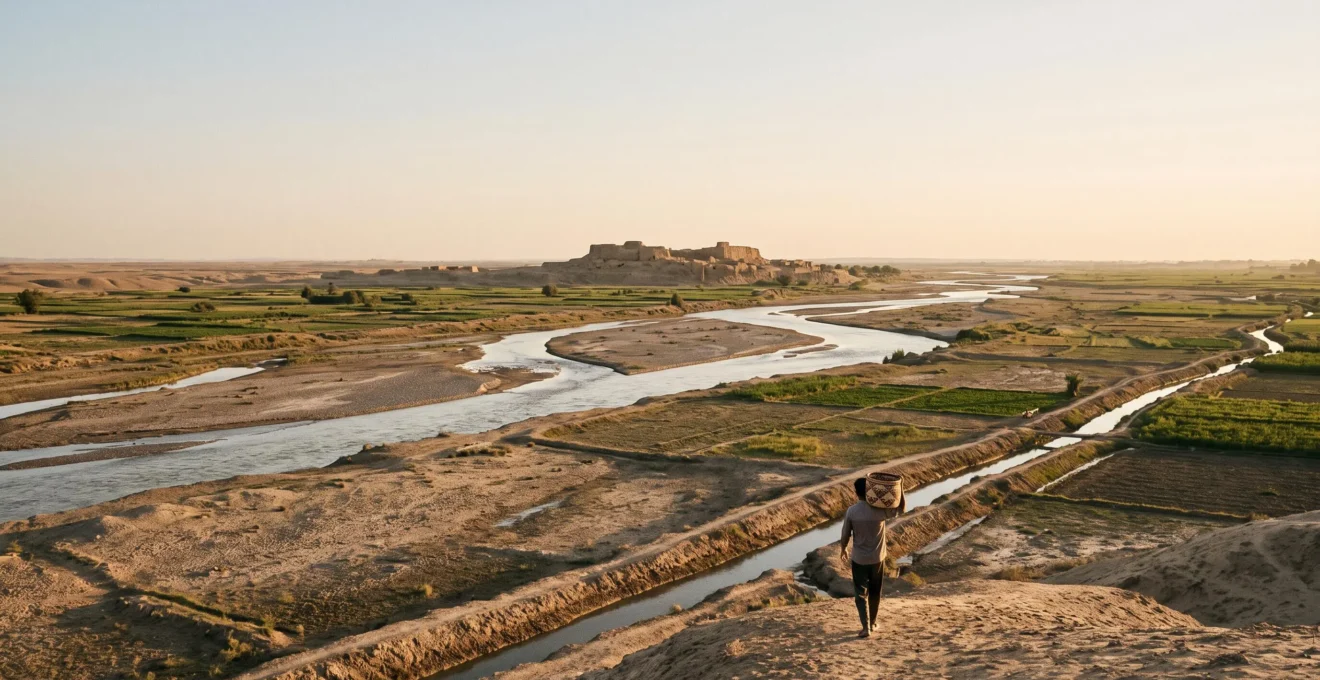
The first cities weren’t built on fertile land; they were built on the knife-edge of systemic risk and engineered abundance.
- River irrigation could produce 400% more grain than rain-fed fields, but this “hydraulic engine” required immense, constant, and centralized management.
- The violent unpredictability of the Tigris and Euphrates rivers demanded far stronger central governance to prevent catastrophic failure compared to Egypt’s more regular Nile.
Recommendation: To understand early civilizations, analyze the fragility and political demands of their resource systems, not just the abundance they produced.
The image of the first cities blooming in the Mesopotamian desert is a cornerstone of human history. We often attribute this miracle to a simple equation: the Tigris and Euphrates rivers provided water, which made the “Fertile Crescent” fertile, allowing for agriculture and, eventually, cities. This narrative, while true, is deceptively simple. It misses the core drama of the story—the profound technological and political revolution that was required to turn flowing water into civilization.
The agricultural surplus that fed Sumer, Akkad, and Babylon was not a natural gift of the rivers. It was an engineered abundance, the precarious output of a massive, complex, and dangerously fragile socio-technical system. This “hydraulic engine” was a high-stakes wager on humanity’s ability to control its environment. The promise was immense: a harvest beyond subsistence, freeing hands and minds to build, write, and rule. But the risk was equally great: a single season of failed maintenance, a poorly managed flood, or a lapse in coordination could lead to widespread famine and societal collapse.
The real story, therefore, is not about water, but about the control of water. It is a story of systemic fragility, where the very complexity that created abundance also introduced new, catastrophic points of failure. This article will deconstruct this hydraulic engine. We will explore the staggering yields it produced, the brilliant engineering that powered it with gravity alone, and the immense political pressures it created. We will see how the constant threat of failure, not just the promise of plenty, acted as a powerful catalyst for centralized government, ultimately explaining why the world’s first true cities arose in the challenging environment between two rivers, and not elsewhere.
This exploration will follow the intricate connections between water management, agricultural output, and political structure. The following sections break down the core components of this hydraulic civilization, from the physics of irrigation to the politics of its maintenance.
Summary: The Hydraulic Engine of Civilization
- Why Did River Irrigation Produce 400% More Grain Than Rain-Fed Fields?
- How Did Engineers Supply Water to 500,000 People With Only Gravity Flow?
- Tigris-Euphrates or Nile Valley: Which River System Required Stronger Central Government?
- The Canal Maintenance Failure That Starved 200,000 People in One Season
- When Did Farmers Release Water: The 5 Seasonal Timing Decisions That Determined Harvests?
- Why Did 7 Environmental Factors Converge Only in Mesopotamia 6,000 Years Ago?
- Why Did Separate Wards Improve Recovery Before Germ Theory Existed?
- Why Did the First Cities Appear in Mesopotamia Rather Than Other Fertile Regions?
Why Did River Irrigation Produce 400% More Grain Than Rain-Fed Fields?
The leap from scattered farming villages to dense urban centers was fueled by one thing: a massive agricultural surplus. This wasn’t just a slight improvement; it was a revolutionary increase in food production that fundamentally altered the basis of society. The key to this revolution was the shift from rainfall-dependent (rain-fed) agriculture to centrally managed river irrigation. In the semi-arid climate of Mesopotamia, relying on unpredictable rainfall was a low-yield, high-risk gamble. Irrigation transformed this gamble into a highly productive, albeit complex, science.
The core advantage was control. Irrigation allowed farmers to deliver the right amount of water at the right time, decoupling crop growth from erratic seasonal rains. This reliability and precision amplified yields dramatically. While a rain-fed field might produce enough for a single family with a small surplus in a good year, an irrigated field could consistently produce far more. The ability to manage water inputs, protect seedlings from drought, and ensure soil saturation during critical growth phases created an agricultural engine of unprecedented power. This is the foundation upon which urbanism is built, as a surplus was essential for sustaining non-farming populations like priests, soldiers, and artisans. As the Brewminate Editorial Team notes, “An agricultural surplus was essential to the creation of the first cities and urban societies; only when farmers’ crop yields exceeded their subsistence needs was it possible to sustain the needs of cities.”
The Ubaid-Period Shift to Engineered Water Delivery
Historical analysis shows this was a deliberate technological choice with clear results. Research published in the Athens Journal of History highlights how the Ubaid-period shift to canal irrigation around 5500-5000 BCE produced a documented yield increase over older farming methods. This case demonstrates that even in its early stages, the system of engineered water delivery decisively outperformed rainfall-dependent agriculture, setting the stage for the explosive growth of later Mesopotamian civilizations.
This engineered abundance wasn’t a one-time bonus. It was a consistent, scalable system that turned arid land into the world’s first breadbasket, directly enabling the population density required for cities. The 400% figure represents not just more grain, but a fundamental shift in humanity’s productive capacity.
How Did Engineers Supply Water to 500,000 People With Only Gravity Flow?
Supplying water to vast agricultural lands and a burgeoning urban population of half a million people without modern pumps seems an impossible task. Yet, Mesopotamian engineers achieved this feat through a masterful understanding of a single, powerful force: gravity. They designed and constructed a hierarchical, tiered canal system that was a marvel of hydraulic engineering. This was not a random collection of ditches but a deliberately planned infrastructure network, a true “hydraulic engine” that formed the circulatory system of the entire society.
The system began with massive trunk canals, some stretching for miles, which diverted huge volumes of water from the Tigris or Euphrates. These main arteries were carefully sloped to ensure a steady, controlled flow. From these, a web of smaller branch canals split off, carrying water to different districts. These, in turn, fed even smaller irrigation ditches that delivered water directly to the fields. The entire network was a cascade, with each level slightly lower than the one before it, allowing water to flow naturally without any mechanical intervention. The precision required was immense; a miscalculation in the gradient of a main canal could render the entire downstream network useless.
This network was more than just an irrigation system; it was a multi-purpose infrastructure. As documented in one analysis, the dual use of canals for transportation facilitated trade of the agricultural surplus and building materials, effectively knitting the region’s economy together. This shows how the same gravity-fed network served both hydraulic and logistical functions at scale. Maintaining this intricate system was a monumental undertaking, considered a primary duty of rulers. As one source emphasizes, “Communities and rulers made the maintenance, repair, and dredging of irrigation infrastructure one of their highest priorities.” This constant effort was the price of civilization.
Tigris-Euphrates or Nile Valley: Which River System Required Stronger Central Government?
The idea that large-scale irrigation necessitates powerful, centralized control is known as the “hydraulic empire” thesis, famously proposed by Karl Wittfogel. He argued that wherever a population’s survival depended on a complex waterworks system, the state would monopolize political power to manage it. Both Mesopotamia (Tigris-Euphrates) and Egypt (Nile) were classic hydraulic civilizations. However, the specific characteristics of their respective river systems created vastly different pressures, suggesting that the Tigris-Euphrates demanded a more intensive and reactive form of centralized governance.
The Nile was, relatively speaking, predictable. Its annual flood was a regular, life-giving event that deposited fertile silt with a rhythm that shaped Egyptian cosmology and state legitimacy. While it required management, its predictability allowed for a more stable, cyclical pattern of governance. The Tigris and Euphrates were the opposite: they were violent, erratic, and prone to flash floods that could wipe out settlements and silt up canals in an instant. Furthermore, the flatter Mesopotamian landscape and the higher salt content of the water made salinization a constant, existential threat. A poorly managed irrigation season could poison the land for generations.
This inherent instability and higher risk profile meant that Mesopotamian governance had to be more bureaucratic, interventionist, and technically proficient. It required a permanent administrative class to oversee canal maintenance, manage water allocation disputes, and mobilize massive labor forces for emergency repairs. While the Egyptian Pharaoh’s authority was linked to the flood’s success, the Mesopotamian state’s very existence depended on its day-to-day managerial competence in the face of chaos. It’s important to note that this thesis has been critiqued by scholars like Robert L. Carneiro, who points out that in Mesopotamia, “full-fledged states developed well before large-scale irrigation.” This suggests irrigation was a tool that amplified state power rather than being its sole creator. The debate highlights a complex interplay, but the environmental differences remain stark.
This table summarizes the core differences in the governance pressures exerted by the two river systems, based on an analysis of the hydraulic empire theory and its critiques.
| Criterion | Tigris-Euphrates (Mesopotamia) | Nile Valley |
|---|---|---|
| Flood predictability | Violent, less predictable, silting a constant problem | More regular annual flood cycle |
| Main environmental threat | Flash floods and salinization | Flood failure risked dynastic legitimacy |
| Governance implication (Wittfogel thesis) | Centralized bureaucratic control theorized as necessary for coordination | Centralized pharaonic authority tied to flood management |
| Scholarly critique | As a comparative analysis of the theory shows, full-fledged states may have predated large-scale irrigation | Same critique applies; irrigation as option rather than sole driver |
The Canal Maintenance Failure That Starved 200,000 People in One Season
The hydraulic engine that powered Mesopotamia was immensely productive, but it was also incredibly fragile. Its weak point was the relentless need for maintenance. Silt carried by the rivers constantly clogged the canals, reducing flow and eventually rendering them useless. Embankments eroded and were vulnerable to breaches. A failure at any point in this vast network could have cascading, catastrophic consequences, a fact of life so central it was codified into the earliest laws and etched into the collective psyche.
A single, unrepaired breach in a major canal was not a minor inconvenience; it was an existential threat. It could divert the entire water supply away from thousands of acres of farmland, leading to immediate crop failure. Downstream, the uncontrolled release of water could cause devastating floods, washing away fields, homes, and livestock. The combination of drought in one area and deluge in another, all from a single point of failure, could easily lead to a regional famine affecting hundreds of thousands. This systemic fragility meant that the abundance of one season was always balanced on a knife’s edge. The specter of a maintenance-induced collapse haunted Mesopotamian society.
This fear was not abstract; it was written into the very legal framework of the civilization. The famous Code of Hammurabi, one of the oldest deciphered legal texts, dedicates specific laws to the immense responsibility of canal maintenance, making it a matter of personal and financial liability. The laws treated neglect not as a simple mistake, but as a destructive act against the community. For instance, Law 53 states, “If a man neglect to strengthen his dyke… and a break be made in his dyke and the water carry away the farm-land, the man in whose dyke the break has been made shall restore the grain which he has damaged.” Even more directly, Law 55 stipulates penalties if a man’s negligence in opening his irrigation channel leads to the ruin of his neighbor’s field. These laws, documented and preserved, show a society that understood its survival was tied directly to its collective discipline.
When Did Farmers Release Water: The 5 Seasonal Timing Decisions That Determined Harvests?
The engineered abundance of Mesopotamia was not the result of simply flooding fields with water. It was a highly rationalized system based on a deep understanding of crop cycles, soil conditions, and water availability. The success of a harvest depended on a series of critical timing decisions made throughout the agricultural year. This was a science, not folklore, managed by farmers but overseen by a bureaucracy that understood the stakes. The entire agricultural calendar was a carefully choreographed ballet of water release, planting, and harvesting.
There were at least five key moments when the timing of water release was paramount. First, the pre-sowing irrigation was crucial to soften the sun-baked earth enough for the plow. Second, a post-sowing watering was needed to trigger germination. Third, during the early growth phase, carefully controlled watering was essential—too much could rot the seedlings, too little would stunt their growth. Fourth, a critical watering occurred as the grain heads began to form, directly impacting the final yield. Finally, a last watering might be needed before the harvest to swell the grain, a risky move that had to be balanced against the danger of waterlogging the fields and complicating the harvest.
These decisions were not left to chance or individual whim. They were part of a complex administrative system. As the Farmonaut Research Team highlights, “Cuneiform tablets recorded planting dates, land leases, crop yields, water allocation, and penalties for water disputes—a documented administrative system, not folklore.” This “data-driven” approach, recorded on clay tablets, allowed the central authorities to coordinate activities, predict yields, and collect taxes. It demonstrates a society that applied logic and record-keeping to the fundamental problem of food production, turning agriculture into a managed industry.
Action Plan: Analyzing a Hydraulic Civilization
- Identify Water Control Points: Map all points of water diversion, from major dams and weirs to field-level gates. This defines the physical network.
- Quantify the Surplus: Inventory all evidence of food storage (granaries), taxation records (clay tablets), and non-agricultural specialization (craft workshops) to estimate the scale of the surplus.
- Assess Governance Links: Collate all laws, decrees, and administrative texts related to water allocation, maintenance duties, and dispute resolution to link water control to state power.
- Document Failure Modes: Systematically search archaeological and textual records for evidence of systemic failures like salinization (salt-encrusted soil layers), canal silting, and documented famines.
- Map the Logistical Network: Trace how the same water channels were used for transport, connecting agricultural production zones with urban consumption centers and trade routes.
Why Did 7 Environmental Factors Converge Only in Mesopotamia 6,000 Years Ago?
The birth of urban civilization was not a foregone conclusion. Across the globe, various cultures were domesticating plants and animals. As the World History Encyclopedia notes, “In central America, people domesticated maize and beans, and rice and millet and pigs were first domesticated in China, both without knowledge of earlier advances in the Near East.” Yet, it was in the alluvial plain between the Tigris and Euphrates that the unique alchemy of factors occurred, creating a crucible for the first cities. This wasn’t because Mesopotamia was a gentle paradise; it was because its unique combination of opportunities and severe challenges forced a revolutionary human response.
At least seven environmental factors converged in this one region. First, the presence of two major rivers providing a continuous, if unpredictable, water source. Second, the existence of domesticable native plants and animals, notably wheat, barley, sheep, and goats, which formed the biological foundation of the surplus. Third, the alluvial silt deposited by the rivers created incredibly fertile, renewable soil. Fourth, the arid climate, while challenging, prevented the leaching of soil nutrients and controlled pests, but made irrigation an absolute necessity. Fifth, a flat topography with a gentle gradient was perfect for gravity-flow canal systems. Sixth, a lack of timber and stone forced innovation with the most abundant material: river mud, leading to the invention of mudbrick for monumental construction. Finally, and perhaps most importantly, the region faced extreme environmental volatility.
This volatility was the true catalyst. Unlike the more stable Nile valley, Mesopotamia faced a daunting reality where there was an astonishing variability where good years could see up to 100 times higher production than bad ones. This high-risk, high-reward environment demanded a level of cooperation, long-term planning, and centralized management that was simply not required in more forgiving climates. It was the need to buffer against catastrophic bad years that drove the creation of large-scale food storage, administration, and ultimately, the state.
Why Did Separate Wards Improve Recovery Before Germ Theory Existed?
The organizational blueprint forged by the challenges of large-scale water management did not remain confined to agriculture. The mindset of systematic problem-solving, classification, and resource management, born from the necessity of the hydraulic engine, became a template for tackling other problems of urban density. One of the most remarkable applications of this logic was in public health, specifically in the development of sophisticated hospitals, or *bimaristans*, in the later Islamic world, which built upon these ancient Mesopotamian foundations of urban life.
Long before Louis Pasteur’s germ theory, physicians in these institutions observed a simple, powerful truth: sick people could make other sick people sicker. They noticed that patients with fevers or rashes, when housed together, seemed to spread their afflictions, while patients with broken bones did not. This empirical observation, devoid of a modern scientific explanation, led to a revolutionary innovation: the separation of patients into different wards based on their symptoms. As one study on the topic notes, in a typical bimaristan, three separate halls would be found which were allocated to patients with internal diseases, trauma, and communicable diseases. The reasoning was purely practical: “contagious diseases are highly likely to create fear and panic among patients, so they would not be kept in the same halls.”
This separation acted as a primitive but effective form of quarantine. By isolating patients with communicable diseases, it broke the chain of transmission within the hospital walls, significantly improving recovery rates for all patients. It prevented a patient admitted for a fracture from dying of a fever caught from the person in the next bed. This system was implemented on a massive scale, with records from the period showing some institutions, like the Mansuri Hospital in Cairo, had a capacity for 8,000 patients. The commitment to this principle was profound and inclusive. According to the Middle East Eye, the ethos was that “No patient was to be turned away, regardless of their race, religion, gender or type of illness.” This combination of empirical observation, systematic organization, and a humanitarian mission created one of the most advanced healthcare systems of the pre-modern world.
Key Takeaways
- Surplus Was Engineered: The abundance that fueled cities was not a natural gift but the result of a complex, high-maintenance “hydraulic engine” that required immense technical and social organization.
- Risk Drove Governance: The extreme unpredictability and high stakes of the Tigris-Euphrates system acted as a powerful catalyst for centralized government, which was needed to manage the constant threat of failure.
- Systemic Fragility Mattered: The success of Mesopotamia was defined as much by its ability to manage catastrophic failure (silting, salinization, floods) as by its ability to produce grain.
Why Did the First Cities Appear in Mesopotamia Rather Than Other Fertile Regions?
The final question brings us back to the beginning: Why Mesopotamia? Why did the urban experiment ignite here, and not in the equally fertile Nile Valley, the Indus Valley, or the Yellow River basin at the same time? The answer lies not in the region’s advantages, but in the specific nature of its disadvantages. It was the sheer difficulty and high stakes of survival in the land between the two rivers that acted as the ultimate forcing function for social complexity. Civilization was not a product of ease, but a response to a profound and relentless challenge.
As we’ve seen, the Tigris and Euphrates were not gentle benefactors. They were powerful and chaotic forces. A comparative analysis of hydraulic systems notes that in Mesopotamia, “irrigation was even more demanding than in Egypt: the rivers were less predictable, silting was a constant problem, and coordination failures could salt the soil and destroy productivity for generations.” This environment presented a stark choice: either develop an unprecedented level of social cooperation and centralized control, or face societal extinction. There was no middle ground. Other regions with more predictable rainfall or more manageable rivers did not face this same intense pressure to innovate organizationally.
This reality is the core of Karl Wittfogel’s argument that “climate caused some parts of the world to develop higher levels of civilization than others.” In Mesopotamia’s case, the “despotic rule” he theorized arose not from a desire for power, but from the functional necessity of managing a constrained and high-risk resource. The state became the essential tool for coordinating the massive labor required for canal dredging, enforcing water allocation, and storing surplus grain as a buffer against the inevitable bad year. It was the response to a problem so large that no single village or tribe could solve it alone.
To truly grasp the rise of civilization, it is therefore essential to shift focus from the river’s gift of water to the human response to its immense and perilous challenges. Understanding this dynamic is the first step in analyzing the deep connection between environment, technology, and society, both in the ancient past and in our own time.